



Content Writer
The terminal velocity is the highest constant velocity attained by a body when falling through a viscous medium. When the force of resistance of a medium equals and opposes the force of gravity, it is said to be accomplished.
- Terminal Velocity is liable to drag force, which increases with an increase in velocity.
- In this sum, the total of the buoyancy and drag force is equal to the force of gravity moving downward, affecting the object.
- The acceleration of the object is considered zero since the net force affecting the object is zero.
- Driving force is used to make objects fall under the effect of gravity.
- Terminal velocity is also known as settling velocity.
- In this, the force of air is directly proportional to the velocity of the object falling.
- The resistance of air is equal to the magnitude of the weight of the object falling.
- Raindrops and mists of tiny droplets are the most common examples of terminal velocity in real life.
- The formula of the velocity is as follows:
VT = √2mg / ACd
Key Terms: Terminal Velocity, Force, Velocity, Speed, Weight, Resistance, Gravitational Force, Gravity, Drag Force, Fluid Density, Viscosity, Fluid Dynamics, Mass
What is Terminal Velocity?
[Click Here for Sample Questions]
Terminal velocity is a type of velocity that is attainable when an object falls through a fluid. An object is considered to be moving at terminal velocity in fluid dynamics if its speed remains constant.
- A restraining force is put on it by the fluid in which it moves.
- The qualities of the fluid and the mass of the object affect the object's terminal velocity.
- It is also affected by the projected cross-sectional surface area of the object.
- The net force acting on the object is zero.
- The use of parachutists can explain the concept of the terminal velocity.
- When the parachutist opening is delayed by 150 miles per hour.
Example of What is Terminal Velocity?Example 1. Calculate the terminal velocity of an object at a height of 200 m. Ans. Given h = 200
|
Terminal Velocity Explanation
When a thing falls from a height, we find:
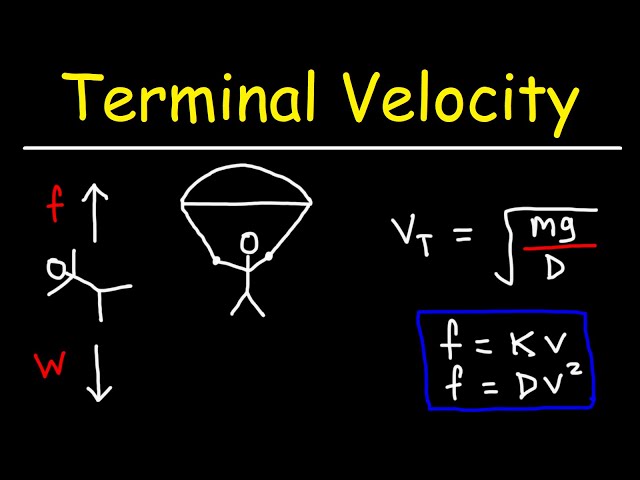
- At first, it falls at a fast speed, as the force of gravity causes it to speed up rapidly.
- Its body weight acts downward, air resistance pushes upward, and gravitational force pulls downward.
- After a while, it falls at a certain constant speed.
- This happens as the air drag force is exactly equal to the gravitational force.
- The object will no longer speed up or decelerate if these two forces are perfectly balanced.
- However, it will continue to descend at a steady pace.
- This steady speed is terminal velocity.
How to find Terminal Velocity?
[Click Here for Sample Questions]
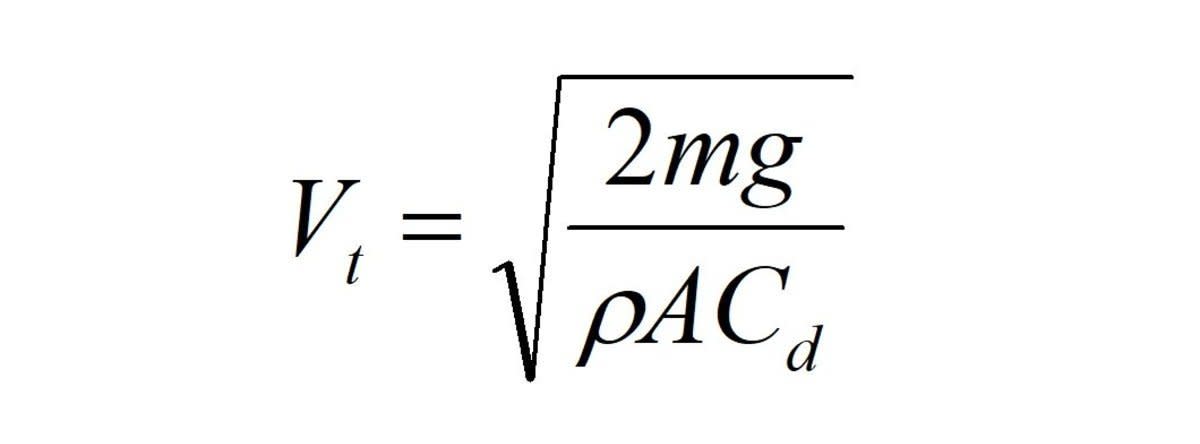
Any moving object can attain terminal velocity if its speed is constant against the force exerted by the fluid through which it is moving. It is calculated by the formula:
VT = √2mg / ACd
- VT stands for terminal velocity;
- M denotes the mass of the falling body;
- G acceleration because of gravity;
- A denotes the projected area of the item;
- Ρ is the fluid density;
- Cd denotes the drag coefficient.
Read More:
| Chapter Related Concepts | ||
|---|---|---|
| Bernoulli’s Principle | ||
| Value of R in Atm | ||
Drag Force
[Click Here for Sample Questions]
Drag force is a resistive force that works in the opposite direction of an object's relative motion in relation to a fluid. It depends on the object's velocity as it falls through the fluid, which makes it different from other resistive forces.
- It is termed as air resistance or fluid resistance.
- Drag D denotes the drag coefficient.
- The complicated dependencies can be described in a single variable, called the drag coefficient, represented as Cd.
- Force is Cd multiplied by density r multiplied by half the velocity V squared multiplied by the reference area A.
- The drag coefficient's value can be determined by experiments.
Drag Force Equation
The equation for drag force is given as:
FD = ½ \(\rho\)\(\nu\)²CDA
- FD = Drag
- \(\rho\)= fluid density
- \(\nu\) = speed of the object in relation to the fluid
- CD = Drag coefficient
- A = cross sectional area
Factors affecting Drag Force
The factors affecting drag force are as follows:
- Density
- Compressibility
- Viscosity of the fluid
- Square of the object's velocity
- Shape and size of the body
- Leaning of the body towards the flow
Terminal Velocity Derivation
[Click Here for Sample Questions]
Terminal Velocity Derivation gives:
D = 1/2ρv2ACd
- Net force exerted on the body-
- Fnet = ma = Gravitational force - Drag force
- ma = mg - 1/2ρv2ACd
- At equilibrium, F = 0, this implies:
- 0 = mg - 1/2ρv2ACd
- mg = 1/2ρv2ACd
- By solving this,
- VT = √2mg / ρACd
It can be derived as W= weight of the ball,
- W= mg
- W= vρog (v= volume)
- FV = Viscous force
- FV=6πηrv
- Fd = buoyant force,
- Fd = vρg
- In Equilibrium,
- W= FV + Fd
- FV = W - Fd
- 6πηrv = vρog – vρg (v= 4/3πr3)
- 6πηrv = 4/3πr3 (ρo−ρ) g
v= 2r2 (ρo−ρ) g / 9η
Terminal Velocity Formula
Example of Terminal Velocity DerivationExample 1. Calculate the terminal velocity of an object at a height of 600 m. Ans. Given h = 600
|
Read More:
| Class 12 Physics Related Concept | ||
|---|---|---|
| Properties of Fluids | ||
| Fluid Pressure | ||
Things to Remember
- Terminal Velocity is the highest constant velocity attained by a body while falling during a thicker medium.
- It is also equal to the maximum velocity of a body travelling through a viscous fluid.
- It is achieved when the medium's force of resistance equals and opposes the force of gravity.
- As the velocity rises, the retarding force rises with it will be reached when gravity's force equals the resistance force.
- Formula of terminal velocity is given as: VT = √2mg / ACd
Sample Questions
Ques. What is the terminal velocity of a person. (2 marks)
Ans. Terminal velocity is a type of velocity that is attainable when an object falls through a fluid. An object is considered to be moving at terminal velocity in fluid dynamics if its speed remains constant.The terminal velocity of the human body in a stable, belly to earth position is around 200 km/h (about 120 mph). The speed of a stable, free-flying, head down position is roughly 240-290 km/h (around 150-180 mph).
Ques. Explain: (A) What is a drag force example
(B) What is the world's largest animal capable of surviving terminal velocity. (2 marks)
Ans. (A) The drag force, which is the force that objects feel when moving through a fluid, is an example of air resistance (liquid or gas).
(B) A study involving 132 cats falling an average of 5.5 stories published in The Journal of the American Veterinary Medical Association showed that a cat can survive at her ultimate velocity of 60 miles per hour. Ninety percent made it, though many needed medical help.
Ques. When fully immersed, a steel ball bearing with a mass of 3.3 10–5 kg and a radius of 1.0 mm displaces 4.1 10–5 N of water. Allow the ball to descend through the water until it achieves its maximum speed. If the viscosity of the water is 1.1 10–3 N s m–2, find the terminal velocity. (2 mark)
Ans. F = W–U
6πη r ν = W–U
v = (W–U)/ (6πηr)
V = (3.3 × 10–5 kg × 9.8 N kg–1–4.1 × 10⁻⁵ N) / (6π × 1.1 × 10–3 N s m–2 × 1.0 × 10–3 m)
= 14 m/s
The terminal velocity is 14 m/s
Ques. Determine the terminal velocity of (a) a steel ball bearing with a radius of 1 mm falling through glycerine in a cylinder and (b) a steel ball bearing with a radius of 2 mm falling through glycerine in a cylinder. (3 marks)
Ans. Given: The viscosity of glycerine 1.5 Pa s. (at 20 degree C)
- Density of steel = 7800 kg/m^3
- Density of glycerine = 1200 kg/m^3
- g = 9.81 m/s^2
- Solution:
- (a) for 1 mm radius ball bearing:
- Vt = [2 r2 g (ρs–ρf)] / [9\(\eta\)]
- [2 (1×10⁻³) 2 x 9.81 X (7800-1200)]/ [9×1.5] = 9.6 x 10⁻³ ms-1
- (b) for 2 mm radius ball bearing:
- Vt = [2 r2 g (ρs – ρf)] / [9\(\eta\)]
- [2 (2×10⁻³) 2 x 9.81 X (7800-1200)]/ [9×1.5] = 3.8 x 10⁻² ms-1
Ques. A solid sphere of radius R gains a terminal velocity v1 when falling (because of gravity) through a viscous fluid having a coefficient of viscosity η. The sphere is broken into 27 identical spheres. If each of these gains a terminal velocity v2, when falling through the same fluid, the ratio (v1/v2) equals. (2 mark)
(a) 9
(b) 1/27
(c) 1/9
(d) 27
Ans. 27 x (4/3) πr3 = (4/3) πR3
Or r = R/3
Terminal velocity, v ∝ r3
Therefore, (v1/v2) = (R2/r2)
v1/v2= [R/ (R/3)] 2= 9
(v1/v2) = 9
Hence, (a) 9
Ques. A man stands 2000 metres above the ground. What would be his maximum speed? (2 marks)
Ans. Given A Height (h) = 2000 m,
The terminal velocity (V) formula is given by:
V= √2×9.8 ×2000
= √39200
= 197.98 m/s.
Ques. Establish the height of the body if its terminal velocity is 100 m/s. (1 mark)
Ans. Given:
Terminal velocity, V= 100 m/s
The height is given by:
= 10000 / 9.8 x 2
h = 510.204, m.
Ques. A copper ball with a radius of 2.0 mm falling into a tank of oil at 20oC has a terminal velocity of 6.5 cm s-1. Calculate the oil's viscosity at 20°C. Oil has a density of 1.5 x 10³ kg m-3, while copper has a density of 8.9 x 10³ kg m-3. (2 marks)
Ans. Given: - vt = 6.5 × 10⁻² ms-1, a = 2 × 10⁻³ m,g = 9.8 ms-2, ρ = 8.9 × 10³ kg m-3,
σ =1.5 × 10³ kg m-3. From Equation: -vt =2r2 (ρ – σ) g/9 η
=2/9(2 x10-3 m2 x 9.8ms-2/ 6.5x10⁻²ms-1) x 7.4 103 kgm-3
=9.9 x 10⁻¹ kgm-1s-1
Ques. Calculate the terminal velocity in air of an oil drop with a radius of 2x10⁵ m using the following information: g=9.8m/s2; air viscosity coefficient =1.8x10⁻⁵Pas; oil density=900kg/m3. Is it possible to overlook the upward thrust of air? (2 marks)
Ans. Radius r =2x10⁻⁵ m
g=9.8m/s2
η=1.8x10⁻⁵Pas
ρ =900kg/m3
v=vtwhen 6πηrv = mg
6πηrv =ρx4/3r3g
Simplifying: - vt =2r2gρ/9π = (2 x (2x10-5)2x9.8x900)/9x1 x 8x10-5
=4.36cm/s
Ques. Calculate the terminal velocity of an object at a height of 1000 m. (2 marks)
Ans. Given h = 1000
- g = 9.8
- Using the formula we get,
- v = √(2gh)
- √(2 × 9.8 × 1000)
- √19600
- 196 m/s
Ques. Calculate the terminal velocity of an object at a height of 2000 m. (2 marks)
Ans. Given h = 1000
- g = 9.8
- Using the formula we get,
- v = √(2gh)
- √(2 × 9.8 × 1000)
- √39200
- 392 m/s
Read Also:



Comments