



Content Curator
The law of inertia states that an object remains in either a state of rest or motion unless an external force acts on it.
- Inertia is a characteristic of a body that opposes any force that requires it to move or, if it is moving, to change the magnitude or direction of its velocity.
- Mass is the measure of inertia.
- The more the mass, the greater the inertia will be.
- The law of inertia is also known as Newton’s first law of motion.
There are three types of inertia
- The inertia of rest: It states that a body at rest will remain at rest.
- The inertia of motion: It states that if a body is moving with constant speed it will keep moving with that speed.
- The inertia of direction: It states that if a body is moving in a particular direction it will keep moving in that direction.
| Table of Content |
Key Terms: Law of inertia, Force, Galileo’s Free Fall Experiment, Measure of inertia, Motion, Uniform motion, Velocity, Newton’s first law of motion
What is Inertia?
[Click Here for Sample Questions]
Inertia is an intrinsic property of all bodies that prevents them from changing their state of rest or uniform motion along a straight line on their own.
- Mass is the measure of inertia.
- The more the mass of an object, the more is its inertia.
- Unless a force is applied to move an object, inertia causes the object to remain in a state of rest.
- It is also responsible for objects to be in motion in a straight path at a constant speed unless a force is applied to stop or change their direction of motion.
Check More:
| Important Concept Related Topics | ||
|---|---|---|
| Rigid Bodies | Moment Formula | Radius of Gyration |
Examples of Inertia
[Click Here for Previous Year Questions]
Some examples of inertia we experience in our everyday life are as follows
- A person sitting on a bus moves backward when a bus starts suddenly. This is because our lower body starts to move with the bus while our upper body tends to remain stationary.
- Athletes run a certain distance before performing a long jump.
- A person falls forward when a horse at full speed suddenly stops
- When you shake the mango tree, the mango falls off.
- When a car suddenly rounds a curve, the driver gets thrown outside.
Types of Inertia
[Click Here for Sample Questions]
There are three types of inertia
- Inertia of Rest
- Inertia of Motion
- Inertia of Direction
Inertia of Rest
It states that a body at rest will remain at rest until an external force is applied to cause it to move. Therefore, the inertia of rest refers to the inability of the body to move on its own.
Example of Inertia of Rest
When a bus suddenly starts moving, the passenger of the bus falls backward.
- This is because the lower part of the body of the passenger being in contact with the floor of the bus comes in motion along with the bus.
- Whereas the upper part of the body remains at rest due to inertia of rest.
- Hence the passenger sitting on the bus falls backward.
Inertia of Motion
A body in motion will continue to move uniformly, and the property that opposes the change in its current condition is known as inertia of motion.
Example of Inertia of Motion
The passenger sitting on the bus falls forward when a moving bus suddenly stops.
- This is because the lower part of the body of the passenger comes to rest along with the bus.
- Whereas the upper part of the body continues to move due to inertia of motion.
- Hence the passenger falls forward when the bus suddenly stops.
Inertia of Direction
It states that if a body is moving in a particular direction will keep moving in that direction and cannot change its direction by itself.
Example of Inertia of Direction
If a bus takes a turn along a curved road, the passenger experiences a force acting away from the center of the road.
This is due to the inertia of direction, which tends the passenger to move in the straight path.
Law of Inertia
[Click Here for Previous Year Questions]
According to the law of inertia, inertia is an inherent property of a body that has the inability to change its state rest, uniform motion, or direction of motion by itself.
- Newton's first law of motion, also known as the law of inertia, states that an object remains in either a state of rest or motion unless an external force acts on it.
- The Aristotle fallacy, which states that a body must always be moved by an external force, is well known.
- This was proven incorrect when the concept of inertia was developed.
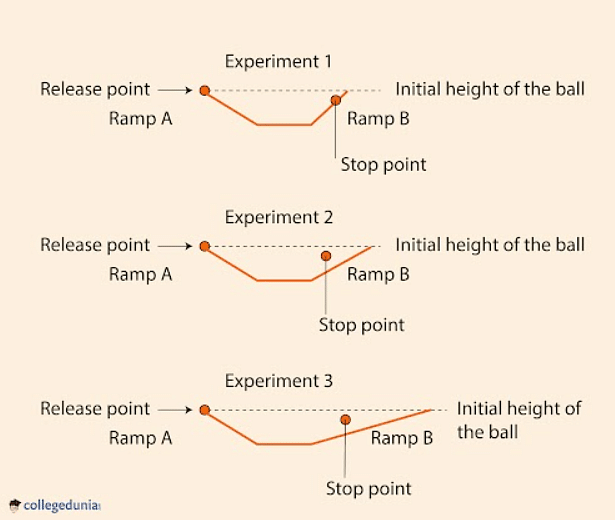
- Galileo developed the concept of inertia through the following two experiments.
Examples of the Law of Inertia
[Click Here for Sample Questions]
Some examples of the law of inertia are
- Jerk experienced when the lift operates suddenly.
- Sudden start of the lift.
- Moving forward when a sudden brake is applied.
- The tendency to move back when the stationary bus starts to move.
Galileo’s Free Fall Experiment
[Click Here for Previous Year Questions]
Galileo proposed that a falling object develops equal amounts of velocity at equal time intervals.
- This also means that as it falls, the speed increases at a constant rate.
- However, there was an issue with confirming this hypothesis.
- Galileo couldn't observe the free-falling motion of the object, and technology at the time was unable to record such high speeds.
- As a result, Galileo attempted to decrease the speed of the falling object by replacing it with a ball rolling down an inclined path.
- He believed that because free-falling is similar to a totally vertical ramp, a ball rolling down a ramp would accelerate in the same manner that a falling ball would.
Law of Inertia Experiment
Galileo used two inclined planes and made the ball roll down the first plane and rise up the other.
- He determined that if the planes are smooth, the final height of the ball is almost equal to the height through which it rolls from the first plane.
- The slope of the second inclined plane was reduced in the second experiment, and the ball was allowed to roll once again.
- The ball still reaches the same height, but it covers a larger horizontal distance.
- According to the observation, when the slope of the second plane was reduced to zero, the plane became horizontal, and the ball was meant to travel an infinite distance, implying that the motion never stopped.
- However, the object does come to rest after a certain distance due to the opposing friction of the plane.
- Under perfect conditions, when there is no friction, the ball would continue to travel with constant velocity on the horizontal plane.
With this result, Aristotle's claims were proven wrong. He found that the assumption that a net force was required to keep a body in uniform motion was wrong and that the states of rest and uniform motion were comparable.
Things to Remember
- The law of inertia states that inertia is an inherent characteristic of a body that has the inability to change its state of rest, uniform motion, or direction of motion on its own.
- Newton’s second first of motion is also known as the law of inertia.
- Mass is the measure of inertia.
- There are three types of inertia: Inertia of rest, inertia of motion, and inertia of direction.
- The inertia of rest states that a body has the inability to change its state of rest on its own.
- The inertia of motion states that a body has the inability to change its state of motion if it is moving with constant velocity.
- The inertia of direction states that if a body is moving in a certain direction, it will continue to move in that direction and cannot change its direction on its own.
Check More:
| Important Concept Related Topics | ||
|---|---|---|
| Angular Speed | Rolling Motion | Difference Between Momentum and Inertia |
| Types of lever | Linear Momentum Formula | Angular Momentum |
Previous Year Questions
- Extraction of metal from the ore cassiterite involves...[JEE Advanced 2011]
- Commonly used vectors for human genome sequencing are...[NEET UG 2014]
- Interfascicular cambium and cork cambium are formed due to..
- Pneumotaxic centre is present in...[UP CPMT 2007]
- Reaction of HBr with propene in the presence of peroxide gives….[NEET UG 2004]
- Assuming the expression for the pressure exerted by the gas on the walls of the container, it can be shown that pressure is...[MHT CET 2016]
- Which among the following is the strongest acid?...[TS EAMCET 2017]
- Isopropyl alcohol on oxidation forms..
- A vector is not changed if..
- Which of the following arrangements does not represent the correct order of the property stated against it?...[JEE Main 2013]
- The major product of the following reaction is...[JEE Main 2019]
- Major product of the following reaction is..[JEE Main 2023]
- The percentage of nitrogen in urea is about..
- The electric field at a point is
- Which of the following statements is true?..[JKCET 2006]
Sample Questions
Ques. State law of inertia. (2 Marks)
Ans. The law of inertia, also referred to as Newton's first law states that if a body is at rest or moving at a constant speed in a straight line, it will remain at rest or continue to move in a straight path at constant speed until acted upon by a force.
Ques. What causes the motion of a body which is initially in the state of rest? (2 Marks)
a) Velocity
b) Force
c) Speed
d) Displacement
Ans. The correct answer is b. Force
Explanation: According to the first law of motion, a body stays in motion or at rest until and unless an external force is applied to it.
Ques. State Newton’s first law of motion? (2 Marks)
Ans. According to Newton’s first law of motion, Everybody continues in its state of rest or uniform motion in a particular direction until and unless an external force is applied to change that state.
Ques. Explain the different types of inertia. (3 Marks)
Ans. There are three types of inertia
- The inertia of rest: It states that a body at rest will stay at rest until some external force causes it to move. As a result, the inertia of rest refers to the body's inability to move on its own.
- The inertia of motion: A moving body will continue to travel at a uniform speed, and any property that opposes the change in its existing state is known as the inertia of motion.
- The inertia of direction: It states that if a body is moving in a specific direction, it will continue to move in that direction and cannot change its direction on its own.
Ques. Inertia is (2 Marks)
a) Tendency of mass to accelerate
b) Property of mass to remain unchanged
c) Property of mass to accelerate
d) Property of mass to change continuously
Ans. The correct answer is b. Property of mass to remain unchanged
Explanation: Inertia is the property of mass to remain constant. In the absence of any external force, a mass maintains its initial state due to inertia. Only an external force can change a body's inertia.
Ques. How is inertia used in satellite propagation? (2 Marks)
Ans. Inertia is the property of a body to resist changes in its state of rest or uniform motion. Satellites in space can either remain stationary or revolve around the planet. In each of these circumstances, it is the inertia of the satellite that keeps it moving or stationary in orbit.
Ques. What are the real-life examples of the law of inertia? (5 Marks)
Ans. The following are the real-life examples of the law of inertia
- To remove dust particles, the carpet is beaten with a stick. When the carpet is beaten with a stick, it moves, but the dust particles remain at rest due to the inertia of rest.
- When a bus or train starts suddenly, the person standing inside falls backward. This happens because the feet of the passenger, which are in touch with the floor of the bus, move with the vehicle while the upper half of the body remains at rest because of the inertia of rest. As a result, the passenger falls backward.
- After the electricity is turned off, the electric fan continues to rotate. The blades of the fan were in motion. Hence, they will need some time to come to rest after being turned off.
- If you jump from a moving car or bus, your body continues to move in the same direction as the vehicle. When your feet touch the ground, the ground acts on them, causing them to stop moving. You will fall because your upper body didn't stop, and you will fall in the direction you were moving.
Ques. Why do we not experience any leaning when a train takes a turn? (2 Marks)
Ans. The turning radius of the train is large in comparison to the turning radii of normal vehicles. As a result, there is no sharp or quick turn. Therefore, the passengers do not experience any leaning.
Ques. If a body has more mass, it has more inertia. (2 Marks)
a) True
b) False
Ans. The correct answer is a. True
Explanation: The mass of a body is a measure of its inertia. It is more difficult to change its state of rest or uniform motion when the body has more mass.
Ques. Why do we fall sideways when the bus takes a sharp turn? (2 Marks)
Ans. Because of the inertia of motion, we fall sideways when the bus makes a sharp turn. The part of our body that makes contact with the bus causes the motion to change direction. However, because of the inertia of motion, the remaining part of the body tends to move in the same direction as previously.
Ques. Force is a polar vector. (2 Marks)
a) True
b) False
Ans. The correct answer is a. True
Explanation: Because it has a point of application, force is a polar vector. It is a push or a pull that tends to change the state of rest or uniform motion of a body.
Ques. Why do the passengers in a bus tend to fall backward when it starts suddenly? (3 Marks)
Ans. When a bus suddenly starts to move, the passenger falls backward.
- This is because the lower part of the body of the passenger, which is in touch with the floor of the bus, moves with the bus.
- The upper body, on the other hand, remains at rest due to inertia of rest.
- Therefore, the bus passenger falls backward.
Ques. Why do athletes run a few steps before taking a jump? (2 Marks)
Ans. An athlete runs before jumping to create momentum, which helps in jumping higher and longer because of the inertia of motion obtained as a result of motion. When the athletes jump, they already have a forward momentum that is greater than that of a jump made from standing in one spot.
Ques. A football has lesser inertia than a stone of the same size because (2 Marks)
a) a football has less air inside than a stone
b) a football has more air inside than a stone
c) a football has more mass than a stone
d) a football has less mass than a stone
Ans. The correct answer is d. A football has less mass than a stone
Explanation: The inertia of stone is more than that of football because the mass of stone is more than the mass of football even though both are of the same size.
Ques. State Newton’s Second Law of Motion. (2 Marks)
Ans. According to Newton’s second law of motion, the rate of change of momentum of a body is directly proportional to the applied force and it takes place in the direction in which the force acts.
For Latest Updates on Upcoming Board Exams, Click Here: https://t.me/class_10_12_board_updates
Check-Out:



Comments