


Light Emitting Diode (LED) converts electrical energy into light energy. Explain.

Collegedunia Team logo

Collegedunia Team

Content Curator

A Light Emitting Diode (LED) is a semiconductor device that converts electrical energy into light energy. When a voltage is applied across the p-n junction of the LED, the electrons and holes combine and release energy in the form of photons. This process is called electroluminescence.

  1. A Light Emitting Diode is a semiconductor device that is designed to emit light when an electrical current flows through it.
  2. It is made of semiconductor material, such as gallium arsenide or silicon, that has been doped with impurities to create a p-n junction.
  3. When a voltage is applied across the p-n junction, the diode becomes forward-biased, allowing electrons and holes to recombine and release energy in the form of photons (light).
  4. The energy of the photons emitted by the LED is determined by the energy gap between the conduction and valence bands of the semiconductor material.
  5. The color of the light emitted by the LED is also determined by the material used to make it. For example, gallium arsenide produces red or yellow light, while indium gallium nitride produces blue or green light.
  6. The efficiency of the LED is determined by the ratio of the electrical power applied to it to the optical power emitted by it. This efficiency can be improved by using better semiconductor materials and by optimizing the design of the LED.
  7. LEDs are commonly used in a wide range of applications, including lighting, displays, and indicators, due to their low power consumption, long lifespan, and fast response time.
  8. The increasing use of LED technology is contributing to energy savings and reducing carbon emissions.
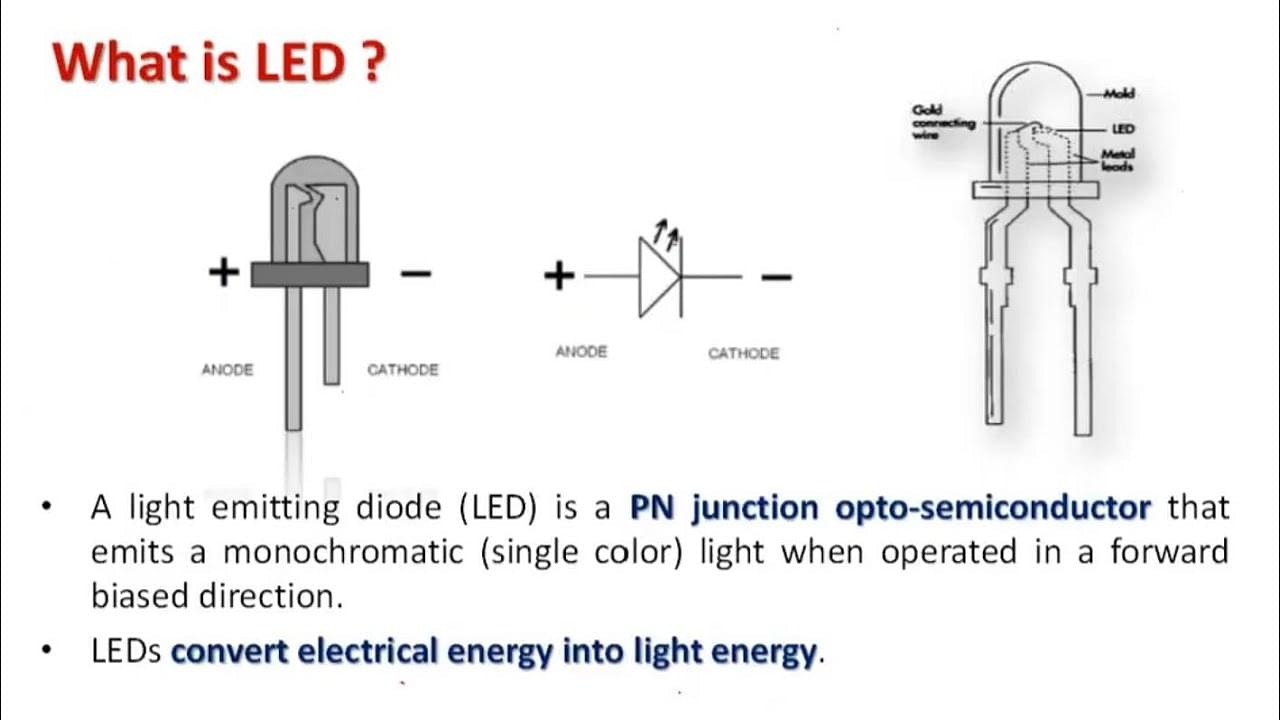
LED converts electrical energy into light energy

LED Converts Electrical Energy into Light Energy

Also read:

CBSE CLASS XII Related Questions

  • 1.
    The resistance of a metal wire at \( 20^\circ \text{C} \) is \( 1.05 \, \Omega \) and at \( 100^\circ \text{C} \) is \( 1.38 \, \Omega \). Determine the temperature coefficient of resistivity of this metal.


      • 2.
        Derive an expression for the capacitance of a parallel plate capacitor of plate area A and plate separation d with air present between the plates.


          • 3.
            Consider the nuclear reaction \( X \to Y + Z \). Let \( M_x \), \( M_y \), and \( M_z \) be the masses of the three nuclei X, Y, and Z respectively. Then which of the following relations hold true?

              • \( (M_x - M_z)<M_y \)
              • \( (M_x - M_y)<M_z \)
              • \( M_x>(M_y + M_z) \)
              • \( M_x<(M_y + M_z) \)

            • 4.
              An electric field $\vec{E}$ is established across the ends of a cylindrical conductor of length L and area of cross-section A. Discuss how electrons attain an average velocity, independent of time. Hence, obtain a relation between current in the conductor and this ‘average velocity’ of electrons.


                • 5.
                  Two air-filled capacitors of capacitances $C_1$ and $C_2$ are connected in parallel with a dc battery. After the capacitors are fully charged, a slab of dielectric constant K is inserted between the plates of each capacitor. How will the (i) charge on each capacitor and (ii) energy stored in the capacitor affected after the slab is introduced.


                    • 6.
                      Read the following paragraph and answer the questions that follow.
                      A p-type or n-type semiconductor can be converted into a p-n junction by doping it with suitable impurity. The motion of majority charge carriers causes diffusion current across the junction while the barrier electric field causes motion of minority carriers for drift current. In case of unbiased diode, the diffusion and drift currents are equal. This equilibrium is disturbed by the biasing batteries. Diodes, therefore, allow currents in one direction. This property of diode is used in making rectifiers.

                        CBSE CLASS XII Previous Year Papers

                        Comments


                        No Comments To Show
