



Education Journalist | Study Abroad Lead
Difference between diode and rectifier is that diode is a device that becomes a short circuit when it is forward biased and open circuit when it is reverse biased. On the other hand, a rectifier is a device used to convert AC signal into DC signal.
A diode is a two-terminal semiconductor device that allows the flow of electric current in one direction only. A rectifier uses a solid-state electronic switching device such as a diode, SCR, etc. as its main component.
| Table of Content |
Key Terms: Diode, Rectifier, Zener Diode, Pn junction diode, Full wave rectifier, Half wave rectifier, Bridge rectifier, AC signal, DC signal, Electronic switching device, Two-terminal semiconductor device, Electric current
What is a Diode?
[Click Here for Sample Questions]
A diode is a semiconductor device that allows current to flow in one direction only. It will let current flow in one direction while restricting movement in the opposing direction. Because they convert alternating current to direct current, diodes are also known as rectifiers. Every diode has an anode and a cathode, which only allow current to flow when a positive voltage is given to the anode's positive lead. When a diode allows current to flow, it is forward-biased. A diode that is reverse-biased acts as an insulator. Signal limiters, voltage regulators, switches, signals, and even oscillators are all used as diodes.

Diode
Also check:
Definition of a Rectifier
[Click Here for Previous Year Questions]
Rectifiers are devices that convert AC to DC. Nowadays, there are two types of rectifiers in use. The bridge rectifier is one of the most frequent rectifiers. It provides electric power and involves DC-DC conversion.
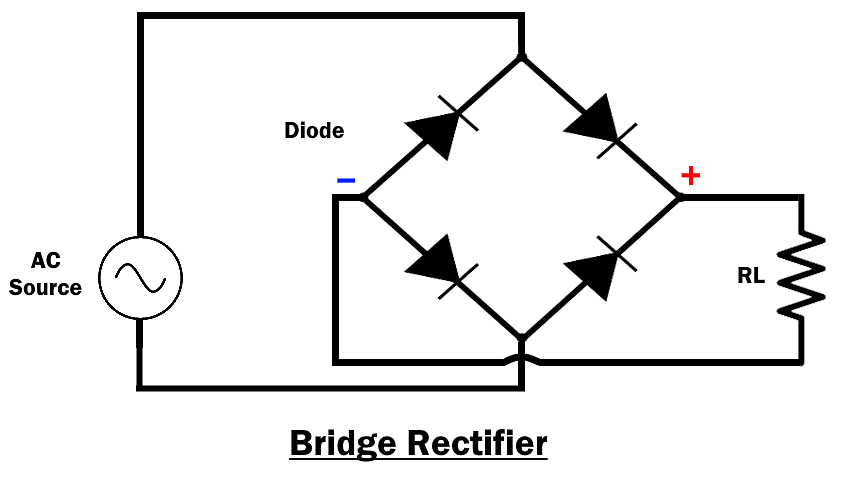
Rectifier
The other different types of rectifiers are:
- Single-phase rectifiers
- Three-phase rectifiers
- Half-wave rectifiers
- Full Wave Rectifier
- Controlled rectifiers
- Uncontrolled rectifiers
- Centre tapped rectifiers
Differences Between Diode and Rectifier
[Click Here for Sample Questions]
A diode is a switching device, whereas a rectifier is typically used to convert AC to DC voltage. Other differences between Diode and Rectifier are tabulated below:
| Diode | Rectifier |
|---|---|
| When a diode is forward-biased, it allows the current to pass and a rever-biased diode prevents the flow of current. | A rectifier consists of a transformer, a diode, and a filter circuit. |
| The current-carrying capacity of diodes is low. | The current-carrying capacity of rectifiers is high. |
| Categories of diodes: Zener Diodes, Photodiodes | Categories of Rectifiers: Single-phase rectifiers and Three-phase rectifiers |

Diode and SCR
Facts about Diodes and Rectifiers
[Click Here for Previous Year Questions]
Here are some key facts about Diodes and Rectifiers
- In a diode, current flows only in one direction.
- The Schottky diode concept was discovered in 1938.
- Diodes are used in solar cells as well as radar detectors.
- Photodiodes and Zener diodes are important electronic components. Voltage regulators are made of zener diodes.
- Diodes are all rectifiers, but rectifiers are not all diodes.
- Every diode has a black band that represents the cathode.
- Silicon diodes are widely used in the market and require 0.5 volts to pass current.
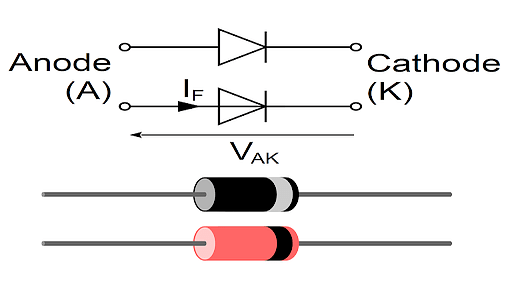
Diodes and Rectifiers
Previous Year Questions
- The V-I characteristic of a diode is shown in the figure… [VITEEE 2018]
- A zener diode has break down voltage of 5.0 V… [WBJEE 2016]
- The light emitting diode (LED) is… [KEAM]
- In a p-n-p transistor working as common base amplifier…
- Two ideal diodes are connected to a battery as shown in the circuit…
- The material used in solar cells contains…
- In CE transistor amplifier, the audio signal voltage across the collector…
- V-I characterstics of LED is shown correctly by graph…
Things to Remember
- A diode is a device that only allows current to flow in one direction.
- A rectifier is a diode that can convert the current from alternating current to direct current.
- The rectifier is connected to one of the AC lines prior to the load.
- When the diode is turned on, it emits a small amount of current.
- The rectifier cleans up the circuit.
- A diode can be forward or reverse-biased.
- A forward-biased diode is placed in the direction of current flow, while a reverse-biased diode is placed in the opposite direction of current flow.
- A forward-biased diode has a small depletion region, whereas a reverse-biased diode has a large depletion region.
Also check:
Sample Questions
Ques. Explain forward biasing and reverse biasing? (3 Marks)
Ans: Forward Biasing: When the outer end of the reverse type section is connected to the negative terminal and the outer end of the p-type section is connected to the positive terminal, the junction is forward biasing.
The free majority charge carriers from each part move forward towards the junction. If the forward bias potential is greater than the potential barrier, the charges from both sections cross the intersection, and a current flows through the intersection and the circuit. It is referred to as forwarding current. Forward biasing reduces the size of the depletion layer, which reduces resistance.
Reverse biasing occurs when the outer end of the re-type section is connected to the positive terminal and the outer end of the p-type section is connected to the negative terminal.
Due to reverse bias, the minority carrier charge is driven toward the junction. The minority carrier charge crosses the intersection, and there is minimal current in order to micron across the intersection – in reverse bias, the size of the depletion layer expands, and thus resistance increases.
Ques. Define Diode (2 Marks)
Ans: A diode is a semiconductor device that allows current to flow in one direction only. It will let current flow in one direction while restricting movement in the opposing direction. Because they convert alternating current to direct current, diodes are also known as rectifiers. The Schottky diode concept was discovered in 1938. Diodes are used in solar cells as well as radar detectors.
Ques. What are Special–Purpose Diodes and their applications? (3 Marks)
Ans: There are some special-purpose diodes that perform a few specific functions. There are different special-purpose diodes available, including transient voltage suppression diodes, hold diodes, super barrier diodes, and point contact diodes. On either side of a junction, there are two potentials. In the depletion region, there is a capacitance. In the PN junction, the tunnel diode has a higher concentration. The concentration rises as the energy level rises. The varactor diode and tunnel diode are used in a variety of applications, including:
- Frequency modulator
- Phase shifter
- Automatic frequency control
- Tank circuit
- Microwave oscillators
- Relaxation oscillators
- High-speed switching devices, along with memory storage devices.
Ques. Difference between Diode and Rectifier. (4 Marks)
Ans: Here are the key differences between Diodes and Rectifiers:
| Diode | Rectifier |
|---|---|
| A diode passes current when it is forward-biased and it prevents the flow of current when it is reverse-biased. | Rectifier circuits include a diode, a step-down transformer, and a filter circuit that converts AC to DC. |
| The current-carrying capacity of a diode is low. | The current-carrying capacity of a rectifier is high. |
| Diodes can be used in switches, clippers, clampers, etc. | Rectifiers can be used in batteries, computers, etc. |
| Types of Diodes: Zener Diode, Photodiode, etc. | Types of Rectifiers: Single-phase and Three-phase rectifiers. |
Ques. Where are Diodes Used in Home Applications? (3 Marks)
Ans: Diodes are found in almost every home appliance, including phones, LED, laptops, TVs, play stations, and other electronic devices. Every device has an alternating current/direct current (AC/DC) converter. When you unscrew your devices, you can see the resistors, capacitors, and inductors. Electronic circuits, such as remote controls, are made up of two parts. One is a small grey p-type semiconductor. The other is an n-type semiconductor that is black in colour. Diodes are mostly electronic devices that protect household appliances like lights and remote controls in televisions and radios. Make sure not to mix up the connections when connecting the diode. If the connections are not properly made, current will not flow.
For Latest Updates on Upcoming Board Exams, Click Here: https://t.me/class_10_12_board_updates
Check-Out:



Comments