


List the findings from Bohr Model for Hydrogen Atom.

Collegedunia Team logo

Collegedunia Team

Content Curator

Bohr model is a simple model proposed by Niels Bohr in 1913 to explain the atomic structure of the hydrogen atom. It is based on the classical laws of physics and the quantum theory of energy. Here are the findings from Bohr Model for Hydrogen Atom:

  1. Quantized energy levels: Bohr proposed that electrons revolve around the nucleus in specific circular orbits, each corresponding to a fixed energy level. The energy levels are quantized, meaning that only specific energy values are allowed for the electron in the atom.
  2. Electrons do not lose energy while in their orbits: According to classical physics, charged particles moving in circular orbits should lose energy in the form of electromagnetic radiation. However, Bohr explained that in the hydrogen atom, the electrons do not lose energy while in their orbits, thus avoiding a collapse of the atom.
  3. Emission and absorption of radiation: When an electron moves from a higher energy level to a lower energy level, it emits a photon of radiation. Conversely, when an electron absorbs a photon of radiation, it moves to a higher energy level. This process is responsible for the emission and absorption spectra of the hydrogen atom.
  4. The electron in the ground state has the lowest possible energy: The ground state is the state in which the electron is closest to the nucleus and has the lowest possible energy.
  5. The Rydberg formula: The Bohr model of the hydrogen atom led to the derivation of the Rydberg formula, which calculates the wavelengths of the spectral lines observed in the emission and absorption spectra of hydrogen. This formula was a significant contribution to the development of quantum mechanics.
  6. The angular momentum of the electron is quantized: Bohr proposed that the angular momentum of the electron is quantized and can only take on certain discrete values.

In summary, the Bohr model of the hydrogen atom was significant in laying the foundations of quantum mechanics and helped explain many of the observed properties of the hydrogen atom.
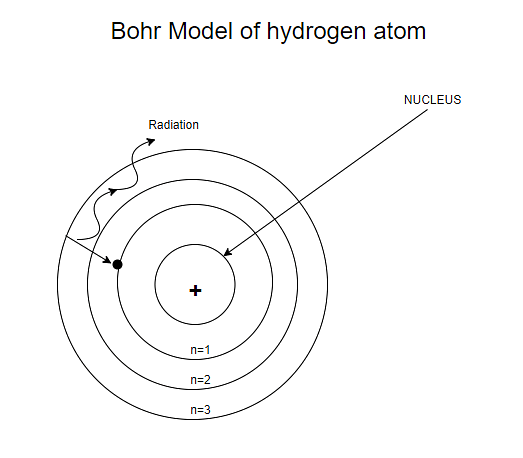
bohr model for hydrogen atom

Bohr Model for Hydrogen Atom

Check out:

CBSE CLASS XII Related Questions

  • 1.
    Derive an expression for the capacitance of a parallel plate capacitor of plate area A and plate separation d with air present between the plates.


      • 2.
        A charged particle $+q$ in an electric field $\vec{E}$ experiences a force in the direction of the electric field. As a result, its kinetic energy changes. Similarly, the charged particle also experiences a force when it moves in a magnetic field $\vec{B}$. But this magnetic force is perpendicular to both velocity $\vec{v}$ of the charged particle and the magnetic field $\vec{B}$, so it cannot change the kinetic energy of the charged particle. Consider two charged particles 1 and 2 of masses $m$ and $\frac{m}{2}$ having charges $-q$ and $+2q$ respectively. They are accelerated from rest through the same potential difference $V$ and acquire kinetic energy $K_1$ and $K_2$. Then they enter in a region of uniform magnetic field $\vec{B}$ perpendicular to their velocities.


          • 3.
            This ‘average velocity’ is found be few mm/s for currents in range of a few amperes. How then is current established almost the instant a circuit is closed ?


              • 4.
                Read the following paragraph and answer the questions that follow.
                A p-type or n-type semiconductor can be converted into a p-n junction by doping it with suitable impurity. The motion of majority charge carriers causes diffusion current across the junction while the barrier electric field causes motion of minority carriers for drift current. In case of unbiased diode, the diffusion and drift currents are equal. This equilibrium is disturbed by the biasing batteries. Diodes, therefore, allow currents in one direction. This property of diode is used in making rectifiers.


                  • 5.
                    An astronomical telescope consists of two converging lenses. One of them of large aperture and large focal length is called objective lens and the other one, of smaller focal length and smaller aperture is called the eyepiece. It is used to see distant objects which are not seen clearly with naked eyes. The image formed by the objective lens acts as an object for the eyepiece and the final image produced by the eyepiece is magnified.


                      • 6.
                        Two metal spheres of radii $r_1$ and $r_2$ ($> r_1$) having charges $q_1$ and $q_2$ respectively kept in air, are brought in contact. Which of the following statements is not correct ?

                          • The total charge of the two spheres is conserved.
                          • Both spheres attain the same potential.
                          • The final potential of the system equals $\frac{1}{4\pi\epsilon_0} \frac{(q_1 + q_2)}{(r_1 + r_2)}$
                          • The final potential of the system equals $\frac{1}{4\pi\epsilon_0} \frac{(q_1 + q_2) (r_1 + r_2)}{r_1 r_2}$
                        CBSE CLASS XII Previous Year Papers

                        Comments


                        No Comments To Show
