



Content Curator
Bohr model is a simple model proposed by Niels Bohr in 1913 to explain the atomic structure of the hydrogen atom. It is based on the classical laws of physics and the quantum theory of energy. Here are the findings from Bohr Model for Hydrogen Atom:
- Quantized energy levels: Bohr proposed that electrons revolve around the nucleus in specific circular orbits, each corresponding to a fixed energy level. The energy levels are quantized, meaning that only specific energy values are allowed for the electron in the atom.
- Electrons do not lose energy while in their orbits: According to classical physics, charged particles moving in circular orbits should lose energy in the form of electromagnetic radiation. However, Bohr explained that in the hydrogen atom, the electrons do not lose energy while in their orbits, thus avoiding a collapse of the atom.
- Emission and absorption of radiation: When an electron moves from a higher energy level to a lower energy level, it emits a photon of radiation. Conversely, when an electron absorbs a photon of radiation, it moves to a higher energy level. This process is responsible for the emission and absorption spectra of the hydrogen atom.
- The electron in the ground state has the lowest possible energy: The ground state is the state in which the electron is closest to the nucleus and has the lowest possible energy.
- The Rydberg formula: The Bohr model of the hydrogen atom led to the derivation of the Rydberg formula, which calculates the wavelengths of the spectral lines observed in the emission and absorption spectra of hydrogen. This formula was a significant contribution to the development of quantum mechanics.
- The angular momentum of the electron is quantized: Bohr proposed that the angular momentum of the electron is quantized and can only take on certain discrete values.
In summary, the Bohr model of the hydrogen atom was significant in laying the foundations of quantum mechanics and helped explain many of the observed properties of the hydrogen atom.
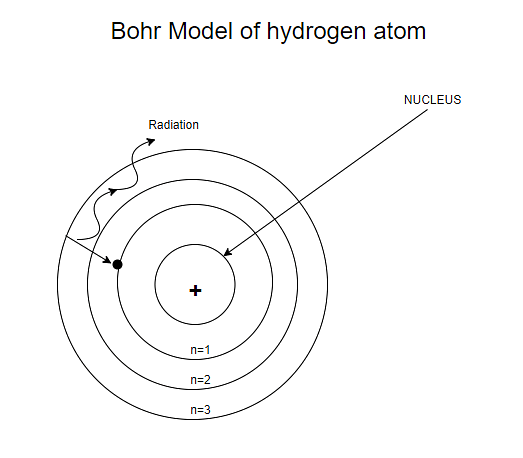
Bohr Model for Hydrogen Atom
Check out:



Comments