



Content Curator
Locomotion and movement are one of the most important characteristic features of living organisms. Microorganisms, plants and animals exhibit different kinds of movements in different situations. Even the unicellular protozoans like Amoeba and Paramecium exhibit streaming movement of protoplasm within the cell. The locomotory organelles in unicellular organisms like cilia, flagella, and tentacles are useful in locomotion.
Movements can be with or without the change in the position of the living organism. So, all locomotion is a kind of movement, but not vice versa. Locomotion is due to a change in the position of the organisms from one place to the other. Gliding, swimming, creeping, crawling, walking, running, and flying are different kinds of locomotor movements. Organisms need locomotion in search of food, shelter, mates, suitable conditions, and also to escape from dangers and enemies.
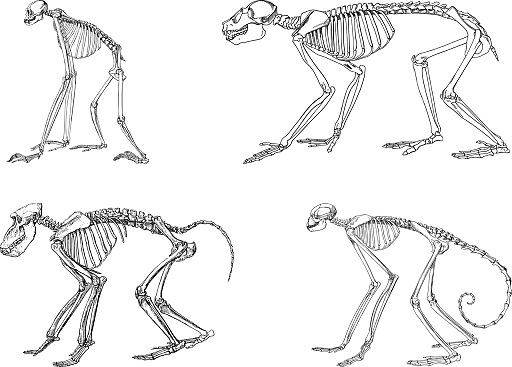
Movement in animals at skeletal level
Very Short Answers (1 Mark)
Ques 1. What is meant by locomotion?
Ans. Locomotion is a kind of movement. It is the movement of organisms from one place to the other. It is one of the most important features of animals.
Ques 2. What are the different kinds of locomotion in human beings?
Ans. Human beings exhibit different kinds of locomotion. They are walking, jogging, running, jumping, climbing, skiing, and swimming.
Ques 3. Is locomotion a kind of movement?
Ans. Yes, locomotion is a kind of movement. Simple movement occurs due to the displacement of different parts of a body, but not the entire organism. Locomotion is due to the movement of an entire organism from one place to the other.
Ques.4. What are the differences between the matrix of a bone and cartilage?
Ans. The matrix of a bone is called ossein. The matrix of cartilage is called chondrin. The Ossein of the bone is inflexible with calcium salts. The chondrin of cartilage is flexible with or without calcium salts.
Ques 5. What are actin fibres? What are its components?
Ans. Actin fibres are abundant in muscle cells. They are useful in maintaining the shape of the cell and also in muscular movements. The components of actin fibres are troponin, tropomyosin, and F-actin.
Ques 6. What kind of cells contain sarcolemma, sarcoplasm, and sarcoplasmic reticulum?
Ans. Generally, the plasma membrane of a muscle cell or muscle fibre is called the sarcolemma, its proplasm is called sarcoplasm, and its endoplasmic reticulum is called sarcoplasmic reticulum. It secretes calcium ions that are helpful in the movement of muscles.
Ques 7. What are the three systems whose coordination leads to locomotion?
Ans. In human beings and animals, locomotion is a coordinated activity. It occurs due to coordination among the muscular system, skeletal system, and nervous system.
Ques.8. What are the cells and tissues in the human body that show amoeboid and ciliary movements like that of unicellular organisms?
Ans. White blood cells (leucocytes) and macrophages show amoeboid movements in blood. Ciliated epithelium in the trachea and fallopian tubes of females show ciliary movements.
Short Answers (2 Marks)
Ques 1. What is the importance of movements in animals?
Ans: Movements are one of the most important features of living. Animals need locomotion in search of food, shelter, mates, suitable conditions, and also to escape from dangers and enemies. It also keeps animals physically active.
Ques 2. How do muscles get energy for contraction?
Ans. Muscles need ATP energy for muscle contraction. It is produced by the myosin ATPase enzyme. C2+, Mg²⁺ ions, inorganic phosphate ions, and ADP are required to produce ATP. ATP helps myosin bind to actin and cause muscle contraction.
Ques 3. What is a muscle twitch and lag phase?
Ans. Muscle twitch occurs when a muscle fibre suddenly contracts to a stimulus (command) by the nervous system in certain circumstances. The time gap between the activation of one motor neuron till the contraction of the muscle is called the lag phase or latent phase.
Ques 4. What are the different kinds of joints in human beings?
Ans. The four kinds of joints are ball-and-socket joints (shoulder and hip joints), hinge joints (elbow, knee, toes, and ankle joints), pivot joints (neck), and ellipsoidal joints (knuckle joints, wrist joints, metacarpophalangeal joints)
Ques 5. Explain briefly about osteoporosis.
Ans. Osteoporosis is a common disorder found in old people. There is a deficiency of estrogen hormone in old people, especially women. It occurs after menopause. It leads to less deposition of calcium in bones. It makes bones less dense and fragile.
Ques 6. What are the two hormones that maintain calcium levels?
Ans: In mammals and human beings calcium metabolism is under the control of two hormones, namely calcitonin and parathyroid hormone. Parathyroid hormone is secreted by the parathyroid gland. It regulates calcium levels in the blood. Calcitonin is produced by c-cells of the thyroid gland.
Ques 7. Describe briefly gout?
Ans. It is the inflammation of joints due to metabolic disorders. It is due to the accumulation of excess quantities of uric acid in synovial joints. It makes joint movements very painful.
Long Answer Questions (3 Marks)
Ques 1. How are movements useful in animals?
Ans. Movements are useful in the following ways
- Movements are useful in the maintenance of the equilibrium of the body during changes in body posture and movement of limbs.
- The body moves from place to place by locomotion.
- Different animals collect food by the movement of cilia, tentacles, limbs, lips, jaw, tongue etc..
- The movement of the eyeball, pinna and head is useful in sensing the changes in the external environment. .
- The movements in the heart cause the pumping and circulation of blood to different body parts.
- The movement in the diaphragm causes inhalation and exhalation of air possible (breathing).
Ques 2. What are the biological functions of the skeletal system?
Ans:
- The skeleton provides the surface of attachment to body muscles.
- It acts as the storage house of calcium and phosphate minerals.
- It is useful in the formation of blood called erythropoiesis.
- The skeletal bones in the ear ossicles propagate sound waves.
- Red Bone marrow helps in the formation of erythrocytes, leukocytes and Blood platelets through haemopoiesis.
Ques 3. Explain about three types of ribs in human beings?
Ans: The ribs with two articulating surfaces on their dorsal ends are called bicephalic ribs. True ribs are the first seven pairs of ribs in the human chest region. They are attached to the sternum on its ventral surface and to the thoracic vertebrae in the dorsal region. Floating ribs are the last two pairs of ribs in the thoracic region. They are not attached ventrally but float freely.
Ques 4. What are the differences between isotonic and isometric contractions?
Ans. The differences between isotonic and isometric contractions are tabulated below
| Isotonic contraction | Isometric contraction |
|---|---|
| 1. The isotonic contraction causes changes in the shape of muscles. | 1. The isometric contractions do not cause any change in the shape of muscles |
| 2. There is a maintenance of tension in muscles. | 2. There is a maintenance of the length of muscles. |
| 3. When muscles contract, the load is lifted | 3. When muscles contract, the load cannot be lifted. |
Ques 5. What is arthritis? What are the different factors that are responsible for arthritis?
Ans: The condition in which the fibrous tissues in the joints between bones are ossified, and consequently, the joints become immovable is called arthritis. In ossification flexible cartilage becomes stiff due to the deposition of bone elements. Arthritis is of several types like gouty arthritis, osteoarthritis and rheumatoid arthritis.
Arthritis is caused due to the inflammation of the bone joints, muscular weakness, wear and tear of joints, genes, autoimmune disorders, age, injuries, and obesity.
Very Long Answer Questions (5 Marks)
Ques 1. Write the differences between pectoral and pelvic girdles?
Ans. The differences between pectoral and pelvic girdles are as follows:
| Pectoral Girdle | Pelvic Girdle |
|---|---|
| As it is present in the shoulder region, it is called the shoulder girdle. | As it is present in the hip region, it is called the hip girdle. |
| It is divided into two parts namely the scapula and clavicle. | It is formed by two innominate bones. Each innominate bone has 3 parts namely ilium, pubis, and ischium. |
| The pectoral girdle is not articulated with the vertebral column. | THe pelvic girdle is articulated with the vertebral column. |
| The clavicle and scapula articulate the axial skeleton and upper limb. | The innominate bone has a deep cup-shaped acetabulum at its mid-lateral surface. Here the head of the femur connects the two parts of the pelvic girdle. It results in the formation of the pubic symphysis. |
| The associated bones of the pectoral girdle are light and are not subject to much stress. | The associated bones of the pelvic girdle are hard and are subject to much stress. |
| The pelvic girdles are useful in holding and lifting objects. | The pectoral girdle is useful in standing, walking, running, and jumping. |
Ques 2. How can the slipped disc affect our lower back and overall health?
Ans. The vertebrae in the vertebral column are protected by the intervertebral discs. They are meant for absorbing shocks from heavy activities like lifting, jumping, walking, climbing, and twisting. The vertebral disc is very strong due to its structure. The soft inner portion is gelatinous and the outer portion is tough. In case of accidents and injuries, the inner portion protrudes out through the outer tough ring. This is called the slipped disc. It causes immense pressure on the surrounding muscles and nerves. Its bad effects on health are as follows:
- It causes numbness and pain in only one side of the body
- It causes pain that is generally intensified at night.
- The pain may spread up to the arms and legs.
- The person feels pain while and after walking or sitting for a long time
- It results in the weakness of the muscles
- It causes an aching, burning sensation, and tingling in the affected areas.
If it is left untreated, the slipped disc may cause severe and permanent damage to the nerves in the area. When the nerve impulses are cut off to the cauda equina, the legs and the lower back, it may result in loss of urinary bladder control.
Ques 3. What is a muscle? What are the different types of muscles?
Ans: A muscle is soft connective tissue. It consists of many stretchy muscle fibres. There are more than 600 muscles in our body. In humans, muscular mass constitutes about 40 – 50 per cent of the total body weight. Different types of muscles have different functions. Movements and locomotion depend on the movement of muscles. Muscles are composed of a number of contractile fibres. The muscle fibres are composed of many myofibrils.
Muscles are primarily three types - skeletal muscles, smooth muscles, and cardiac muscles.
- Skeletal muscles: They are also called striped, striated, or voluntary muscles. They are attached to the bones by tendons. They are helpful in the movement of the joints in the skeletal system. These muscles are under the control of the consciousness of the mind.
- Smooth muscles: They are also called the non-striped, non-striated, or involuntary muscles. They are present in internal organs. They are not associated with the skeletal system They are innervated by the autonomic nervous system.
- Cardiac muscles: They are striped and involuntary muscles. They present only in the heart of the mammals. They are meant for a continuous movement of heart muscles throughout the lifespan.
Ques 4. What are the chemical changes that occur during muscle contraction?
Ans. The chemical changes that occur during muscle contraction as described by Albert Szent Gyorgi are
- Acetylcholine that is released from the vesicles at the neuromuscular junction stimulates the skeletal muscles.
- The process of hydrolysis of ATP occurs in the presence of Ca++ and Mg++ ions. This energy is utilised in muscle contraction.
- ADP molecule becomes ATP once again by taking inorganic phosphate from creatine phosphate (CP).
- During the relaxation of muscles, creatine is once again phosphorylated. This energy is provided due to the anaerobic conversion of muscle glycogen into lactic acid.
Creatine + ATP— Creatine-phosphate + ADP
- The amount of energy released by hydrolysis of ATP molecules causes the rotation of myosin heads and brings them near the actin filaments. Here actomyosin complex is formed, and finally, the sarcomere gets shortened.
- Ca++ ions are transported to the sarcoplasmic reticulum in the muscle cells. Hence, no more Ca++ ions are available for ATP breakdown. Consequently, no further energy is available for the further contraction of the sarcomeres.
- A part of the energy is used up by breaking of cross-bridges and thereby the muscle undergoes relaxation.
Check-Out:



Comments