



Education Journalist | Study Abroad Lead
Nucleolus is the unique structure found in the nucleus of eukaryotic cells. It mostly takes involvement in ribosome assembly, changing transfer RNA, and detecting cellular stress. The nucleolus is formed of RNA and proteins, which comprise specific chromosomal regions.
- Despite the nucleolus's historical connection with ribosome biogenesis, current research suggests that the nucleolus also plays other roles, including the control of mitosis, cell cycle progression, and proliferation, various kinds of stress responses, and the biogenesis of numerous ribonucleoprotein complexes.
- Ribonucleic acid, deoxyribonucleic acid, and proteins make up most of the nucleolus.
| Table of Content |
Key Terms: Nucleus, Nucleolus, Cell, Organelles, Ribosome, Proteins, DNA, RNA
What is a Nucleolus?
[Click Here for Sample Questions]
The presence of nucleoli is common in both plant and animal cells. A eukaryotic cell's nucleus comprises the essential cellular element called the nucleolus. In the field of cell biology, the nucleolus is acknowledged as a sub-organelle crucial for nucleus-related processes.
- Within the cell nucleus, there exists a spherical, sometimes minute granular-shaped mass composed of RNA and protein constituents.
- The nucleolus is the primary site for the formation of ribosomes in eukaryotic cells, and it is also involved in the cell's synthesis of ribosomal RNA.
- The existence of nucleoli within a single-cell nucleus of an animal or plant is species-dependent.
Serving as the cell's "control structure," the nucleus's primary function involves carrying the essential genetic information required for cell operations.
- The nucleus houses several different structures, including the nucleolus, which is a significant component.
- In comparison to the cell's size, this structure is relatively large. A cell's chromosomal area known as the nucleolus organizer region (NOR), or nucleolus, develops around it.
- A certain portion of the chromosomes, known as this whole chromosomal area, is associated with the nucleolus shortly after the cell's nucleus splits.
Also Read:
| Related Articles | ||
|---|---|---|
| Energy Currency of the Cell | Translation Protein Synthesis | Prokaryotic and Eukaryotic Cells |
| Nucleoplasm | Meiosis Cell Division | Mitosis |
| Unicellular Organisms | Mycology | Animal Cell |
Structure of the Nucleolus
[Click Here for Sample Questions]
All of the ribosomal RNAs are digested, synthesized, and assembled with ribosomal proteins in the nucleolus, a central region of the nucleus. Thus, the nucleolus is commonly known as the cell's ribosome manufacturing factory.
- The dense fibrillar component (DFC), fibrillar centers (FC), and granular components (GC) make up the three primary parts of a nucleolus structure.
- The nucleolus' intricate organization takes form as the amniotes period replaces the amniotes period during this process.
- The initial fibrillar component was split into fibrillar centers (FC) and dense fibrillar components (DFC) as a result of the DNA intergenic region seeing a large increase during this period of transition.
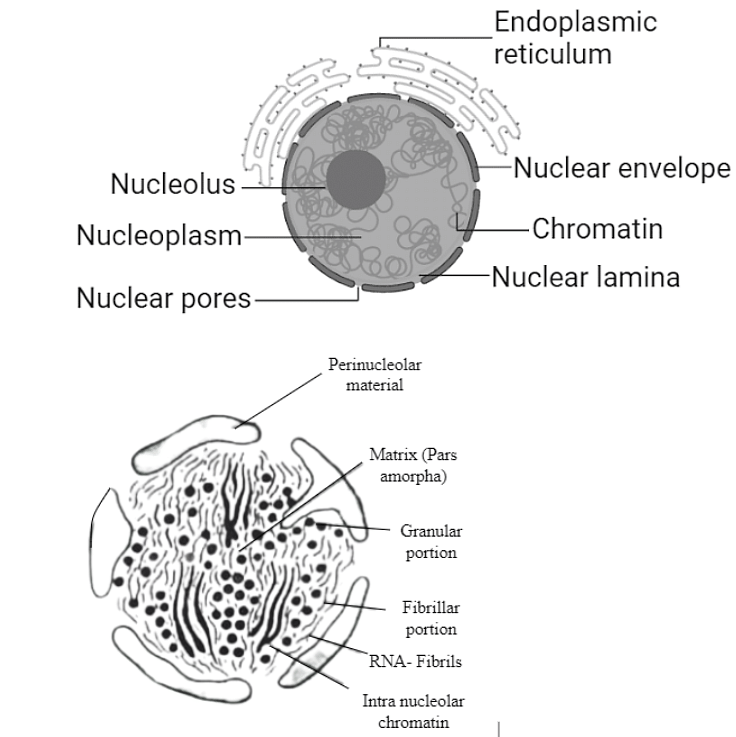
Structure of the Nucleolus
Functions of the Nucleolus
[Click Here for Sample Questions]
Controlling protein exchange is the primary task of the nucleolus in a cell, vital for overseeing various cellular activities. Inside the cell, there exists a non-membrane-bound structure within the nucleus. It includes ribosomes that contain ribonucleic acid (RNA).
- The nucleolus's second primary role is the production and assembly of ribosome components inside the cell.
- The primary function of the nucleolus is to maintain cell organelles in suspension within the cell nucleus.
- The nucleolus, which is one of the primary sources of chromosomes with DNA contained in them, is extremely rich in RNA and is needed for preserving the nucleus' sound form and structure.
- Among the other nucleolus tasks are the transportation of molecules, ions, and essential elements for the efficient operation of cell metabolism.
The nucleolus is a cellular structure made of DNA that is generated to synthesize proteins in the cell to make chromosomes, and it serves as the center for the chromatin network and the RNA in single-unit cell life.
Also Read:
Things to Remember
- The nucleolus is a crucial structure in eukaryotic cells, responsible for assembling ribosomes, altering transfer RNA, and sensing cellular stress.
- It plays a role in controlling mitosis, cell cycle progression, and stress response.
- It consists of RNA and proteins, forming specific chromosomal regions, and is composed of ribonucleic acid, deoxyribonucleic acid, and proteins.
- The nucleolus in eukaryotic cells has four main ultrastructural components: fibrillar centers, granular components, dense fibrillar components, and nucleolar vacuoles.
- The nucleolus maintains cell organelles and helps preserve the nucleus' structure.
- Nucleolus, a 25% nucleus brain, is crucial for protein synthesis and ribosome production in eukaryotic cells, forming subunits for ribosomes, and is essential for efficient cell metabolism and transportation of molecules and ions.
- The nucleus is a specialized structure in most cells, separated by the nuclear membrane, which is continuous with the endoplasmic reticulum and has pores for large molecules.
- Nucleoli can exist in varying numbers within a single-cell nucleus.
Sample Questions
Ques. Define nucleus. (1 mark)
Ans. In most cells, the nuclear membrane, which is continuous with the endoplasmic reticulum and includes holes for big molecules, separates the nucleus, a specialized structure.
Ques. In which part of the cell is the nucleolus located? (1 mark)
Ans. In a eukaryotic cell's nucleus, there is a structure called a nucleolus. The nucleus is enclosed by a membrane.
Ques. What is within the nucleolus? (1 mark)
Ans. DNA, RNA, and proteins are found in the nucleolus. A ribosome factory is what it is. Other species' cells frequently have several nucleoli.
Ques. What would occur if the cell didn't have a nucleolus? (1 mark)
Ans. Ribosome synthesis and protein synthesis would not be possible in the absence of the nucleolus.
Ques. What is the function of the nucleolus? (2 marks)
Ans. Playing a vital cellular role, the nucleolus, located within the nucleus, is accountable for managing protein exchange, supporting cell organelles, and maintaining the integrity of the nucleus' structure. With its RNA richness, the nucleolus assumes essential functions in the synthesis of proteins and chromosomes, and it plays a pivotal role in the efficient transport of molecules, ions, and essential elements necessary for cell metabolism. The nucleolus is essential for preserving the sound form and structure of the nucleus.
Ques. Define the structure of the nucleolus. (2 marks)
Ans. Ribosomal RNAs undergo digestion, synthesis, and assembly within the nucleolus, situated in the central nucleus region.
- The nucleolus' structure consists of the dense fibrillar component (DFC), fibrillar centers (FC), and granular components (GC).
- During the transition from amniotes to amniotes, the intricate organization forms, and the initial fibrillar component divides into FC and DFC.
Ques. What is the primary function of the nucleolus in eukaryotic cells, and how does it contribute to cellular processes? (3 marks)
Ans. Within the cell, the nucleolus serves as a vital structure responsible for overseeing the exchange of proteins, a crucial aspect in the regulation of all cellular processes. It plays a critical role in ribosome assembly, altering transfer RNA, and sensing cellular stress.
As the primary site for ribosome formation in eukaryotic cells, the nucleolus acts as a factory for manufacturing ribosomes, crucial for protein synthesis. It is rich in RNA and proteins, forming specific chromosomal regions.
Besides ribosome biogenesis, current research indicates that the nucleolus has other roles, including controlling mitosis, cell cycle progression, proliferation, and various stress reactions. Through these functions, the nucleolus regulates vital cellular activities, maintaining cellular homeostasis and confirming proper cell function.
Ques. Explain the ultrastructural components of the nucleolus and their significance in ribosome assembly. (3 marks)
Ans. FC, GC, DFC, and nucleolar vacuoles serve as the prominent ultrastructural components in the nucleolus of eukaryotic cells. These components are vital for ribosome assembly and rRNA synthesis. Within FC, rRNA genes undergo transcriptional activity and processing to form precursor rRNA molecules. The DFC is responsible for maturing and processing nascent ribosomal subunits, preparing them for assembly into functional ribosomes.
- Within the nucleolus, GC participates in the final assembly of ribosomal subunits by aiding in ribosomal protein addition.
- The nucleolus actively engages in ribosome formation, combining ribosomal RNAs with ribosomal proteins.
- The precise arrangement of these ultrastructural components guarantees effective ribosome biogenesis, essential for protein synthesis inside the cell.
Ques. How does the nucleolus contribute to cell metabolism and the maintenance of the cell's overall structure? (3 marks)
Ans. The nucleolus plays a significant role in cell metabolism and the maintenance of the cell's structural integrity. It acts as a cellular structure responsible for synthesizing proteins and chromosomes, forming subunits for ribosomes. The nucleolus is extremely rich in RNA and is needed to preserve the nucleus's sound form and structure.
- Furthermore, the nucleolus facilitates the transportation of molecules, ions, and essential elements required for efficient cell metabolism.
- Additionally, it regulates protein exchange, crucial for controlling cellular processes like cell cycle progression, proliferation, and stress response.
- Apart from this, the nucleolus ensures cell organelles remain suspended in the cell nucleus, aiding cellular organization and function.
By performing these vital functions, the nucleolus ensures proper cell metabolism, structural stability, and overall cellular homeostasis. Its significance in maintaining cell health and function makes it a crucial cellular structure in eukaryotic cells.
Ques. How does the nucleolus contribute to ribosome synthesis and its effect on protein production in the cell? (3 marks)
Ans. The nucleolus plays a major part in ribosome synthesis, necessary for protein production within the cell. It acts as the factory for manufacturing ribosomes, where ribosomal RNAs (rRNA) are synthesized, processed, and assembled with ribosomal proteins. The dense fibrillar component (DFC) and fibrillar centers (FC) within the nucleolus are entangled in the transcription and processing of rRNA genes.
During ribosome formation, ribosomal proteins are integrated with rRNA to form ribosomal subunits. These subunits are then exported from the nucleolus to the cytoplasm, where they unite to form functional ribosomes.
The nucleolus plays a vital role in efficiently synthesizing ribosomes for protein production. Ribosomes are accountable for translating mRNA into protein during the procedure of protein synthesis. Thus, the nucleolus's role in ribosome biogenesis directly affects the cell's capacity to produce proteins, which are vital for various cellular operations, including enzymatic reactions, cell signaling, and structural support.
Ques. How does the nucleolus contribute to controlling cell cycle progression and its impact on cellular proliferation? (4 marks)
Ans. The nucleolus plays a vital role in handling cell cycle progression and cellular proliferation. It is involved in the regulation of essential operations like mitosis, guaranteeing proper cell division and proliferation.
During the cell cycle, the nucleolus experiences dynamic transformations, with its structure and composition adapting to different stages of the cell cycle. It handles the synthesis and availability of ribosomes, which are significant for protein synthesis during cell division and proliferation.
Studies have revealed that alterations in nucleolar structure and operation can influence cell cycle progression and lead to abnormal cellular proliferation. Dysregulation of nucleolar activities can lead to uncontrolled cell growth, contributing to circumstances like cancer and other proliferative disorders.
The nucleolus's capability to coordinate cell cycle progression and cellular proliferation emphasizes its vital role in maintaining cellular homeostasis and preventing aberrant cell growth. Understanding these regulatory mechanisms delivers valuable knowledge of cell biology and the molecular basis of diseases linked to cell proliferation.
For Latest Updates on Upcoming Board Exams, Click Here: https://t.me/class_10_12_board_updates
Also Check:



Comments