



Content Writer
The discovery of cells first started in the year 1665 and is considered to be the smallest unit of all living organisms. Scientists who have contributed to the discovery of cells include Theodor Schwann, Robert Brown, Hans and Zacharias Jansen, Matthias Schleiden, Robert Hooke, Rodolph Virchow, and Anton Van Leeuwenhoek.
- Cells are considered the basic and structural unit of life.
- The discovery of cells is considered the biggest breakthrough in the field of life.
- The earlier prediction regarding cells was unsuccessful.
- The discovery of cells was formulated after the introduction of microscopy.
- Cells are made up of pre-existing cells.
- It is derived from a Latin word named cella which means small room.
- They are also considered an important part of reproduction.
Read More: Cell Wall
Key Terms: Cells, Discovery of Cells, Living Organism, Microscopes, Cell Division, DNA, Cell Theory, Organisms, Stem Cells
Discovery of Cells
[Click Here for Sample Questions]
A British scientist named Robert Hooke invented the word cells in 1665. Robert Hooke believes that cells are the structural, fundamental as well as functional components of life. He was the first to observe and investigate living creatures under a microscope based on a cork slice.
- Robert Hooke noticed that the structure of cells is like that of a honeycomb.
- The discovery has been continued by various expert scientists like Louis Pasteur In the realm of science.
- The term cell was originally used to refer to the small units of life.
- Hooke was able to make a significant discovery despite the limitations of his day's microscopes.
- He created the stretch in the image below to demonstrate his observations.
- The cork was made up of numerous small units known as cells.
The scientist who discovered the cells found out the following:
- The cell is a unit of structure, psychology and organisation in living things.
- The cell retains a dual existence as a distinct entity and building block in the construction of organisms.
- Cells is responsibles for free cell formation which is same as the formation of crystals.

Discovery of Cells
Read More:
Landmarks in Discovery of Cells
[Click Here for Sample Questions]
Various discoveries have altered the direction of science and the globe. The revelation of cells was a massive step forward in the progress of Life science. Let us take a comprehensive look into cell discovery in which who discovered cells, and how cells were discovered will be described.
| Scientist | Discovery | |
|---|---|---|
| Robert Hooke | Discovered cells | |
| Robert Brown | Discovered cell nucleus | |
| Antoni Van Leeuwenhoek | Discovered protozoa and bacteria | |
| Albert Von Kolliker | Discovered mitochondria | |
| Evans and Kauffman | Discovered Embryonic Stem cells from mice | |
| James Thomson | Discovered Embryonic stem cells from humans | |
| Schleiden and Schwann | Proposed cell theory | |
| Camillo Golgi | Golgi apparatus | |
| Joseph Bienaimé Caventou and Pierre Joseph Pelletier | Discovered chlorophyll | |
Read More:
| Related Links | ||
|---|---|---|
| Difference Between Cytoplasm and Protoplasm | Gene Regulation | Cell Organelles Types and Functions |
| Cell Wall and Cell Membrane | Endomembrane System | Parts of Cell |
Cell Theory
[Click Here for Sample Questions]
Robert Hooke released Micrographia, a book packed with drawings and descriptions of the creatures he saw via the newly created microscope in 1665. He discovered the cell as a result of the creation of the microscope.
- Robert Hooke saw box-shaped formations when gazing at the cork.
- It reminded him of monastic cells or chambers.
- This discovery paved the way for the creation of classical cell theory.
Theodor Schwann proposed the classical cell hypothesis in 1839.
- This hypothesis was divided into three sections.
- The first section asserted that all creatures are made up of cells.
- The second section asserted that cells are the fundamental components of life.
- These sections were based on a conclusion reached in 1838 by Theodor Schwann and Matthias Schleiden.
- Rudolf Virchow described the third component.
- It claims that cells developed from previous cells have multiplied.
Technology has advanced since the development of classical cell theory, which includes three major additions :
- DNA is passed between cells during cell divisions
- The cells of all organisms within a similar species are mostly the same in both structural and chemical aspects
- Energy flow occurs within cells.
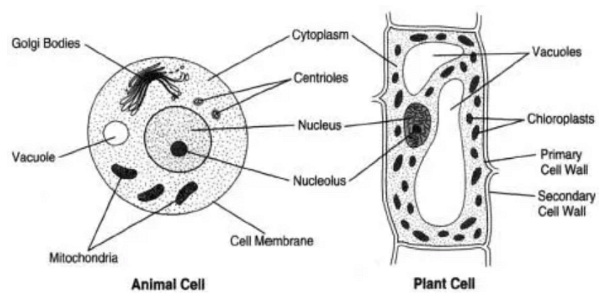
Animal and Plant Cell
Read More: Difference Between Prokaryotic and Eukaryotic Transcription
Discovery of Stem Cells
[Click Here for Sample Questions]
While Robert Hooke was the first to uncover the idea of cells, Dr. James Till and Ernest McCulloch are universally acknowledged for identifying stem cells. Researchers have known for centuries and centuries that the human body is made up of billions of microscopic structures.
- The structures, known as cells, can only be recognized at the microscopic level.
- Functions of cells include pumping blood, digesting food, and clearing the bodies of contaminants and demolition debris.
- According to Ernst Haeckel, the phrase "stem cell" first appeared in the scientific literature dated back in 1868.
- German biologists coined the term to describe the process of fertilized eggs.
- The fertilized eggs are developed into a fully functional adult mammal.
- Ernst Haeckel referred to the ancestral cell of all living things, which is referred to as a stammel.
- In 1886, William Sedgwick used the word cells to refer to the developing portion of plants.
- It renews exclusively at certain locations of the organism.
Scientists uncovered a number of facts concerning stem cells. This information includes where they are usually located and what purposes they have. Cells in the human body can and cannot create extra cells.
- At the beginning of the early 1900s, scientific research articles uncovered highly precise evidence for stem cells.
- These studies provided evidence that blood cells include undifferentiated cells similar to bone and other tissues.
- Stem cell research is now a foundation of regenerative medicine.
- Clinicians can utilize cancer cells to replace damaged bone marrow and blood cells in illnesses such as leukaemia.
- Stem cells also show promise in regenerating resources such as cartilage, which fades in joints after a certain age.
- This eliminates the need for invasive procedures and the introduction of foreign tissues or substances into the blood.
Scientists see a future in which stem cells may entirely reconstruct a severed limb, replace a damaged portion of the brain, and make a heart from the ground up, personalized to the individual. The following scientists contributed many ways to the current understanding of stem cells and the broad range of application of the term:
| Scientist | Contributions |
|---|---|
| Artur Pappenheim | Created an illustration of stem cells |
| Alexander Maximow | Proposed the theory of blood cells |
| Florence Sabin | Discovered the existence of stem cells in the marrow |
| Leroy Stevens | Testicular tumors in mice |
| E. Donnall Thomas | Performed a successful bone marrow transplant |
| James Till and Ernest McCulloch | Released a study providing that master blood cells exist in mice |
| Robert Good | The first successful bone marrow transplant on a youngster with an immunological weakness, utilising donor cells from his sister |

Cells
Read More: Difference Between Cytosol and Cytoplasm
Things to Remember
- The discovery of cells was first initiated in 1665 by scientist Robert Hooke.
- Every living thing, from the tiniest bacterium to the largest whale, is made up of one or more cells.
- After 150 years, scientists used Hooke's observation to form the cell theory.
- All living things are composed of one or more cells.
- New cell arises from pre-existing cells.
- Not all cells are alike; they are diverse in shape, size and internal organisation.
Sample Questions
Ques. According to Robert Hooke, cells are called the fundamental as well as functional components of life. Justify the statement. (2 marks)
Ans. The cell is called the fundamental as well as functional component of the human body because of the particular organisation of membranes and organelles, each cell obtains a different structure and function. As a result, each cell type has a basic structural as well as functional organisation. This function assists distinct cells forming fundamental activities like breathing, food intake, excretion, and so on.
Ques. Who discovered cells? (2 marks)
Ans. Robert Hooke, British scientist, invented the term "cells". The year was 1665. On examining a cork slice, Robert Hooke was the first to investigate and observe like reaches under the microscope. Cells, he claims, are the fundamental structural and functional components of life. He saw a honeycomb -like structure and identified the individual cells that made up the structure. Define cells that were architecturally compared to jail cells.
Ques. What are cell theory's four parts? (2 marks)
Ans. The four fundamental principles of cell theory are as follows:
- All animals and plants have cells as the basic structural components.
- In all animals and plants, cells are the smallest fundamental units of function.
- Division is solvay of cells to arise pre-existing cells.
- Homeostasis is maintained in all cells.
Ques. Who was the German Zoologist who formulated cell theory? Write briefly. (3 marks)
Ans. Theodor Schwann was a German zoologist formulated cells theory with the help of a German Botanist named Schleiden. Both of these scientists worked on their own. We came up with the concept of cell theory. The discovered that the cell is made up of three main components
- Nucleus - present in the middle.
- Cytoplasm - surrounds the nucleus.
- Plasma membrane - forms an outer thin covering.
According to the cell hypothesis, "only living entities are made up of cells and cell products." It is biology's most broad concept. This idea has far - reaching implications for biological study. They also discovered that the cell wall is a separate structure, which can be only found in plants. These findings led to the expansion of the cell hypothesis.
Ques. Who was the scientist who named animalcule for the microscopic organisms? (1 mark)
Ans. Animalcule is an old term for microscopic organisms which means "little animal" that includes bacteria, protozoans and other microscopic animals. Antonie van Leeuwenhoek, a 17th- century Dutch scientist, used the word ro to describe the microorganisms he discovered in rainfall.
Ques. Write two uses of stem cells. (2 marks)
Ans. Two uses are:
- Illnesses such as leukaemia and Hodgkin's lymphoma, clinicians can utilise cancer cells to replace damaged bone marrow and blood cells.
- Stem cells also show promise in regenerating normally limiting resources such as cartilage which fades in joints after a certain age. This eliminates the need for invasive procedures and the introduction of foreign tissues or substances into the blood.
Ques. Which of the following was first examined under a microscope that later led to the discovery of cells? (1 mark)
a) Honeycomb
b) Cork
c) Drosophila
d) Dead leaves
Ans. b) Cork.
Explaination: Robert Hooke in the 16th century examined a cork under the microscope and found a porous honeycomb-like structure which he named as cells.
Ques. Which of the following is a tenet of cell theory, as proposed by Theodor Schwann? (1 mark)
a) Cell can be seen with naked eyes
b) Only animals are composed of cells
c) Cell is the structural unit of life
d) Not all organisms have cells
Ans. c)Cell is the structural unit of life.
Explaination: Theodor Schwann proposed the cell theory. The principle of the cell theory states that every organism is made up of one or more cells and cells form the structural basis of every living being.
Ques. What are the major landmarks in the discovery of cells? (5 marks)
Ans. The major landmarks in the discovery of cells are as follows:
| Scientist | Discovery | |
|---|---|---|
| Robert Hooke | Discovered cells | |
| Robert Brown | Discovered cell nucleus | |
| Antoni Van Leeuwenhoek | Discovered protozoa and bacteria | |
| Albert Von Kolliker | Discovered mitochondria | |
| Evans and Kauffman | Discovered Embryonic Stem cells from mice | |
| James Thomson | Discovered Embryonic stem cells from humans | |
| Schleiden and Schwann | Proposed cell theory | |
| Camillo Golgi | Golgi apparatus | |
| Joseph Bienaimé Caventou and Pierre Joseph Pelletier | Discovered chlorophyll | |
Ques. What inferences are drawn by scientist after discovery of cells? (3 marks)
Ans. The inferences which are drawn by scientist after discovery of cells are as follows:
- The cell is a unit of structure, psychology and organisation in living things
- The cell retains a dual existence as a distinct entity and building block in the construction of organisms.
- Cells form free cell formation, the same as the formation of crystals.
Ques. Briefly explain Theodor Schwann theory on the discovery of cells? (3 marks)
Ans. Theodor Schwann proposed the classical cell hypothesis in 1839.
- This hypothesis was divided into three sections.
- The first section asserted that all creatures are made up of cells.
- The second section asserted that cells are the fundamental components of life.
- These sections were based on a conclusion reached in 1838 by Theodor Schwann and Matthias Schleiden.
- Rudolf Virchow described the third component.
- It claims that cells developed from previous cells have multiplied.
Ques. What is the difference between plant and animal cell? (3 marks)
Ans. The difference between plant and animal cells are as follows:
| Plant Cells | Animal Cells |
|---|---|
| Plant cells are square or rectangular in shape. | Animal cells are irregular in shape. |
| Cell wall is present in plant cell. | Cell wall is absent in animal cell. |
| Nucleus is present on one side of the cell. | Nucleus is found at the centre of the animal cell. |
| Cytoplasm and ribosomes are found in plant cell. | Cytoplasm and ribosomes are not found in animal cell. |
Ques. Name the scientists who contributed to the field of stem cells? (5 marks)
Ans. The following scientists contributed many ways to the current understanding of stem cells and the broad range of application of the term:
| Scientist | Contributions |
|---|---|
| Artur Pappenheim | Created an illustration of stem cells |
| Alexander Maximow | Proposed the theory of blood cells |
| Florence Sabin | Discovered the existence of stem cells in the marrow |
| Leroy Stevens | Testicular tumors in mice |
| E. Donnall Thomas | Performed a successful bone marrow transplant |
| James Till and Ernest McCulloch | Released a study providing that master blood cells exist in mice |
| Robert Good | The first successful bone marrow transplant on a youngster with an immunological weakness, utilising donor cells from his sister |
For Latest Updates on Upcoming Board Exams, Click Here: https://t.me/class_10_12_board_updates
Check-Out:



Comments