



Education Content Expert
Xylem Parenchyma is a component of Xylem, a complex water and mineral transporting tissue in plants. Xylem tissues are primary storage sections and also provide mechanical support to the plant.
- Xylem tissue is made up of Xylem Fibers and Xylem Parenchyma.
- They are present around the conducting cells and facilitate the movement of water upwards.
- The lateral conduction of water is done by Xylem Parenchyma cells.
- They are specialized cells that can store large quantities of water.
- It also maintains the stem’s density and structural strength and controls the sap’s pH value.
- They are living cells with thin cell walls and store tannins that give color to the plant.
- The fibers in Xylem Parenchyma are made up of dead cells that offer mechanical support to the plant.
Read More: NCERT Solutions For Class 11 Biology Anatomy of Flowering Plants
Key Terms: Xylem, Phloem, Xylem Parenchyma, Xylem Fiber, Plant, Cells, Tracheids, Tissue, Xylem Vessels
What is Xylem?
[Click Here for Sample Questions]
Xylem is a type of vascular tissue in plants that primarily transports water and nutrients from roots to stem and leaves. These tissues also provide mechanical strength to the plants.
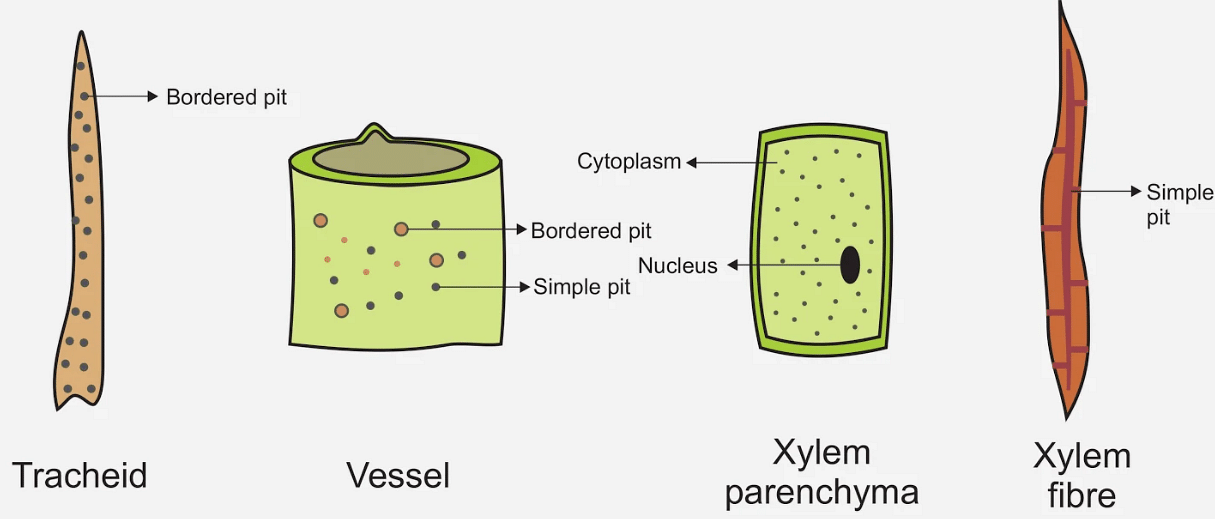
Xylem is made up of four major elements which are as follows:

Xylem
Tracheids
- Xyelm has tracheids shaped as sharp elongated tubes that have minute pores to allow easy passage of water and minerals.
- Their thick cell walls give extra support to the plants.
- Tracheids are individualistic cells with a small lumen.
- They are connected on top of each other like a wall and are present in all vascular plants.
Vessels
- Xylem vessels are short tubes arranged in a connected series, and the cells are non-living in nature.
- Xylem vessels are also devoid of protoplasts but are more advanced than them.
- Their cell lumen is large, and the primitive cells are circularly aligned.
- They also provide a better water conduction system and are present in angiosperms.
Xylem Fibre
- Xylem fibers are dead at their maturity and have no protoplast.
- The walls are thick and lined, and their primary function is to provide extra support to the plant due to their high tensile strength.
- They are present between the tracheids and vessels.
- Xylem fibers are also known as Wood fibers.
Xylem Parenchyma
- They are the only living cells of xylem and acts as a storage for starch and fats.
- They help in the short distance transportation of water.
Read More:
Xylem Parenchyma
[Click Here for Previous Year Questions]
Xylem Parenchyma is a component of complex plant tissue Xylem and helps in the storage and radial conduction of water. Xylem Parenchyma comprises numerous protoplasts forming a three-dimensional network bridge. It is a complex permanent tissue like phloem.
- Parenchyma cells are the only living cells in the Xylem.
- They have thin walls and adapt in accordance with their required functions.
- They provide support in the process of photosynthesis, food storage such as starch, hormones, and proteins, and mineral discharge to other parts of the plants.
- It can be further divided into Sclerenchyma, thick uniform dead tissues acting as support cells, and Collenchyma, which are non-uniform living support tissues.
![Xylem parenchyma]()
Xylem Parenchyma
Structure of Xylem Parenchyma
[Click Here for Sample Questions]
The structure of Xylem Parenchyma is explained as follows:
- It comprises thin cell walls, large vacuoles, a prominent nucleus, and protoplasts.
- The primary xylem is made up of the division of cells in the growing root system.
- The secondary xylem is formed when the plant expands in width and leads to Xylem rings.
- After the formation of the secondary xylem, the primary xylem wards off and loses its basic water transportation function and is left as dead cells supporting the plant.
- The water stored in these cells is very important for the plant’s growth and underwater deficiency.
- Xylem Parenchyma provides water to continue the vascular system.
- The stem is enlarged due to the increase in the surface area of the Xylem Parenchyma tissues.
- They store carbon compounds to help break leaf buds and the growth of the shoot.
Read More: Anatomy of Flowering Plants Important Questions
Shapes of Xylem Parenchyma
[Click Here for Previous Year Questions]
Xylem Parenchyma is found in various shapes which are as follows:
- Polyhedral: One of the most common Xylem Parenchyma shapes. These are also known as Isodiametric.
- Stellate: It is well developed with prominent air spaces between them and is generally found in stems.
- Elongated: These are found in the palisade tissues of the leaf or stem. They are thin-walled cells at right angles to the surface.
- Lubed: These are found in the palisade and spongy tissues of the leaves.
Types of Xylem Parenchyma
[Click Here for Sample Questions]
The types of Xylem Parenchyma are as follows:
- Axial Parenchyma: Cells that are arranged on top of one another or longitudinally.
- Ray Parenchyma: Cells connected in a straight line or radially.
- Palisade Parenchyma: They are tightly packed elongated cells with no air cavity.
- Aerenchyma/Spongy Parenchyma: They are loosely packed elongated cells with numerous air cavities present between them.
Read More: Anatomy of Flowering Plants
Characteristics of Xylem Parenchyma
[Click Here for Previous Year Questions]
Some important features of Xylem Parenchyma are mentioned below.
- Parenchyma has thin-walled cells with abundant cytoplasm.
- These cells have a large potential to divide due to numerous cytoplasm.
- The cytoplasm in the cells consists of an active protoplast.
- The cells have a prominent nucleus.
- They have large vacuoles.
- They have leucoplast, which helps in food storage.
- The cells have a thin primary wall and a thick secondary wall.
- The intercellular spaces are present in between the cells, which enable the easy exchange of gases.
- The connecting point of one cell to another is called Plasmodesmata.
- Merismatic functions of wound healing, regeneration, and union of plant grafts.
- They have chromoplast in the cells.
Functions of Xylem Parenchyma
[Click Here for Sample Questions]
Xylem Parenchyma performs the following functions:
- They store food through starch, fats, and crystals.
- They store mucilage and water.
- They support the process of nectar secretion.
- If they have many chloroplasts containing chlorophyll, they produce photosynthesis.
- Due to the presence of air spaces, they provide buoyancy to the plant on the water surfaces.
- Xylem Parenchyma helps in the radial conduction of water.
- The presence of chromoplast provides colors to fruits, petals, and leaves.
Check More:
Things to Remember
- Xylem Parenchyma is a storage tissue in a complex plant tissue called Xyelm.
- Xylem Parenchyma stores water due to the presence of large air spaces.
- It has thin primary walls and thick secondary walls.
- Xylem parenchyma cells are the only living cells in the xylem.
- They perform photosynthesis in the presence of chloroplasts.
- Axial parenchyma cells and Radial parenchyma cells are the two types of parenchyma cells in xylem.
Previous Years’ Questions
- All the xylem elements, when mature, are dead except…
- The elements of xylem tissue that stores tannins are… (Haryana PMT - 2012)
- The given figures are types of elements (A and B) which constitute… (JIPMER - 2018)
- Which of the following is a complex tissue… (UP CPMT - 2010)
- In which of the following groups, the majority of plants… (COMEDK UGET - 2012)
- Interfascicular cambium develops from cells of… (NEET - 2013)
- Ground tissue includes… (AIPMT - 2011)
- Vascular tissues in flowering plants develop from… (AIPMT - 2008)
- The lowest water potential in the xylem will be of… (UPSEE - 2018)
- Xylem translocates… (NEET - 2019)
Sample Questions
Ques. Name the types of Xylem. (3 Marks)
Ans. Xylem can be categorized into two types namely Primary Xylem and Secondary Xylem.
- Primary Xylem: The primary xylem that is formed first is called protoxylem and later formed primary xylem is called metaxylem.
- Secondary Xylem: It is ormed due to the action of the vascular cambium and is responsible for an increase in the girth of the plant.
Ques. What does the Xylem transport to the other parts of the plant? (1 Mark)
Ans. Xylem transports water, minerals, carbon, and hormones in plants. Xylem Parenchyma of succulent plants has large vacuoles with thin cell walls, allowing the storage and conduction of water, essential minerals, and hormones for plant growth.
Ques. What are Xylem Vessels? (2 Marks)
Ans. Xylem Vessels are defined as short tubes arranged in a connected series, and its cells are non-living in nature. Like tracheids, the xylem vessels are also devoid of protoplasts but are more advanced than them. Their cell lumen is large, and the primitive cells are circularly aligned. They also provide a better water conduction system and are present in angiosperms.
Ques. What role do Xylem Fibers serve? (2 Marks)
Ans. The walls of Xylem Fibers are thick and lined, and their primary function is to provide extra support to the plant due to their high tensile strength, store carbohydrates, and manage their equal transfer. Xylem Fibers are present between the tracheids and vessels. They are also referred to as Wood fibers.
Ques. Which are the chief components of xylem parenchyma tissues? (1 Mark)
Ans. The main components of xylem parenchyma are xylem tracheids and xylem vessels the main function is to manage the flow of water. They have dead cells at maturity and have narrow and long tubular walls.
Ques. What is transported by Xylem in plants? (1 Mark)
Ans. Xylem is present around the conducting cells and facilitates the movement of water upwards and can provide the continuous flow of solute and store large quantities of water. It regulates the flow of water from roots to leaves.
Ques. What is the main difference between Xylem and Phloem tissues? (2 Marks)
Ans. Xylem tissues are the primary storage and transportation unit, whereas Phloem transports the end product of photosynthesis. In Xylem tissues, the movement of water is only upwards, and in Phloem, the movement is in both directions. Besides this Xylem consists of dead cells (except parenchyma), but Phloem consists of living cells.
Ques. What type of tissue is Xylem Parenchyma? (1 Mark)
Ans. Xylem Parenchyma is a complex permanent tissue. It is a collection of non-uniform and differentiated cells bound together to form a common function. They are made up of more than one type of cell.
Ques. Which tissue is composed of living, thin-walled and polyhedral cells? (1 Mark)
Ans. Parenchyma tissues are the tissues that have the most unique polyhedral shapes. These cells are living at their maturity and have thin primary walls with numerous cytoplasm, allowing them to divide.
Ques. What is Xylem Parenchyma? (2 Marks)
Ans. Xylem Parenchyma are ground tissues and are present continuously throughout the plant body. Xylem Parenchyma can be categorized as a complex permanent specialized cell, meaning they have more than one type of cell and a simple permanent specialized cell.
Ques. What are Tracheids? (1 Mark)
Ans. Tracheids are individualistic cells with a small lumen, and their cross-section is in the shape of a polygonal. They are connected on top of each other like a wall and are present in all vascular plants.
Check-Out:



Comments