



Exams Prep Master
Mendel's works deal with the guideline of legacy in hereditary qualities that stayed a secret for a long while. Even though his works were not acknowledged during his period, later were rediscovered and acquired validity. At present, Mendel's work is key for concentrating on legacy design in living organic entities. What's more, it assisted with finding and foreseeing how hereditary problems work. We should find out with regards to family examination and how it helps in foreseeing hereditary problems.
| Table of Content |
Keyterms: Heredity, Pedigree analysis, Plant, Species, DNA, DNA Replication, Chromosome, Allele
Also Read: Reproductive Health
What is a Pedigree Analysis?
[Click Here for Sample Questions]
The family investigation is a graph that addresses a genealogical record, which shows the individuals from the family who are impacted by a hereditary attribute. Here, the lines address the ages of a family, squares address guys and circles address females. As a rule, researchers utilize family investigation to break down the legacy of aggregates, or attributes, including different plant and creature species, utilizing mating tests called crosses.
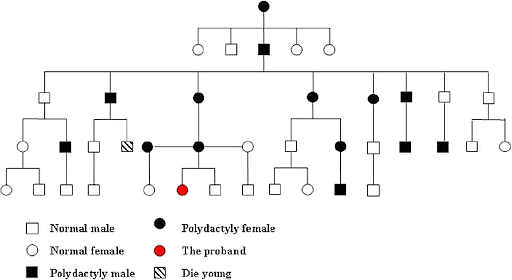
Mendel's trials uncovered that the 'factors', what we know as qualities, are answerable for the legacy of characteristics. They are additionally responsible for the problems winning in living life forms. Qualities are the inherited unit of organic entities, answerable for underlying and utilitarian changes in them. Other than this, it is the reason for variety in life forms which can either bring about a positive or negative characteristic. The ends we inferred were based on controlled crosses on pea plants and different life forms. Because of moral worries, these controlled analyses can't be acted in the human populace. The main recommended answer for this restriction was a family investigation. i.e., to notice and dissect the example of legacy in people utilizing their family ancestry.
DNA groupings are comprised of different, which, thus, code for a specific protein. Any progressions in this arrangement, for example, botches during DNA replication might prompt an adjustment of the hereditary codes or chromosomal distortions. This can be moved from guardians to posterity. Legacy of adjusted qualities causes hereditary issues in posterity. The Mendelian issues might emerge because of progress or modification in one quality. Their hereditary legacy is administered by Mendelian hereditary qualities. Mendelian issues generally happen in families with a specific example mirroring the modification in a solitary quality. A forecast of these problems depends on family ancestry and should be possible with the assistance of a genealogical record. This course of investigation of various ages of a family is known as the family examination. The family examination is a solid apparatus in human hereditary qualities which assists with foreseeing the example of legacy, in any event, when information is restricted.
A genealogical record can be addressed by a family diagram with every one of the individuals from a family. They might be having a hereditary problem or perhaps a transporter of the infection. In the family examination, standard images are utilized to recognize different families.
It is standard to address men by squares and ladies by circles in a diagram for investigation of family examination. Marriage is demonstrated by associating flat lines and the kids by connection to an upward line expanding lower from the even line. People having specific characters to be examined are signified by strong squares or circles while those not having them are shown by traces as it were. Twins are meant by bifurcating vertical lines.
Also Read: Recombinant DNA Technology
General Assumptions
[Click Here for Sample Questions]
In the issues that follow, you'll be thinking about the method of transmission of hereditary qualities that are constrained by one quality, with two alleles, a predominant allele, and a passive allele.
We likewise make three working on presumptions:
- Complete Penetrance. A person in the family will be impacted (express the aggregate related with a quality) when the singular conveys no less than one predominant allele of a prevailing characteristic or two passive alleles of a passive characteristic.
- Uncommon in-Population. In every issue, the attribute being referred to is uncommon in everybody. Expect for the reasons for these issues that people who wed into the family in the second and third ages are not transporters. This doesn't matter to the establishing guardians - either or both of the people at the highest point of the family could be transporters.
- Not-Y-Linked. The causative qualities in these issues might be autosomal or X-Linked, however are not Y-connected.
Also Read: Genetic Engineering
5 Key Clues
[Click Here for Sample Questions]
There are five things to recollect in thinking about families.
(1) An unaffected individual can't have any alleles of a prevailing attribute.
(since a solitary allele of a predominant attribute makes an individual be impacted).
(2) Individuals wedding into the family are expected to have no infection alleles- they won't ever be impacted and can never be transporters of a passive characteristic.
(since the characteristic is uncommon in the populace)
(3) An unaffected individual can be a transporter (have one allele) of a latent characteristic.
(since two alleles of a passive attribute are needed for a person to be impacted)
(4) When quality is X-connected, a solitary latent allele is adequate for a male to be impacted.
(since the male is hemizygous - he just has one allele of an X-connected quality)
(5) A dad sends his allele of X-connected qualities to his girls, yet not his children.
A mother sends an allele of X-connected qualities to both her girls and her children.
Also Read: Endangered Species
Related Biology Terms
[Click Here for Sample Questions]
Allele – a form of a gene. For example, in pea plants, B represents the dominant trait (purple color) and b represents the recessive trait (white color).
Homozygote – an individual that has two of the same alleles for a gene, e.g., BB for a purple pea plant or bb for a white pea plant.
Heterozygote – an individual with two different alleles, such as a pea plant that is Bb.
Autosomal – relating to a chromosome that is not a sex chromosome.
Also Read:
Things to Remember
- Analysis of traits in several generations of family is called pedigree analysis.
- Inheritance of a particular trait is represented in the family tree over generations.
- Autosomal disorders – cystic fibrosis, sickle cell anemia, myotonic dystrophy
- Sex-linked – hemophilia, color blindness
- HAEMOPHILIA – sex-linked recessive disease
- A single protein that is a part of the cascade of proteins involved in the clotting of blood is affected.
- In affected individuals, a simple cut will result in non-stop bleeding.
- A heterozygous female (carrier) can transmit the disease to son.
Also Read: Biotechnology
Sample Questions
Ques. The following pedigree shows a particular trait that is absent in the parents but found in the subsequent generation irrespective of the sexes. Analyze the pedigree and draw a conclusion. (2 marks)
Ans. The pedigree shows an autosomal recessive disorder. The parents are the carrier of the disease so the disease will be visible in only a few offspring. The other offspring will be either a carrier or non-carrier.
Ques. The F2 generation is obtained by Selfing of F1. Why? (1 mark)
Ans. In monohybrid and dihybrid cross, F2 generation is obtained by selfing of F1 hybrids as male and female.
Ques. What are genes? (1 mark)
Ans. Genes are segments of DNA present on chromosomes. Large numbers of genes are located on a single chromosome. A gene or genes determines the traits of the individual.
Ques. How is the map distance of genes on chromosomes is calculated? (1 mark)
Ans. Map distance is a tool to find the distance between two genes on a chromosome. The genes that are closer to each other show less crossing-over percentage.
Ques. Which law is proved by the Dihybrid cross? (1 mark)
Ans. In a dihybrid cross, two new kinds of plants with new traits are formed. This is possible only when all traits assort independently and recombine to form a new combination.
Ques. The phenotypic and genotypic ratios in the F2 generation are the same in a certain kind of inheritance. Name and organism in which it occurs and mention the kind of inheritance involved. (1 mark)
Ans. It occurs in snapdragon/antirrhinum sp. (dog flower). The inheritance involved is incomplete dominance.
Ques. Anju’s parents suffer from high blood pressure and are obese. Anju is also worried about her health. Do you think Anju can inherit these characteristics from their parents? Suggest two measures Anju can adopt to avoid high blood pressure and obesity. (2 marks)
Ans. 1) No, these are lifestyle-related diseases
2) Any two measures- changing in food habits, exercises, leading an active life, meditation.
Values
- Awareness about health.
- Understanding.
Ques. How is sex determined in human beings? (2 marks)
Ans. A baby’s genetic sex is determined at the time of conception. When the baby is conceived, a chromosome from the sperm cell, either X or Y, fuses with the X chromosome in the egg cell, determining whether the baby will be genetically female (XX) or male (XY).
Ques. Study the given pedigree chart and answer the questions that follow: (2 marks)
a) Is the trait recessive or dominant?
b) Is the trait sex-linked or autosomal?
c) Give the genotypes of the parents shown in generation I and their II child is shown in generation II and the first grandchild shown in generation III.
Ans. a) Dominant
b) Autosomal
c) Parents Mother -aa
Father – Aa
Third child – Aa
First grandchild – Aa
Ques. Briefly mention the contribution of T.H. Morgan in genetics. (2 marks)
Ans. Thomas Hunt Morgan put forth the chromosome theory of linkage from this work on the fruit fly (Drosophila melanogaster). He established the principle of linkage, discovered sex linkage and the technique of chromosomal mapping. He wrote a book ‘Theory of Gene’ and was awarded Nobel Prize in 1933.
For Latest Updates on Upcoming Board Exams, Click Here: https://t.me/class_10_12_board_updates
Check-Out:



Comments