



Education Journalist | Study Abroad Lead
Growth is a natural and important factor. Plants, unlike humans, grow throughout their life. Plant growth happens in a systematic manner. Phases of Growth in plants lead to a permanent and irreversible increase in the size of the parts of the plant, organs, tissue, or an individual cell. Cells that continuously divide in plants are known as meristematic cells. All the periodical events in plants, from the zygote stage to the full-grown plant growth take place in an orderly manner and this is known as the growth and development of plants.
| Table of Content |
Key Terms: Plant Growth, Plant Development, Growth Curve, Three Phases of Growth, Growth Rates
Plants Growth
[Click Here for Sample Questions]
Plant growth is an irreversible and permanent increase in the size of the plant, in its parts, tissue, entire plant or an individual cell.
- Growth is a fundamental characteristic of living plants, similar to any other living organism.
- Plant growth is also accomplished by metabolic processes like catabolism and anabolism.
- Catabolism is the breaking of complex molecules in living organisms to form simpler ones resulting in the release of energy.
- Anabolism is the synthesis of complex molecules in living organisms from simpler ones together to store energy.
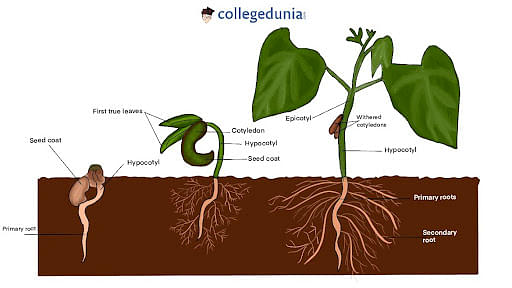
Plant Growth
- The growth in plants is open which means it is undetermined, and some of the cells continue to grow which helps in increasing the size of the tissue or the cell.
- Such cells which divide continuously are known as the meristematic cells.
- Phases of growth in plants can be measured since the protoplasmic content also increases.
- The fresh and dry weight of the plant also increases.
- Dry weight refers to all constituents of plants except water.
- Fresh weight includes water, which makes it less reliable while observing how specific plant management or system management is impacting plant performance.
Also Read:
Phases of growth in plants
[Click Here for Previous Year Questions]
In general there are three phases of growth in Plants: Elongation, Meristematic and Maturation.
Meristematic or Formative Phase
The tip region of the roots (lower part of the plant) and the Shoot (upper part of the plant) consists of the meristematic tissue as it always keeps growing.
- The meristematic cells in this region divide continuously and are isodiametric (with no spaces between the cells).
- The zone is referred to as the meristematic zone.
The characteristics of Meristematic cells in the Formative Phase are:
- The cells in the meristematic zone have rich protoplasm.
- The cell walls are primary in nature. They are thin and have cellulose.
- The cells in the meristematic zone have white plasmodesmata connection.
- Plasmodesmata is a microscopic cytoplasmic canal, passing through the plant cell walls.
- It allows molecules to communicate directly with the adjacent plant cells.
- Meristematic cells have a large and conspicuous nucleus.
- These cells keep dividing vigorously.
Elongation Phase
The cells which are present in the next region after the meristematic cells belong to the elongation region. The enlargement of the cell takes place in the elongation phase. This phase is also marked by the formation of the new cell wall, vacuoles, etc.
The characteristics of the cell in the Elongation Phase are:
- The elongation of these cells takes place due to the enlargement of the vacuole in the cell and therefore the zone is known as the zone of elongation.
- These cells have an increased number of vacuoles.
Maturation Phase
The cells in the maturation phase achieve their maximum size. They do not further divide into cells. The maturation zone is found as the mass differentiation phase where cells differentiate to perform special functions.
The cell in the Maturation Phase have proper wall thickening and protoplasmic modifications of the cells take place.
After studying all three phases of cell growth the three main processes which occur in these phases are -
- Cell division - The division of a cell into two daughter cells with the same genetic material
- Cell enlargement - The cells increase in size
- Cell differentiation - The process during which young, immature (unspecialized) cells take on individual characteristics and reach their mature, specialised form and function.
The first two stages of plant growth can lead to an increase in the plant size whereas the third phase is more marked to bring maturity in the cells. During differentiation, the cells show structural changes in the protoplasm and the cell wall.

Plant Growth
Growth Rates
[Click Here for Sample Questions]
The number of cells in organisms increases in a number of ways. The growth rate is the increase in growth per unit of time. This can be expressed mathematically by a formula.
There are two types of growth rates in plants: Arithmetic and Geometric Growth Rates.
- Arithmetic Growth in Plants:
Mitosis is a process of nuclear division that occurs when a parent cell in eukaryotic cells divides to produce two identical daughter cells.
- When the plant cells undergo mitotic division, two cells are formed out of one cell.
- Out of these two cells one cell continues dividing and the other one gets differentiated and forms a different structure.
- The former cell again divides and forms two more cells and then one continues dividing and there is one more that is differentiated.
- Now there are two differentiated cells from the one cell initially.
- Similarly, by following this a pattern is formed and a gradual increase in the size of the plant takes place.

Arithmetic Growth in Plants
To calculate Arithmetic Growth, the Formula is:
Lt = L0 + rt
Where,
- L= length of the plant
- Lt = length at time ‘t’ or after time ‘t’
- L0 = Length at initial time
- r = rate of growth
- t = time interval when we are calculating the plant growth rate
- Geometric Growth in Plants
Through geometric growth, the cell divides by mitotic division and two cells are formed. Both the cells then again divide to form two more cells for each. Thus, now the number of cells doubles at each stage.
- The number of cells will be like 2, 4, 8, 16, 32, 64, ...and so on, unlike arithmetic growth stages, here no differentiation of cells takes place.
- The cell growth rate is rapid here in the geometric phase.
- When the growth reaches its peak, it becomes slow and later becomes steady due to some limiting factors.

Geometric Growth in Plants
The geometric plant growth can be represented in the form of an S-shaped graph given as a Sigmoid Growth curve in plants.
- Lag Phase- It is the slower phase where cell division is slow at the beginning.
- Log Phase- A steep curve is formed here. The growth is very fast here. And it is also known as the exponential phase too.
- Stationary or Steady Phase- In this the growth is steady or stationary. It can be stated that growth becomes constant.
Formula that Represents this Sigmoid Growth Curve is as Follows:
Wt = W0 * ert
Where,
- W0 = size at the initial time
- Wt= size at time t or after time t
- r = growth rate
- t = time period
- e = base of natural logarithm
Growth is a natural process and unlike human beings plants have different forms of growth and carry out it in a very different way. The process which helps the growth to the fullest is the particular process known a photosynthesis. It is the process that plants perform in the presence of sunlight, water and organic compounds in order to produce food in the form of ATP. This helps the plant to grow and to provide energy to each and every cell of its structure.
Also Read:
Characteristics of plants growth
[Click Here for Previous Year Questions]
Some of the characteristics of plant growth are given below:
- Plant Growth is Indeterminate: Plants have meristems in roots and shoots. Meristems give a legitimate reaction to essential development. Due to the presence of meristems, the plants develop endlessly all throughout their life. Meristems have the ability to gap and self-proliferate. This is on the grounds that plant development is supposed to be uncertain.
- Plant Growth is Measurable: Growth simply indicates a regular increase in protoplasm. Growth in plants is measured by the increase in cell number, area, volume, length, etc. Usually, the growth in plants is hard to measure. This is why the increase in the quantity of plant growth is measured accordingly. The increment of plant growth and protoplasm shares a proportionality. And thus this can be used to measure the growth.
Conditions for Growth
[Click Here for Sample Questions]
The elements which are essential for the growth of plants are oxygen, water, and nutrients. Water enters the cells and causes turgidity. This causes enlargement of the cell. Water also provides a medium for the activities of enzymes and is also used to carry out many other activities inside a plant. Oxygen and nutrients are the sources of metabolic energy. Other conditions for the proper growth and development of plants also include optimum temperature, light, and gravity.
Things to Remember
- Growth is an essential, natural and irreversible factor. Plants grow throughout their lives.
- Phases of growth in plants are - The meristematic or Formative Phase, Elongation Phase, and Maturation Phase.
- Arithmetic and Geometric are two types of growth rates in plants.
- To calculate the Arithmetic Growth curve results, the Formula is Lt = L0 + rt.
- The geometric plant's growth can be represented in the form of the S-shaped graph having a Sigmoid Growth curve Wt= W0 * ert.
Previous Year Questions
- Which of the following terms will you use to describe them?..[NEET 2014]
- Under which one of the following categories will you place this plant?..[NEET 2004]
- Treatment of seed at low temperature under moist conditions to break its dormancy called...[NEET 2006]
- Abscisic acid controls...[NEET 1990]
- Hormone connected with cell division, is…...[NEET 1991]
- Auxin can be bioassayed by…..[NEET 2015]
- Coiling of garden pea tendrils around any support is an example of...[NEET 2010]
- Cytokinins are known to :...[NEET 1992]
- Dwarfness can be controlled by treating the plant with…..[NEET 1980]
- Flowering dependent on cold treatment is.[NEET 1992]
- Fruit and leaf drop at early stages can be prevented by the application of:…...[NEET 2017]
- Gibberellins promote…...[NEET 1988]
- If the apical bud has been removed observe….[NEET 2000]
- If the growing plant is decapitated, then...[NEET 1994]
- Which combination of hormones can be applied to artificially induce flowering in pineapple plants throughout, the year to increase yield ?...[NEET 2019]
Sample Questions
Ques. How many phases are there in the sigmoid curve of Geometric Growth in Plants? (5 marks)
Ans. The geometric plant's growth can be represented in the form of the S-shaped graph given as a Sigmoid Growth curve in plants. This shows that plant growth is not indeterminate. It is sometimes fast and sometimes slow.
- Lag Phase- It is the slower phase where cell division is slow at the beginning.
- Log Phase- A steep curve is formed here. The growth is very fast here. And it is also known as the exponential phase too.
- Stationary or Steady Phase- In this the growth is steady or stationary. It can be stated that growth becomes constant.
Ques. What are the three main processes during the stages of plant growth? (3 marks)
Ans- Three main processes which occur in these phases of plant growth are -
- Cell division - The division of a cell into 2 female offspring cells with an equivalent genetic material
- Cell enlargement
- Cell differentiation - The young, immature (unspecialized) cells fight individual characteristics and reach their mature, specialised kind and function.
Ques. Write the formula for Arithmetic Growth in Plants and Geometric Growth in Plants. (5 marks)
Ans. The formula for Arithmetic Growth in Plants is:
Lt = L0 + rt
Where,
- L= length of the plant
- Lt = length at time ‘t’ or after time ‘t’
- L0 = Length at initial time
- r= rate of growth
- t= time interval when we are calculating the plant growth rate
The formula for Geometric Growth in Plants is:
Wt = W0 * ert
Where,
- W0 = size at the initial time
- Wt= size at time t or after time t
- r = growth rate
- t = time period
- e = base of natural logarithm
Ques. What are the characteristics of Meristematic cells? (3 marks)
Ans. The characteristics of the Meristematic cells are as follows:
- The cells are rich in protoplasm.
- They have a large and conspicuous nucleus.
- The cell wall is thin and consists of cellulose.
Ques. What are the required conditions for the growth of plants? (3 marks)
Ans. The elements which are essential for the growth of plants are oxygen, water, and nutrients. Water enters the cells and causes turgidity. This results in the enlargement of the cell. Water also provides a medium for the activities of enzymes and also used to carry out many other activities inside a plant. The metabolic energy required for various activities is obtained from oxygen and sometimes nutrients. Other conditions for the proper growth and development of plants also include optimum temperature, light, and gravity.
Ques. What is the elementary structure of plants that develop? (2 marks)
Ans. Elementary structures in plant development square measure buds, shoots, roots, leaves, and flowers; plants deliver these tissues and structures throughout their life from plant tissue situated at the ideas of organs or between mature tissues.
Ques. Explain the process of Geometric Growth in Plants. (5 marks)
Ans. The cell here divides by mitotic division and two cells are formed.
- Both the cells then again divide to form two more cells for each.
- Thus, now the number of cells doubles at each stage.
- The number of cells will be like 2, 4, 8, 16, 32, 64, ...and so on.
- The most important thing to observe here is, unlike arithmetic growth stages, here no differentiation of cells takes place.
- The cell growth rate is very fast here in the geometric phase.
- When the growth comes at its peak, it becomes slow and later is steady due to some limiting factors.
Ques. What are the characteristics of the cells in the Elongation phase? (3 marks)
Ans. The characteristics of the cell in the elongation phase:
- The elongation of these cells takes place due to the enlargement of the vacuole present in the cell and hence that zone is termed the zone of elongation.
- These cells show increased vacuolation, i.e. more number of vacuoles.
- There is a new cell wall deposition.
Do Check Out:



Comments