



Education Journalist | Study Abroad Lead
Potassium Cyanide is a chemical compound with the chemical formula KCN. This colourless crystalline salt is similar in appearance to sugar and is highly soluble in water. Potassium Cyanide is majorly used in organic synthesis, gold mining, and electroplating. Smaller applications in our daily lives include making jewellery for chemical gilding and buffing. About 50,000 tonnes of KCN are produced every year through one of two processes: the treating of hydrogen cyanide with an aqueous solution of potassium hydroxide or treating formamide with potassium hydroxide.
| Table of Content |
Key Terms: Potassium Cyanide, Cyanide Compounds, Crystalline Salt, Potassium Hydroxide, Hydrolysis, Cyanuric Acid, Hydrogen Cyanide
What is Potassium Cyanide?
[Click Here for Sample Questions]
Potassium cyanide is a systematic toxicant that affects virtually every cell and organ in the body by interfering with the cell’s ability to utilize oxygen. The moist solid releases small amounts of hydrogen cyanide because of the process of hydrolysis, which smells like bitter almonds.
The taste of potassium cyanide can be described as acrid and bitter, which has a burning sensation similar to the eye.
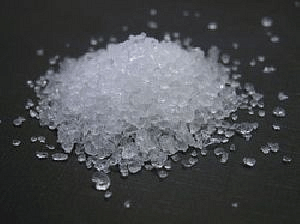
Potassium Cyanide
Also Read:
| Related Articles | ||
|---|---|---|
| Sodium Cyanide (NaCN) | Potassium Acetate | Potassium Iodate |
| Potassium Hypochlorite Formula | Potassium Permanganate | Potassium Iodide |
Properties of Potassium Cyanide
[Click Here for Sample Questions]
The major properties of Potassium Cyanide are mentioned below:
| Chemical Formula of Potassium Cyanide | KCN |
| Molecular Weight of Potassium Cyanide | 65.12 g/mol |
| Density of Potassium Cyanide | 1.52 g/cm3 |
| Melting Point of Potassium Cyanide | 634.5 °C |
| Boiling point of Potassium Cyanide | 1,625 °C |
Structure and Formula of Potassium Cyanide
[Click Here for Sample Questions]
The chemical formula of potassium cyanide is KCN. Potassium Cyanide can be classified as a salt composed of the potassium (K+) cation and the cyanide (CN-) anion. In this, the carbon atom is triply bonded to the nitrogen atom and carries a negative charge. The solid form of Potassium Cyanide exists in a similar cubic crystalline structure as sodium chloride (NaCl).
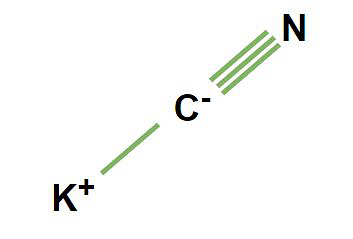
Structure of Potassium Cyanide
Preparation of Potassium Cyanide
[Click Here for Sample Questions]
Potassium cyanide can be produced in various ways.
One way to produce Potassium Cyanide is by melting cyanuric acid or urea with potassium hydroxide. This gives potassium cyanate. Crush the resulting solid and grind it. Now, you have to mix it with a reducing agent, such as carbon and heat it till no more gases are released. One can also use magnesium as a reducing agent to make a thermite-like mixture, which is then ignited to reduce the potassium cyanate to potassium cyanide, though the yield of this route is bad. Both of these ways or routes give impure potassium cyanide, which needs to be purified to be of any use in chemical reactions.
There is one different route too that involves treating formamide with potassium hydroxide. The decomposition of potassium ferrocyanide also results in the production of potassium cyanide.
Things to Remember
- Potassium Cyanide, which is also referred to as Cyanide of potassium or Cyano Potassium, is a chemical compound which arises due to the reaction between hydrogen cyanide (HCN) and potassium hydroxide (KOH).
- The chemical formula of Potassium Cyanide is KCN and it is a crystalline salt with no colour and is highly toxic and soluble in water.
- Potassium Cyanide smells like bitter almonds and tastes like acrid with a burning sensation.
- Potassium Cyanide has an equal number of potassium cations and cyanide anions.
- Potassium cyanide is very poisonous. These are neurotoxic effects, and clinical, and cardiovascular effects which enhance danger at different stages from acute to severe.
- Chlorates plus potassium cyanide explode when heated. Nitrogen chloride also explodes when in contact with potassium cyanide.
Also Read:
Sample Questions
Ques. How is KCN made? (3 Marks)
Ans. KCN is the salt with a solid base (KOH) and a weak acid (HCN), and thus the salt should have a simple pH in aqueous solution. KCN is formed by the treatment of hydrogen cyanide with an aqueous potassium hydroxide solution, followed by the vacuum evaporation of the solution: HCN + KOH → KCN + H2O. Around 50,000 tonnes of potassium cyanide is produced annually.
Ques. What are cyanides, and how are they used? (3 Marks)
Ans. Fast-acting toxins, cyanides, can be fatal if ingested. The first time they were utilised as chemical weapons were during World War I. We eat and use everyday products that contain trace amounts of cyanides. Certain bacteria, fungi, and algae are capable of producing cyanides. Smoke, car exhaust, and food sources like spinach, bamboo stems, almonds, lime beans, and fruit pits all contain cyanides.
Ques. What are the properties of Potassium Cyanide? (3 Marks)
Ans. The properties of Potassium Cyanide are as follows:
- Chemical Formula: KCN
- Flash Point: Not flammable
- Melting Point: 1173°F
- Specific Gravity: 1.52 at 60.8°F
- Boiling Point: Very high
- Molecular Weight: 65.11
- Water Solubility: 72 % at 77°F
Ques. What is the structure of Potassium Cyanide? (3 Marks)
Ans. Solubilized potassium (K+) ions and cyanide (CN) ions are formed when KCN is dissolved in water. Solid KCN has the same crystalline structure as sodium chloride, with six cyanide ions surrounding each potassium ion and vice versa, and is stable at room temperature and pressure. Cyanide's time-averaged form is spherical, even though it's less symmetric than chloride's because it's a diatomic ion.
Ques. What is the process of drying potassium cyanide over sulfuric acid? How is it done in the laboratory? (3 Marks)
Ans. A potassium cyanide solution is essential in order to calibrate absorbance curves in a cassava cyanide quantification protocol.
Therefore, in order to obtain a stock KCN solution (5mM) for calibration of absorbance values:
- Dry potassium cyanide over concentrated sulfuric acid (H2SO4) in a desiccator for at least 12h
- Next, dissolve 125 mg in 500 mL of 0.2M NaOH
- Now, dilute the above 100 times in 0.1 M pH 6 phosphate buffer in a volumetric flask to give a 2.5 μg / mL solution
Ques. What does potassium cyanide react with? (3 Marks)
Ans. Potassium cyanide is water-reactive. Potassium cyanide can be reactive with many things like decomposition on contact with water, carbon dioxide, humidity and acids, thue, producing toxic and highly flammable hydrogen cyanide gas. The solution of potassium cyanide in water is a strong base and it reacts violently with acid and is corrosive.
Ques. What is Potassium Cyanide? (3 Marks)
Ans. Potassium cyanide is a chemical compound with the formula KCN. It is colourless crystalline salt, that is similar in appearance to sugar, and is highly soluble in water. It is majorly used in gold mining, organic synthesis, and electroplating. Smaller applications in our daily lives include making jewellery for chemical gilding and buffing.
For Latest Updates on Upcoming Board Exams, Click Here: https://t.me/class_10_12_board_updates
Check-Out:



Comments