



Education Journalist | Study Abroad Lead
In this article, we have covered various topics for Cyanide. You will learn about all the topics regarding cyanide discussed in the following article. However, you will understand the following topics in the article:
| Table of Content |
Keyterms: Cyanide, Cyano group, Carbon, Atom, Nitrogen, Anion, Nitrile anion, Potassium cyanide, Sodium cyanide, Sodium nitrite, Solution
What is Cyanide?
[Click Here for Sample Questions]
Cyanide is a medium of chemical that contains the C≡N group. The C=N, the cyano group, constitutes a carbon atom that is triple bonded to a nitrogen atom. It is also known as Cyanide anion or nitrile anion cyanide ion. Some cyanide, such as potassium cyanide and sodium cyanide, occurs in white powder form and smells like bitter almonds. Cyanide-containing compounds and cyanide are useful in plastics, pharmaceutical and dyeing companies, photo-developing companies, etc. Industrial processes like wastewater treatment, as well as steel manufacturing, can also produce cyanide.

Cyanide
Cyanide chemicals are used in numerous chemical processes, including fumigation, case hardening of steel and iron, electroplating, and also the concentration of ores. Substances that can be chemically converted into cyanide in nature are present in certain seeds, such as the seeds of apples and the pit of the black cherry. Since cyanide works so rapidly, the speed at which an antidote, such as sodium nitrite, amyl nitrite, or sodium thiosulfate solution, is administered is vital in preventing death.

Cyanide
Nomenclature and Etymology: In the IUPAC nomenclature, organic compounds that contain a – C ≡ N functional group are referred to as nitriles. Therefore, nitriles are organic compounds. Examples of nitrile are given as acetonitrile, CH3CN, which is also called methyl cyanide. Usually, nitriles do not release cyanide ions. A functional group is having cyanide and hydroxyl bonded to similar carbon known as cyanohydrin. Unlike nitriles, cyanohydrins do release hydrogen cyanide. In inorganic chemistry, salts that contain the C≡N− ion are referred to as cyanides. However, the cyanide ion holds a carbon atom, which is usually not considered organic.
Also Read:
| Related Articles | ||
|---|---|---|
| Combustion Reaction | Tetravalency of Carbon | Weak Base |
| Henderson Equation | Homogeneous Equilibria | Law of Mass Action |
Occurrence of Cyanide
[Click Here for Sample Questions]
Information regarding Occurrence of Cyanide is as follows:
- Cyanides are produced by certain fungi, algae, and bacteria, and they are found in many plants.
- Cyanides are also found in substantial amounts in fruit stones and certain seeds. For example, those of apricots, bitter almonds, peaches, and apples. Chemical compounds, which release cyanide are called cyanogenic compounds.
- Usually, cyanides are bound to sugar molecules in plants in the form of cyanogenic glycosides, and they defend the plant against herbivores. Cassava roots are an important potato-like food grown in tropical countries that also have cyanogenic glycosides.
- The Madagascar bamboo, which is called Cathariostachys madagascariensis, produces cyanide as a grazing deterrent. As a result, the golden bamboo lemur, which consumes the bamboo, has gained a high cyanide tolerance.
Organic Derivatives: Because of the cyanide anion's high nucleophilicity, the cyano group can readily be introduced into organic molecules by the displacement of a halide group (e.g., the chloride on methyl chloride). Natural cyanides are commonly known as nitriles. Thus, CH3CN can be called methyl cyanide but is generally known as acetonitrile. In organic synthesis, cyanide is a known C-1 synthon as it is useful to lengthen the carbon chain by one while preserving the ability to function.
RX + CN− → RCN + X− (nucleophilic substitution)
followed by:
RCN + 2H2O → RCOOH + NH3 (hydrolysis under reflux with mineral acid catalyst), or
2RCN + LiAlH4 + (second step) 4 H2O → 2 RCH2NH2 + LiAl (OH)4 (under reflux in dry ether, followed by addition of H2O)
Manufacturing of Cyanide
[Click Here for Sample Questions]
The principal method for manufacturing the cyanide is the Andrus sow process in which gaseous hydrogen cyanide emits methane and ammonia in the presence of oxygen and a platinum catalyst.
2CH4 + 2NH3 + 3O2 → 2HCN + 6H2O
Sodium cyanide production takes place by treatment of hydrogen cyanide with sodium hydroxide.
HCN + NaOH → NaCN + H2O
Toxicity of Cyanide
[Click Here for Sample Questions]
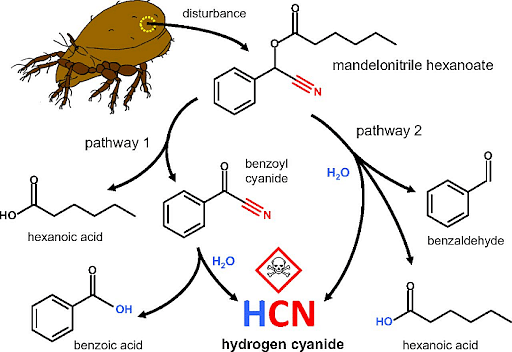
Some cyanides are highly poisonous. Cyanide anion is an inhibitor of the enzyme cytochrome c oxidase, the fourth complex of the electron transport chain located in the inner membrane of eukaryotic mitochondria. Within this protein, it binds to the iron. Hydrogen cyanide is the most toxic compound which is a gas that kills by inhalation.
- The person performing with hydrogen cyanide should always wear the external oxygen respirator supply.
- Cyanide binding to this enzyme inhibits the transport of electrons from cytochrome c to oxygen. As a response,
- The electron transport chain is broken, which means that the cell can no longer aerobically generate ATP for energy.
- Tissues that are strongly dependent on aerobic respiration, such as the central nervous system and the heart, are mainly affected.
Toxicity of Cyanide
Antidote for Cyanide
[Click Here for Sample Questions]
Following are the antidotes for cyanide:
- Hydroxocobalamin interacts with cyanide to create cyanocobalamin so that the kidneys can safely remove them.
- This approach prevents methaemoglobin formation. This antidote package is sold under the brand name Cyanokit and licensed by the U.S. FDA in 2006.
- The antidote produces a large pool of ferric iron (Fe3+) to compete with cytochrome a3 for cyanide (so that cyanide will bind to it rather than the enzyme).
- Nitrites oxidize haemoglobin to methaemoglobin that competes with cytochrome oxidase for the cyanide ion. The mechanism important for eliminating cyanide from the body is the enzymatic conversion of the mitochondrial enzyme rhodanese to thiocyanate.
- Thiocyanate is a comparatively non-toxic molecule that excretes from the kidneys. To accelerate this detoxification, sodium thiosulfate administration is necessary to supply the Rhodanese sulphur donor required to generate thiocyanate.
Uses of Cyanide
[Click Here for Sample Questions]
Following are the Uses of Cyanide:
Medical Uses:Following are the Medical Uses of Cyanide:
- The compound of cyanide sodium nitroprusside is used in clinical chemistry to measure urine ketone bodies, primarily to diagnose diabetic patients.
- Occasionally used in situations of medical emergencies to produce a rapid decrease in blood pressure in humans.
- Used as a vasodilator in vascular research.
- The cobalt present in artificial vitamin B-12 comprises a cyanide ligand as an artifact of the purification process, and this must be removed by the body before the vitamin molecule is activated for biochemical use.
- The copper cyanide compound was briefly used by Japanese physicians to treat leprosy and tuberculosis during World War I.
Pest Control Uses: Following are the Pest Control Uses of Cyanide:
- M44 cyanide devices are used in the U.S. to kill coyotes, including other canids.
- It is used for pest control in New Zealand, specifically for possums, which is an introduced marsupial that threatens the conservation of native species and spreads tuberculosis amongst cattle.
- Possums may become bait shy, but the use of the pellets containing the cyanide reduces bait shyness.
Formulas of Cyanide
[Click Here for Sample Questions]
Following are the Formulas of Cyanide:
- Hydrogen Cyanide: The formula for hydrogen cyanide is HCN. It's a colourless, very deadly, and combustible liquid that boils at 25.6°C (78.1°F), a little above room temperature.
- Sodium Cyanide: NaCN compound name is the formula for sodium cyanide is. The toxic chemical sodium cyanide (NaCN) has the formula NaCN. It's a water-soluble white solid. NaCN + H2SO4 → HCN + NaHSO4
- Calcium Cyanide: The formula for Calcium cyanide is Ca (CN)2 that is the calcium salt of hydrocyanic acid.
- Ammonium Cyanide: The inorganic compound ammonium cyanide (NH4CN) is an unstable inorganic chemical.
- Silver Cyanide: The chemical molecule AgCN stands for silver cyanide. It's a white solid that forms when Ag+ containing solutions are treated with cyanide, which is used to recover silver from solution in some systems.
Things to Remember
Following are some important points:
- A medium of chemical that contains the C ≡ N group is known as Cyanide.
- Organic compounds that contain a – C ≡ N functional group are referred to as nitriles.
- Certain fungi, algae, and bacteria produces cyanides.
- The person performing with hydrogen cyanide should always wear the external oxygen respirator supply.
- Cyanides are found in various plants.
Also Read:
Sample Questions
Ques: Can we touch Cyanides? (1 mark)
Ans: Cyanides are acute poisonous. It can cause skin reactions known as cyanide rash. It can cause itching, vesiculation and disruption of the skin and various other cases to the skin.
Ques: Is Cyanide drinkable? (1 mark)
Ans: No, Cyanides are not drinkable as they can cause food poisoning and various health issues. It can harm our body if we drink or eat it, especially in a poorly ventilated space.
Ques: What would happen if anybody drank or eat cyanides? (1 mark)
Ans: If anybody drank or eat cyanides, his/her skin would unusually turn pink or cherry red as the oxygen will stay in the blood and not get into the cells. Heartbeat would get slow or fast and the person may also breathe very fast.
Ques:Can anyone become immune to cyanide? (1 mark)
Ans: Yes, it is normally said that the body can develop a natural immunity or tolerance to some very toxic substances such as cyanides by administering very small doses of it over a period of time.
Ques: Are there any precautions if cyanide gets into anybody’s eyes? (1 mark)
Ans: Yes, If the poison gets into anybody’s eye, they have to use cool or lukewarm water to gently flush it out. It would provide relief to the victim, and it is the best precaution if cyanide gets into anybody’s eyes.
For Latest Updates on Upcoming Board Exams, Click Here: https://t.me/class_10_12_board_updates
Check-Out:



Comments