



Content Curator
Prawn refers to a group of tiny aquatic crustaceans, some of which are edible, that have 10 legs and an exoskeleton. It is a member of the order decapoda,particularly those with commercial significance in the fishing sector, are referred to as "prawns”
| Table of Contents |
Key Terms: Prawn, Scientific name, Hierarchy, Arthopoda, Zoological Terminology
What are Prawns?
[Click Here for Previous Year Questions]
Prawn refers to a group of tiny aquatic crustaceans, some of which are edible, that have 10 legs and an exoskeleton. In order to develop, prawns must regularly lose their shells, a process known as moulting. Protein, calcium carbonate, and chitin make up the shell (a substance that resembles the protein in human hair and nails).
Prior to shedding, the prawn increases water intake to create a gap between the body and the new shell and reabsorbs the majority of the protein and chitin from the old shell while the new one builds below.
The carapace (the shell enclosing the body region) and tail of the soft-shelled shrimp split apart to allow the prawn to exit the old shell. The prawn expands into the newly formed shell as it hardens.
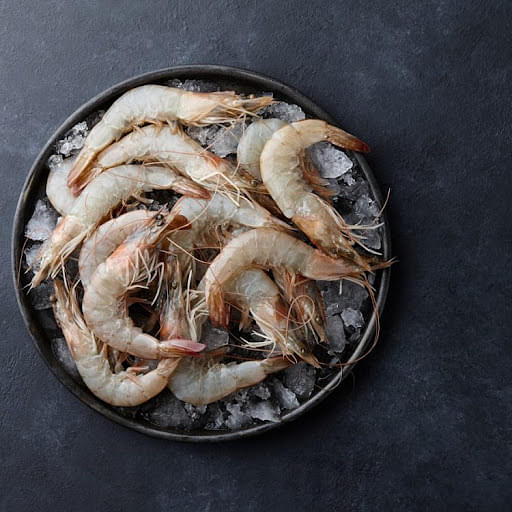
Prawns
Also read: Invertebrates
Scientific Name of Prawns
[Click Here for Sample Questions]
The scientific name of the common prawn is Dendrobranchiata.
- Animals called prawns fall within the phylum Arthropoda and class Malacostraca.
- They are also among the more ancient species, with fossil evidence going back to the Devonian era, or around 400 million years ago.
- Members typically weigh between 0.3 and 0.4 kilos and reach lengths of 12 to 13 inches.
What do Prawns eat?
Plant materials, decomposing organic matter, microorganisms, tiny shellfish, and worms are all food sources for prawns. Due to their sensitivity to light, king prawns bury themselves during the day.Most of the time, tiger prawns are active.
What is the habitat and distribution of Prawns?
King, tiger, and banana prawns are found in coastal waters close to the coastline. Both tiger and banana prawns are found mostly in northern regions; tiger prawns may be found from Exmouth northwards.
All of Western Australia's coastline is home to king prawns. Estuaries like the Swan River are home to them as well. From Perth southward, estuaries are home to school prawns.
Learn More About:
Taxonomy of Prawns
[Click Here for Previous Year Questions]
Biology defines the class of prawns as Class Malacostraca in taxonomy.The following are the taxonomic classifications :-
| Classification | |
|---|---|
| Kingdom | Animalia |
| Phylum | Arthropoda |
| Order | Decapoda |
| Family | Palaemonidae |
| Class | Malacostraca |
| Subphylum | Crustacea |
Different Species of Prawns
[Click Here for Sample Questions]
There are a lot of different kind of species of prawns:
- This subspecies is known scientifically as Macrobrachium rosenbergii. Both subtropical and tropical oceans contain it.
- There are Macrobrachium rosenbergii species all throughout the Indo-Pacific. Some of these subspecies do, however, exist at saltwater river mouths, despite the fact that most of them are freshwater dwellers.

Macrobrachium rosenbergii
- In Pakistan, India, and Bangladesh, you may find the Palaemon prawn in ponds, rivers, and streams.
- In the 15th century, the term "prawn" was first used in England. During that time, the animal was referred to as prane, prayne, or praine.
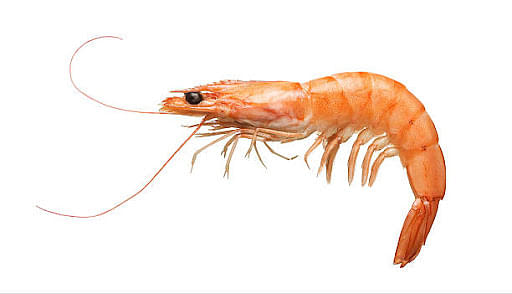
Shrimp
- Today, Ireland and the United Kingdom are the two countries that use the phrases "shrimp" and "prawn fish" most frequently.
- Prawns come in a variety of popular varieties, including Crevettes, Langoustine, Tiger Prawns, Easy-Peel Prawns, Brown Shrimp, and Cocktail Prawns.
Behavior and Appearance of Prawns
[Click Here for Previous Year Questions]
Prawns may be found in a range of hues, including as pink, white, black, and grey.
- A Palaemon prawn is between six and eight inches long when completely developed. When caught, the fish has a light blue colour. It has a cylindrical and elongated body.
- The colour of a prawn can vary depending on the situation. The pigment in their epidermis, which is located just beneath their shell, allows them to accomplish this.
- The cells in their skin let them change colours, turning blue, yellow, and brown. What colour they change depends on how many of such cells are present in their body.
- Deepwater prawns develop brilliant red or even spots as a result of the cells, as opposed to school prawns who have pale spots.
- Deepwater prawns exhibit brilliant reddish coloration as a result of their oceanic habitat. They seem black because the colour is hidden from view. As a consequence, predators will have a harder difficulty spotting them.
Also Check:
Things to Remember
- The scientific name of the common prawn is Dendrobranchiata.
- King, tiger, and banana prawns are found in coastal waters close to the coastline.
- "Prawn" refers to a group of tiny aquatic crustaceans, some of which are edible, that have 10 legs and an exoskeleton.
- Biology defines the class of prawns as Class Malacostraca in taxonomy.
Sample Questions
Ques. What is the scientific name for a Prawn? (1 mark)
Ans. The scientific name of the common prawn is Dendrobranchiata.
Ques. What group prawn belongs to? (1 mark)
Ans. The term "prawn" refers to a group of tiny aquatic crustaceans, some of which are edible, that have 10 legs and an exoskeleton.It is a member of the order decapoda.
Ques.What is the scientific name of Tiger Prawn? (1 mark)
Ans. The scientific name of the common prawn is Penaeus Monodon.
Ques.What are prawns? (2 marks)
Ans. Invertebrates called prawns inhabit the silt and come to the surface to eat, shed their skin, and reproduce. These aquatic crustaceans feature multiple pairs of head appendages in addition to a head, tail, five pairs of walking legs, or pereopods, and five pairs of swimming legs, or pleopods.
Ques.What is the Phylum Class Order Family of Prawn? (2 marks)
Ans. The prawn is a member of the class Malacostraca and phylum Arthropoda. It is well known as a tasty and nourishing dish. The prawn is a member of the Malacostraca class and of the phylum Arthropoda.
Ques. What do prawns eat? (5 marks)
Ans. The greatest Phylum in the animal kingdom is this one. In the animal kingdom, the phylum Arthropoda is home to over 80% of all animal species. They are triploblastic, bilaterally symmetric coelomate creatures.
It is separated into the head, thorax, and abdomen, which are three separate components. A cephalothorax is a condition where the head and thorax are fused together. They have a segmented body on the exterior.
Ques.What do prawns eat? (2 marks)
Ans. Plant materials, decomposing organic matter, microorganisms, tiny shellfish, and worms are all food sources for prawns. Due to their sensitivity to light, king prawns bury themselves during the day.Most of the time, tiger prawns are active.
Ques. What is a baby prawn called? (1 mark)
Ans. A baby prawn is called a galmo.
Ques.Are prawns classified as fish ? (1 mark)
Ans. Prawns are not fish, though. They are categorised as arthropods and are crustaceans.
Ques. What is the taxonomy of Pigeons? (2 marks)
Ans. Biology defines class of birds as Class Aves in Linnaean taxonomy.Aves belong to the group Theropoda according to phylogenetic classification.It belongs to Chordata phylum.
Also check:



Comments