



Education Journalist | Study Abroad Lead
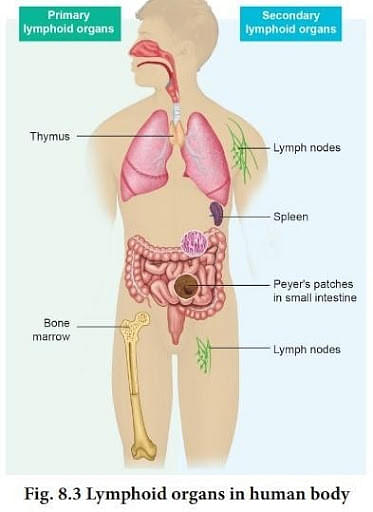
Lymph fluids are formed when the interstitial fluid is collected through tiny lymph capillaries located throughout the body. The fluids are then transported throughout the human body through the lymph vessels to the lymph nodes. The lymph nodes clear and filter lymph fluids. Within this system lies primary and secondary lymphoid organs.
Read Also: Transportation in Human Beings
| Table of Content |
Key Terms: Lymph Nodes, Lymphoid Organs, Lymphatic System, Circulation, Lymphocytes, Immune System, Lymph fluids, T cells, B cells, Stem cells
Primary Lymphoid Organs
[Click Here for Sample Questions]
They are the centers of the immune system where lymphocyte development and maturation occur i.e., they are responsible for lymphocyte proliferation, differentiation, and maturation. Therefore, the initial cells in the primary lymphoid organs are the undifferentiated stem cells in the lymphoid. The stem cells grow into either T Cells or B Cells in the environment provided by such sites.
For example, lymphoid stem cells proliferate and differentiate in the bone marrow which is a kind of primary lymphoid organ. These stem cells are differentiated into both T lymphocytes and B lymphocytes in the bone marrow. The T Cells then travel through the blood to the thymus, which is another primary lymphoid organ, where they mature. But the maturation of the B Cells happen in the bone marrow itself.

Check Important Notes for Open and Closed Circulatory System
Secondary Lymphoid Organs
[Click Here for Sample Questions]
They are the locations of the immune system, where lymphocytes are functionally specialized by allowing them to come into contact with different antigens. Hence, secondary lymphoid organs form an array of filters to collect antigens, which always track the contents of the extracellular fluid including blood, tissue fluid, and lymph.
Examples of secondary lymphoid organs: lymph nodes, tonsils, spleen, Peyer's patches, mucosa-associated lymphoid tissue (MALT), etc.
The lymphoid tissue is encapsulated by about 100 - 200 lymph nodes. Focusing mostly on the thorax, abdomen, and pelvis, they have lymphocytes T and B, as well as antigen-capture macrophages. MALT also filers the fluid in tissues. Mucosa-associated lymphoid tissue is about 1 mm in diameter. This exists mostly in the digestive tract, oral passage, nasopharyngeal tract, thyroid, breast, lung, salivary glands, hair, and skin. Often, tonsils, Peyer's spots, and appendix are MALT cases. All of the above discussed secondary lymphoid organs contain T and B lymphocytes as well as antigen-capture macrophages.
Similarities Between Primary and Secondary Lymphoid Organs
[Click Here for Sample Questions]
- Both of them assist the immune system.
- Both of them provide a stationary structure for producing, maturing, and interacting migratory immune cells with antigens.
Check Also: Microbiology
Differences Between Primary and Secondary Lymphoid Organs
[Click Here for Sample Questions]
| Primary Lymphoid Organs | Secondary Lymphoid Organs |
|---|---|
| Organs of the immune system in which lymphocytes are made and where they mature. | Organs of the immune system in which naïve mature lymphocytes are sustained and adaptive immune response begin. |
| They proliferate, differentiate, and mature lymphoid stem cells. | They make lymphoid cells functional. |
| They contain either T Cells or B Cells. | They contain both T Cells and B Cells. |
| They have no contact with antigens. | They have contact with antigens. |
| They undergo atrophy with age. | They increase in size with age. |
Check Also: Antigen and Antibody
Things to Remember
[Click Here for Sample Questions]
- Lymph fluids are formed when the interstitial fluid is collected through tiny lymph capillaries located throughout the body.
- Lymph fluids are transported throughout the human body through the lymph vessels to the lymph nodes.
- The lymph nodes clear and filter lymph fluids.
- Primary lymphoid organs are the centers of the immune system where lymphocyte development and maturation occur i.e., they are responsible for lymphocyte proliferation, differentiation, and maturation.
- The initial cells in the primary lymphoid organs are the undifferentiated stem cells in the lymphoids. The stem cells grow into either T Cells or B Cells in the environment provided by such sites.
- Secondary lymphoid organs are the locations of the immune system where lymphocytes are functionally specialized by allowing them to come into contact with different antigens.
- Secondary lymphoid organs form an array of filters to collect antigens, which always track the contents of the extracellular fluid including blood, tissue fluid, and lymph.
Also Read:
Sample Questions
Ques. What is the largest lymphoid organ? (2 Marks)
Ans. The largest lymphoid organ is the spleen. It is located on the left side of the ribs and above the stomach.
Ques. What organ has the most lymphoid tissue? (3 Marks)
Ans. The most highly organized lymphoid tissues are found in the thymus and lymph nodes – both well-defined encapsulated organs with easily identifiable architectures. In the spleen, the lymphoid tissue is a cylinder of loosely organized cells surrounding small arteries.
Ques. How do secondary lymphoid organs develop? (3 Marks)
Ans. Secondary lymphoid organs develop during the early postnatal period. This process happens independently of antigen or pathogen recognition at predetermined sites throughout the body as a result of complex interactions between various hematopoietic, mesenchymal and endothelial cells.
Ques. Which organ produces immune cells? (3 Marks)
Ans. All the cells of the human immune system are produced by the bone marrow from a common starting cell called the stem cell. These stem cells later develop into various cell types like red blood cells, platelets (important for blood clotting), and white blood cells (important for immune responses).
Ques. What are the differences between primary lymphoid organs and secondary lymphoid organs? (5 Marks)
Ans. Although the primary and secondary lymphoid organs share similarities, they also have certain differences. They are listed in the table below.
| Primary Lymphoid Organs | Secondary Lymphoid Organs |
|---|---|
| Organs of the immune system in which lymphocytes are made and where they mature. | Organs of the immune system in which naïve mature lymphocytes are sustained and adaptive immune response begin. |
| They proliferate, differentiate, and mature lymphoid stem cells. | They make lymphoid cells functional. |
| They contain either T Cells or B Cells. | They contain both T Cells and B Cells. |
| They have no contact with antigens. | They have contact with antigens. |
| They undergo atrophy with age. | They increase in size with age. |
Ques. What is the most important role of the lymphoid organs? (3 Marks)
Ans. The most important function of the lymphoid organs is to filter and trap invading pathogens and present them to immune-competent cells. The secondary lymphoid organs provide the site for interaction of lymphocytes with the antigen, which then proliferates to become effector cells.
Ques. Which blood cells are related to immunity? (3 Marks)
Ans. White blood cells are the key players in the immune system. They are created in the bone marrow and are part of the lymphatic system. White blood cells move through blood, looking for foreign invaders (microbes) such as bacteria, viruses, parasites, and fungi.
Ques. Which lymphocytes mature in the thymus? (2 Marks)
Ans. Precursors of the T Cells travel from the bone marrow and mature in the thymus. The process is similar to that of B Cells including the sequential rearrangement of antigen receptor gene segments.
For Latest Updates on Upcoming Board Exams, Click Here: https://t.me/class_10_12_board_updates
Check-Out:



Comments