



Education Journalist | Study Abroad Lead
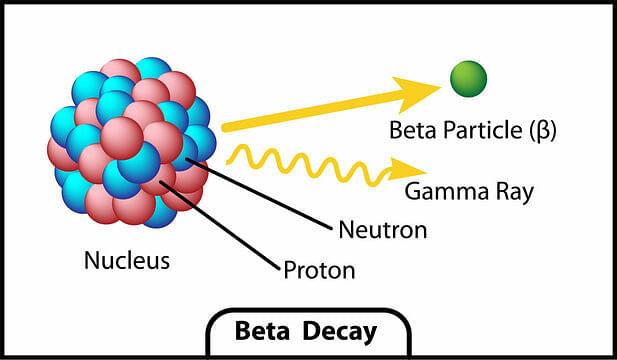
Beta decay is a type of radioactive nuclear decay involving the release of a beta particle, which can be an energetic electron or positron.
- The process converts the initial nuclide into its isobar, maintaining the conservation of mass number and lepton number.
- In beta decay, a neutron transforms into a proton and emits an electron along with an antineutrino.
- Conversely, a proton can decay into a neutron and a positron through beta decay.
- Beta decay is moderated by the weak nuclear force.
- It plays an important role in adjusting the proton-to-neutron ratio for stabilization.
- Unstable atoms undergo beta decay to achieve a more stable configuration.
- The binding energies of nuclides, influenced by beta decay, contribute to the nuclear band.
- Beta decay is an important process in nuclear reactions.
- It impacts the energy states and stability of atomic nuclei.
- It finds applications in nuclear medicine, where it is used for both diagnosis and treatment.
| Table of Content |
Key Terms: Beta Decay, Radioactivity, Electron, Positron, Proton, Nucleus, Atom, Isotopes, Beta-minus decay, Beta-plus decay
Beta Decay
[Click Here for Sample Questions]
Beta decay is a nuclear process where a proton transforms into a neutron or vice versa, within the nucleus of a radioactive sample.
- During beta decay, a beta particle, either an electron or positron, is emitted from the nucleus.
- Positrons are generated to maintain the conservation of charge.
- Beta decay happens through weak interaction.
- It comes in two types: beta-minus decay (\(\beta\)-) and beta-plus decay (\(\beta\)+).
- Beta decay is exhibited by various elements and their isotopes, leading to the creation of artificial isotopes.
- Neutron decay, proton decay, and electron decay are three ways to differentiate beta decay processes.
- The discovery of beta decay dates back to 1934 when Frédéric and Irène Joliot-Curie conducted experiments with alpha particles on aluminium.
- It resulted in an isotope emitting positrons.
- This discovery of artificial radioactivity earned them the Nobel Prize in Chemistry in 1935.
Beta Decay
Radioactivity and Beta Decay
Radioactivity is the spontaneous decay of unstable atomic nuclei. Beta decay is a type of radioactivity in which a neutron decays into a proton and an electron (beta particle), or a proton decays into a neutron and a positron.
- Beta decay conserves mass number and lepton number.
- Beta decay is the process by which unstable atoms obtain a more stable ratio of protons to neutrons.
Beta Decay Types
[Click Here for Sample Questions]
There are two types of radioactive beta decay that includes –
Beta-Minus Decay
Beta Minus decay involves the transformation of a neutron into a proton, leading to an increase in the atomic number of the atom.
- The process includes the production of an electron (e-) and an antineutrino (ν̅) to maintain the conservation of charge.
- Antineutrinos are neutral particles with negligible mass, interacting weakly with matter.
- They can travel the entire Earth without disturbance.
- Applications of beta-minus decay include nuclear medicine and carbon dating.
- The equation N = P + e- + ν̅ signifies the conservation of charge during beta-minus decay.
- The atomic configuration change in beta-minus decay is represented as
AZX → AZ+1 Y +e- +v
Example of beta-minus decay – Transformation of 14C into 14N, usually occurring in neutron-rich nuclei.
In this decay, a neutron transforms into a proton, producing an electron and an antineutrino. The atomic number increases by 1, while the mass number remains constant.
14C → 14N + e- + ν̅ₑ

Beta Minus Decay
Beta-Plus Decay
In beta-plus decay, a proton transforms into a neutron, decreasing the atomic number of the radioactive element.
- This process leads to a loss of a proton and a gain of a neutron in the nucleus.
- To conserve charge, beta-plus decay produces a positron and a neutrino.
- The positron is the antimatter equivalent of an electron.
- The process conserves mass number as a proton and a neutron have the same mass.
- It is the process by which unstable atoms with too many protons obtain a more stable ratio of protons to neutrons.
- It is used in positron emission tomography (PET) to create images of the body's metabolism.
- Beta-plus decay is also known as positron emission.
- The emitted positron can annihilate with surrounding electrons, releasing two gamma rays.
- The equation representing beta-plus decay is
AZX → AZ-1Y + e+ + v
Examples of beta-plus decay
- Fluorine-18 decay: F-18 → O-18 + e⁺ + ν̅ₑ
- Carbon-11 decay: C-11 → B-11 + e⁺ + ν̅ₑ

Beta Plus Decay
Beta Decay Procedure
[Click Here for Sample Questions]
In the process of Beta decay, the proton present inside the nucleus turns into a neutron or the exact opposite thing takes place.
- If a neutron gets converted to a proton, the process is called (\(\beta\)-) beta minus decay.
- If the proton is converted to a neutron, it is known as (\(\beta\)+) beta plus decay.
- Beta particles are emitted due to the change in the nucleus.
- These particles are used to cure health conditions like bone cancer and eye cancer.
- Beta particles are often used as tracers
Also Read: Gamma-ray
Example of Beta Decay
[Click Here for Sample Questions]
The neutron of a carbon atom is converted into a proton and emits a beta particle which is an electron. An example of (\(\beta\)-) decay of C-14 into Nitrogen-14:
146C → 147N + e- + ve
This form of decay is also known as nuclear transmutation. The decaying element is known as parent nuclide and the resulting element is called daughter nuclide.

Beta decay of carbon 14
Electron Capture
Electron capture occurs together with beta-plus decay in certain radioactive processes.
- Instead of emitting a beta particle, in electron capture, a proton absorbs an electron from the K shell, converting the proton into a neutron.
- The equation for electron capture is P = n + e+ + v
- The energy released in electron capture is around 3 MeV, and the emitted particles include a neutrino.
- Beta particles generated in this process can penetrate matter and lose energy through collisions with atoms.
- Energy loss occurs through two mechanisms
- A beta particle passes a fraction of its energy to the collided atom.
- Deflection of the beta particle from its original path contributes to the emission of electromagnetic radiation, such as low-energy x-rays.
Applications of Beta Decay
[Click Here for Sample Questions]
The applications of beta decay are –
- Radionuclide therapy (RNT) in cancer treatment: Elements undergoing beta decay, such as lutetium-177 or yttrium-90, are utilized in treating cancer by destroying cancer cells through emitted beta particles.
- Carbon-14 dating: Beta decay is crucial in determining the age of organic materials, including archaeological artefacts and fossils.
- Medical imaging (PET scans): Beta-emitting isotopes contribute to diagnostic imaging, particularly in positron emission tomography (PET) scans.
- Nuclear power generation: Beta decay is a key process in the energy production of nuclear reactors.
- Particle physics experiments: Beta particles are utilized in various experiments to detect and analyze subatomic particles.
- Stellar nucleosynthesis: Beta decay plays a role in the processes within stars, contributing to the creation of elements.
- Fundamental physics research: The study of beta decay provides insights into the weak nuclear force and fundamental interactions between particles.
- Industrial radiography: Beta-emitting isotopes are applied in radiography for inspecting materials in industrial settings.
Beta Emission in Beta Decay
[Click Here for Sample Questions]
Beta particles emitted in beta decay consist of high-energy, high-speed electrons (e.g., potassium-40).
- Beta particles have greater penetration capability compared to alpha particles, but they are weaker than beta-gamma rays.
- The emitted beta particles are a form of ionizing radiation, commonly referred to as beta emission or beta rays.
Also Read:
Fermi’s Theory of Beta Decay
[Click Here for Sample Questions]
Enrico Fermi proposed the Theory of Beta Decay in 1934, the first successful theory of weak interaction.
- According to Fermi's theory, beta decay involves a four-fermion interaction, occurring at a single vertex.
- This theory provides insights into the continuous energy spectrum of beta particles and the angular distribution relative to neutrinos.
- Fermi's interaction shows the direct coupling of four fermions: a neutron, an electron, a neutrino (or antineutrino), and a proton.
- His work extended to create the world's first nuclear reactor.
Things to Remember
- Beta decay is a radioactive decay in which a neutron decays into a proton and an electron, or a proton decays into a neutron and a positron.
- It is mediated by the weak nuclear force.
- Beta decay is the process by which unstable atoms obtain a more stable ratio of protons to neutrons.
- The energy spectrum of beta particles is continuous.
- Beta decay is a relatively slow process, with half-lives ranging from milliseconds to years.
- Beta-plus decay (proton decay) can be used in positron emission tomography (PET) to create images of the body's metabolism.
Sample Questions
Ques. Give an example of beta plus decay. (2 marks)
Ans. An example can be given of Beta-plus decay of Magnesium-23 into sodium -23:
2312Mg → 2311Na + e+ + ve
Beta decay results in reduction of atomic number and nuclear transmutation.
Ques. How does the beta decay formula represent the transformation of particles in the process? (2 marks)
Ans. The beta decay formula represents the transformation of particles in the process by showing how the mass number, atomic number, and lepton number are conserved. The formula is as follows:
AZX → AZ+1 Y + e- + v
where:
- AZX is the decaying nucleus with mass number A and atomic number Z
- AZ+1 Y is the daughter nucleus with mass number A and atomic number Z+1
- e- is the emitted electron
- v is the emitted antineutrino
The formula shows that the mass number is conserved because the sum of the mass numbers of the parent nucleus and the emitted particles is equal to the mass number of the daughter nucleus.
Ques. Describe the beta decay spectrum. (2 marks)
Ans. The beta decay spectrum is the distribution of beta particle energies in a beta decay reaction.
- Beta decay spectrum is continuous, with a maximum energy equal to the difference in mass between the parent and daughter nuclei, minus the mass of the electron.
- The shape of the spectrum depends on the type of beta decay and the properties of the parent and daughter nuclei.
- For allowed beta decay, the beta decay spectrum is approximately parabolic.
- For forbidden beta decay, the beta decay spectrum is more complex.
Ques. What are the selection rules of beta decay? (3 marks)
Ans. Selection rules in beta decay determine whether a transition is allowed or forbidden.
- Conservation of various quantities guides these rules.
- Mass number, atomic number, angular momentum, parity, and lepton number are conserved in beta decay.
- Allowed transitions adhere to all selection rules.
- They involve specific changes in mass number, atomic number, angular momentum, parity, and lepton number.
- Forbidden transitions violate one or more selection rules.
- They are less likely to occur than allowed transitions.
- Key Selection Rules:
- ΔA = 0 for mass number conservation.
- ΔZ = ±1 for atomic number conservation.
- ΔI = 0, ±1 for angular momentum conservation.
- ΔP = no for parity conservation.
- ΔL = -1 for lepton number conservation.
- Forbidden transitions have a lower probability.
- The probability decreases with the number of violated selection rules.
Ques. What is a Feynman diagram, and how is it related to beta decay? (2 marks)
Ans. Beta decay is a type of radioactive decay in which a neutron decays into a proton and an electron, or a proton decays into a neutron and a positron.
A Feynman diagram for beta decay can be used to show how the particles involved in the decay interact with each other. The diagram can also be used to calculate the probability of the decay and the energy distribution of the emitted particles.
Ques. What symbol is commonly used to represent beta decay in nuclear reactions? (1 mark)
Ans. The symbol commonly used to represent beta decay in nuclear reactions is the Greek letter β.
Ques. What do you mean by beta decay? (1 mark)
Ans. Beta decay in nuclear physics is the decay of a nucleus by emitting an electron or a positron. Beta particles emitted in the process are fast-moving electrons of nuclear origin.
Ques. What is the usage of beta decay? (1 mark)
Ans. Beta decay is very much beneficial in medical science to cure various health problems:
- To treat eye & bone cancer
- used in form of tracers
Ques. What is the law of Conservation in Beta decay? (1 mark)
Ans. In radioactivity beta decay, the law of conservation takes place. To maintain balance in the charges inside a nucleus, when a parent nucleus decays it forms a daughter nucleus to follow the law of conservation.
Ques. What do you mean by Beta particles in Beta decay? (1 mark)
Ans. Beta particles are the emitted charged particles which flow from the nucleus of a certain radioactive element during the beta decay procedure which has mass equal to 1/1837 in comparison to the mass of protons. These particles carry a single negative (electron) or a single positive (positron) charge.
Ques. (a) Write the basic process involved in nuclei responsible for: \(\beta\)- and \(\beta\)+ decay
(b) Why is it found experimentally difficult to detect neutrinos? (2015)
Ans. (a) \(\beta\)- decay = 10n11P+0+1 \(\beta\)+v
\(\beta\)+ decay = 11P10n+0+1\(\beta\)+v
(b) It is difficult to detect neutrinos in nuclear \(\beta\)-decay because they are considered chargeless containing very little mass particles that rarely interact with matter.
Ques. Why is it found experimentally difficult to detect neutrinos in nuclear \(\beta\)-decay? (2014)
Ans. It is difficult to detect neutrinos in nuclear \(\beta\)-decay because they are considered chargeless containing very little mass particles that rarely interact with matter.
Ques. In both \(\beta\)- and \(\beta\)+ decay processes the mass number of a nucleus remains same whereas the atomic number Z increases by one in\(\beta\)- decay and decreases by one in \(\beta\)+ decay. Explain giving reasons. (2014)
Ans. On case of \(\beta\)-decay , a \(\beta\) having zero mass and -1 charge is exerted. The decay process can be observed through:
Since the \(\beta\)-particle has negligible small mass, there is no change in the mass number of the nucleus and there is an increase in the atomic number by 1 as a result of the loss of 1 negative charge.
In the same manner for a \(\beta\)-decay, a \(\beta\) particle exerts an extremely small +1 charge. The decay process can be expressed as: 
There is no change in the mass number but in this case, there is a decrease in the atomic number by 1 as a result of the loss of 1 positive charge.
Ques. A nucleus undergoes \(\beta\)--decay. How do its (i) mass number (ii) atomic number change? (2011)
Ans. When a nucleus undergoes \(\beta\)--decay:
(i) There is no change in the mass number.
(ii) There is an increase in the atomic number by one unit.
Ques. A nucleus 2310Neundergoes \(\beta\)-decays and becomes 2311Na. Calculate the maximum kinetic energy of emitted electrons assuming that the daughter nucleus and antineutrino carry negligible kinetic energy. (2008)
Mass of 2310Ne = 22.994466 u
Mass of 2311Na = 22.989770 u
Lu = 931 MeV/c2
Ans. The equation that represents \(\beta\)- decay of 2310Ne is 2310Ne 2311Na+\(\beta\)-+v+Q
Where Q is considered as the kinetic energy shared by 2310Ne and 2311Na ignoring the other part of the mass of antineutrino (v) and electron.
Mass defect \(\Delta\)m = m(2310Ne) - m(2311Na) - m(\(\beta\)-) = (22.994466 - 22.989770) = 0.004696 u
Therefore Q = 0.004696*931 MeV = 4.372 MeV
Hence K.E. of \(\beta\)- = 4.372 MeV when (v) carries the energy and is 0.
For Latest Updates on Upcoming Board Exams, Click Here: https://t.me/class_10_12_board_updates
Check-Out:



Comments