



Education Journalist | Study Abroad Lead
Radioactivity is a process in which a heavy nucleus disintegrates into small nuclei to achieve stability. This process was first discovered by A.H Becquerel purely by accident. Subsequent studies found that radioactivity is a nuclear phenomenon and involves the decaying of nuclei. Today, there are 40 elements in the periodic table that are radioactive in nature. There are mainly three types of radioactive decay which are alpha decay, beta decay, and gamma decay. Alpha and beta decays are independent but gamma decay accompanies alpha and beta decay. The unstable nucleus can even decay multiple times until it comes to a stable state. This is called the decay chain. In this article, we will have a look at radioactivity gamma decay, its sources, and applications.
| Table of Content |
Key takeaways: Radioactivity, alpha-decay, beta decay, gamma decay, radioactive particles, sources of gamma rays, applications of gamma rays, pair production, nucleus, radiation
What is Radioactivity?
[Click Here for Sample Questions]
Radioactivity is a phenomenon where a highly unstable nucleus disintegrates into a stable nucleus by the emission of some particles. Several elements in the periodic table are radioactive in nature. According to quantum theory, it is impossible to predict when an atom will undergo radioactive decay. There are mainly three types of radioactive decay which are alpha decay (α-decay), beta decay (β-decay), gamma decay (γ-decay). In all these decay processes more than one particle is emitted. As the gamma decay is accompanied by alpha and beta decay, let us learn about the first two decays.
Also Read:
| Related Articles | ||
|---|---|---|
| Nuclear Force | Binding Energy | Nuclear Energy |
| Nuclear Physics | Nuclear reactor based on nuclear fission | Nucleon |
Alpha decay
[Click Here for Sample Questions]
The alpha particle is actually the nucleus of the helium-4 atom. It carries a double positive charge. When a nucleus becomes stable after rejecting an alpha particle, it undergoes alpha decay. The mass number of the parent atom is reduced by four and the atomic number is reduced by two. Alpha decay mainly occurs in heavy nuclides. The general equation of alpha decay is given below:
\(^{A}_{Z}X \rightarrow ^{A-4}_{Z-2}Y +^{4}_{2}He\)
\(Q=(m_{_{x}}-m_{y}-m_{He}) c^{2}\)
Here, X is the parent nucleus
A is the total number of nucleons
Z is the total number of protons
Y is the daughter nucleus formed after alpha decay
Q here is the disintegration energy that is released and its value is the difference between initial mass-energy and final mass-energy of the decayed particles.
Do you know - The Chernobyl nuclear plant disaster was one of the most disastrous events in human history. Today, 27 years after the disaster, still people do countermeasures to mitigate its impact of it.
Beta-decay
[Click Here for Sample Questions]
Beta-decay involved the emission of beta particles from a nucleus, transforming the original nuclide to its isobar. In beta decay, a nucleus emits an electron( (β − decay) or a positron (β+ decay). Beta-decay of a neutron transforms it into a proton by the emission of an electron and an antineutrino or a proton is converted into a neutron by the emission of a positron and a neutrino. Neither the beta particles nor the neutrino exists in the nucleus before the decay process. They are formed during decay.
An example of beta decay is the decay of Carbon-11 to Boron-11 by the emission of positron and neutrino.
\(^{11}_{6}C \rightarrow ^{11}_{5}B + e^{+} + v^{{Q_{\beta +}= 0.97 MeV}}_{{t_{\frac{1}{2}}=20.4 min}}\)
The basic nuclear process under β − decay is –
\(n\rightarrow p+e^{-} + \bar{v}\)
The basic nuclear process under β+ decay is –
\(p\rightarrow n+e^{+} + v\)
Gamma decay
[Click Here for Sample Questions]
Gamma decay is the emission of electromagnetic radiation of high frequency releasing enough energy to stabilize the nucleus. It exhibits two internal processes also, that is internal conversion and pair production. In internal conversion, the excess energy of a nucleus is transferred to its outer shell orbiting electron leading to its emission. In pair production, the excess energy of the nucleus is directly converted into a pair of electrons and a positron which are emitted together. Gamma decay doesn’t normally occur on its own but the unstable nucleus that undergoes gamma decay must be a product of alpha or beta decay or any other radioactive processes. The gamma rays are of very high frequency comparable to that of X-rays. The gamma rays are found to be more penetrating than X-rays.
The gamma decay of Barium-137
\(^{137}_{56}Ba \rightarrow ^{137}_{56}Ba + ^{0}_{0}\gamma \)
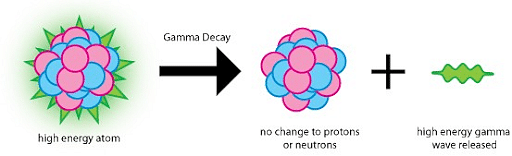
Gamma Decay
Natural Sources of gamma rays
[Click Here for Sample Questions]
In nature, gamma rays are mostly found as a result of gamma decay or due to the intervention of cosmic rays in the earth’s atmosphere. Mostly heavenly bodies from outer space are the major sources of gamma rays.
- For example, the pulsars, quasars, black holes, distant galaxies, etc emit radiations of gamma rays.
- On Earth, they are generated by a lightning strike, nuclear explosions, etc.
Gamma rays are highly penetrable and can cause damage at the cellular level and serious diseases to the human body.
Applications of gamma rays
[Click Here for Sample Questions]
The applications of gamma rays are:
- It is used in chemotherapy. Gamma rays are used to treat cancer, tumors and also sterilize medical equipment.
- Earlier, an x-ray or gamma-ray was used to see the morphological structure of internal organs.
- Gamma rays are used as an external beam in particle accelerators.
- Gamma signals from space are used to locate different galaxies and stars by astronomers.
- Gamma rays are used in the nuclear industry for research and development purposes.

Therapeutic Application of Gamma Rays
Also Read:
Things to remember
[Click Here for Sample Questions]
- Radioactivity is a process in which a heavy nucleus disintegrates into small nuclei to achieve stability.
- Radioactivity is a nuclear phenomenon and involves the decaying of nuclei.
- There are mainly three types of radioactive decay which are alpha decay, beta decay, and gamma decay.
- Alpha and beta decays are independent but gamma decay accompanies alpha and beta decay.
- Gamma decay is the emission of electromagnetic radiation of high frequency releasing enough energy to stabilize the nucleus.
- The gamma-rays are of very high frequency comparable to that of X-rays.
- In nature, gamma rays are mostly found as a result of gamma decay or due to the intervention of cosmic rays in the earth’s atmosphere.
- Gamma rays are used as an external beam in particle accelerators.
Sample Questions
Ques. What is radioactivity? (3 marks)
Ans. Radioactivity is a phenomenon where heavy unstable nuclei disintegrate into smaller nuclei with the emission of some radioactive particles. A.H Becquerel was the first scientist to observe radioactivity when he was experimenting with the fluorescence of elements. Any material that is unstable and can potentially disintegrate is considered radioactive. According to quantum theory, it is impossible to predict when the unstable nucleus will disintegrate.
Ques. Explain what happens during alpha decay. (3 marks)
Ans. Alpha decay mainly occurs in heavy nuclides when they become stable after emitting an alpha particle (helium nucleus) and hence decays into some smaller stable nuclei. The nucleus which is heavier than nickel-28 has a greater chance of undergoing alpha decay. They may also undergo multiple alpha decay if the daughter nucleus is also unstable. This is called chain decay. Examples of particles undergoing alpha decay - Radium, uranium, thorium, etc.
Ques. What are the types of radioactive decay? (3 marks)
Ans. There are mainly three types of radioactive decay-
- Alpha decay - When a nucleus becomes stable after emitting a He +2 nucleus, it undergoes alpha decay.
- Beta-decay - There are two types of beta decay - in one decay, it produced an electron an antineutrino and in the other, it produces a positron and a neutrino.
- Gamma decay - It is the emission of high-energy photons from the unstable nucleus. It occurs after alpha or beta decay.
Ques. What is emitted in gamma rays? (3 marks)
Ans. Gamma rays consist of highly energetic photons which are emitted from an unstable nucleus. Gamma rays consist of high-energy electromagnetic radiation. During the gamma decay, the atomic number and mass number remain the same. It is mainly found in astronomical explosions and other heavenly bodies such as black holes, quasars, galaxies, etc.
Ques. What is the speed of gamma rays? (3 marks)
Ans. A highly unstable nucleus after undergoing alpha decay or beta decay produces a smaller nucleus which is also sometimes unstable. This unstable nucleus undergoes gamma decay and produces gamma rays. Gamma rays are nothing but high-energy electromagnetic radiation (photons) which travel with the speed of light (3 x 10^8 m/s). They are highly penetrating and thus harmful to human skin.
Ques. Give some uses of gamma rays. (5 marks)
Ans. Some uses of gamma rays are:
- Gamma rays are used in gamma-ray sensors which are used in food packaging.
- Gamma rays are used to cure some types of cancer cells.
- Gamma rays are used as an external beam in particle accelerators.
- Gamma signals from space are used to locate different galaxies and stars by astronomers.
- Gamma rays are used in the nuclear industry for research and development purposes.
Ques. Explain what happens during a gamma decay. (5 marks)
Ans. Like an atom, a nucleus also has discrete energy levels - the ground state and excited states. The scale of energy is, however, very different. Atomic energy level spacings are very low, near to the order of eV, while the nuclear energy levels differ by the order of MeV. When a
nucleus gets into an excited state spontaneously decays to its ground state (or to a lower energy state), a photon is emitted with energy equal to the difference in the two energy levels of the nucleus. This is called gamma decay. The energy (MeV) corresponds to radiation of an extremely high frequency, more than the X-ray region.
A gamma-ray is emitted when an α or β decay results in a daughter nucleus in an unstable state. This then returns to the ground state by a single photon transition or successive transitions that involve more than one photon.
Ques. What are the sources of gamma radiation? (5 marks)
Ans. Gamma rays are produced by the hottest and most energetic objects in the universe. Gamma rays are mostly radiated from heavenly bodies such as quasars, supernovas, black holes, distant galaxies, These rays help in calculating the distance of other planets and stars from earth. It is also created on earth during lightning or nuclear explosions.
Gamma rays are produced when the cosmic rays from space come in contact with the ions present in the atmosphere. When gamma rays reflect after colliding with different elements it emits unique identifiable signatures in form of gamma rays. This property is used by scientists to know about elements on different planets.
For Latest Updates on Upcoming Board Exams, Click Here: https://t.me/class_10_12_board_updates
Check-Out:



Comments