



Education Journalist | Study Abroad Lead
Reflex Action is a kind of quick response made by our body to a stimulus, involuntarily and without any conscious thought. It happens rapidly and suddenly and is our body’s way of automatically trying to protect itself from harm. Examples include suddenly drawing our hands away from a hot surface, or involuntarily closing our eyes when a bright light is shined on them. These actions take place without us having to think about it. Reflex actions are very important for our body and require different parts of our nervous system to function.
| Table of Contents |
Key Terms: Reflex Action, Spinal Cord, Neurons, Stimulus, Response, Reflex Arc, Nervous System, Brain
What is a Reflex Action?
[Click Here for Sample Questions]
A reflex action can be defined as a sudden involuntary response made by our body in response to stimuli. It is our body’s automatic attempt to protect itself from harm. It occurs without any conscious effort or thought. The pathway through which a reflex action takes place is known as a reflex arc. It consists of different parts of the nervous system.

Reflex Action
Reflex Arc
[Click Here for Sample Questions]
The pathway that controls reflex actions is known as the reflex arc. It primarily consists of two components, the receptor and the effector. Reflex arcs can be of two types; automatic, which affects our internal organs, and somatic, which affects our muscles. They are formed in the spinal cord, and consist of the following parts-
- Receptor: This is the part of the reflex arc that is responsible for detecting a stimulus. It is connected to a sensory organ, which receives the stimulus, and is highly sensitive to responding.
- Effector: It is the part of the body that acts out the reflex action. It could be muscles or glands, and they execute the response by neuromuscular movements.
- Sensory Neuron: This is the neuron that conveys the stimulus to the spinal cord so that a reflex action can take place. It is also called an afferent neuron.
- Motor Neuron: This neuron conveys the commands related to movement to the respective effector organs. It is also referred to as an efferent neuron.
- Interneuron: The interneuron is like a midpoint between the sensory neuron and the motor neuron. It passes the impulse from the sensory neuron to the motor neuron. It is also called a relay neuron.
- Spinal Cord: This is the part of the nervous system that interprets the stimulus and gives an appropriate command to the motor neurons. It controls the reflex action.
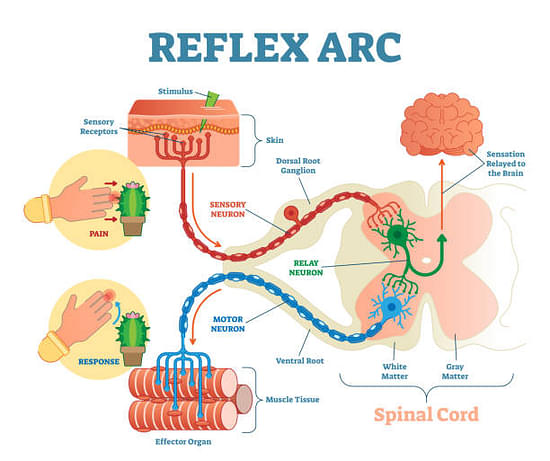
Reflex Arc
Read More: Types of Reflexes
Mechanism of Reflex Action
[Click Here for Sample Questions]
The reflex arc consists of the effector, receptor, spinal cord, and motor and sensory neurons. A reflex action starts with the receptor organ detecting some kind of stimulus and it is recognized by the sensory organ. This is then passed by the sensory neuron, onto the motor neuron through the interneuron. Once this signal is received by the motor neuron, it conveys the impulse to the effector organ, which responds by a sudden movement or reaction, which we call reflex action.
Importance of a Reflex Action
[Click Here for Sample Questions]
Reflex actions are important because they help protect our bodies from possible harm. They also avoid overloading the brain by giving an immediate response.
Read More: Conduction of Nerve Impulse
Examples of Reflex Actions
[Click Here for Sample Questions]
Some important examples of reflex actions are:
- Withdrawing our hand when near a hot object.
- Closing our eyes when a bright line is shined into it.
- Sneezing.
- Knee jerk reflex.
- Raising our hands in defense when an insect or object is coming toward us.
Read More: Neural Control and Coordination
Things to Remember
- A reflex action is an immediate and involuntary response to stimuli. It is carried out with much conscious thought or effort.
- A reflex action is carried by the pathway of a reflex arc. A reflex arc is formed in the spinal cord and happens with the help of various parts of the nervous system.
- A reflex action also involves sensory neurons, motor neurons, effectors, receptors, interneurons, and sensory organs.
- A stimulus once detected by the receptor is passed on through the sensory organs and sensory neurons to the spinal cord.
- The spinal cord interprets the stimulus and sends a response to the motor neurons and the appropriate effector organs.
Sample Questions
Ques. What is a receptor and effector in reflex action? (3 Marks)
Ans. The receptor is the part of a reflex action which detects a stimulus and then passes on that information through the sensory organ.
Effector cells are the part of the body that acts in response to stimuli. The muscles and glands are examples of effectors.
Ques. (a) Differentiate between afferent and efferent neurons?
(b) What is an interneuron? (3 Marks)
Ans. (a) Afferent neurons are those which convey the detection of stimulus to the spinal cord. On the other hand, efferent neurons are those which convey the motor response to the effector organs.
(b) An interneuron is a neuron that passes a signal from the sensory neuron to the motor neuron. It is also called a relay neuron.
Ques. What is the mechanism of a reflex action? (3 Marks)
Ans. First, the receptor cells detect stimuli from the surroundings. It is then recognized by the sensory organ. This information is then passed by the sensory neuron, onto the motor neuron through the interneuron. Once this signal is received by the motor neuron, it conveys the impulse to the effector organ, which responds by a sudden movement or reaction, which we call reflex action.
Ques. What are the two types of reflex arcs? (3 Marks)
Ans. There are two kinds of reflex arcs. The first one is the autonomic reflex arc, which occurs when the inner organs of our body are affected. The second type is the somatic reflex arc, which affects our muscles.
Ques. Why does the brain lack a major role in reflex action? (3 Marks)
Ans. Reflex action is a type of response that happens without conscious thought and often involuntarily. This is because even though the information is sent to the brain, the reflex arc takes place in the spinal cord. Hence the brain does not play a major role in a reflex action.
Ques. What are the types of reflex actions? (3 Marks)
Ans. A reflex action can be of two types. A natural reflex is one which we are born with, and it does not require any prior experience to learn. Examples include swallowing, blinking, etc. A conditioned reflex is one which is gained by experience in a lifetime. Examples include jerking your hand back or jumping back due to the development of fears of certain events like needles or fire.
Ques. (a) Elaborate upon the role of the spinal cord in reflex action.
(b) Why are reflex actions important for our bodies? (3 Marks)
Ans. (a) The spinal cord is the organ that interprets the stimulus and then conveys an appropriate response for it. The reflex arc is formed in the spinal cord.
(b) Reflex actions are important because they help protect our bodies from possible harm. They also avoid overloading the brain by giving an immediate response.
| Science Study Guides | ||
|---|---|---|
| NCERT Solutions for Class 10 Science | Biology MCQs | Difference between in biology |



Comments