



Education Journalist | Study Abroad Lead
SDS PAGE stands for Sodium Dodecyl Sulfate-Polyacrylamide Gel Electrophoresis. It is a process in which proteins are separated based on their molecular weight. This technique is generally used in genetics, forensics, biotechnology, and molecular biology. The main aim of the process is to separate the protein molecules based on their molecular weight. In this process, the charged protein molecule moves towards electrodes with opposite signs when it is put into an electric field. The molecules migrate towards the positive side i. e. anode.
Read Also: Gene and DNA
| Table of Content |
Keyterms: Sodium Dodecyl, Sulfate-Polyacrylamide Gel, Electrophoresis, Genetics, Forensics, Biotechnology, Molecular biology, Protein, Electrodes, Electric field, Anode, Molecules
What is SDS PAGE?
[Click Here for Sample Questions]
SDS-PAGE (sodium dodecyl sulfate-polyacrylamide gel electrophoresis). This is a process that was developed by Ulrich K. Laemmli.

This technique is used to separate proteins with molecular masses.SDS stands for Sodium dodecyl sulfate is also known as sodium lauryl sulfate. The Polyacrylamide gel influences structure and charge, and hence allows migration to the molecules.
The proteins are separated based on their molecular weight. When the acrylamide and bis-acrylamide react with each other, it forms polyacrylamide gel. After the reaction, we get a highly cross-linked gel matrix. The gel is responsible for the movement of protein molecules in response to the electric field. Proteins contain either positive or negative charges. Due to this, the protein molecules move towards the isoelectric point. When the proteins are broken into small parts, it gives them a uniform negative charge so that they can be separated. This all can be done when the molecules migrate towards the positive electrode in an electric field.

SDS can be able to dissolve tissues and cells of proteins as it is a very powerful detergent. In the preparation, most of the samples are completely dissolved when heated to the temperature of 95°C in a loaded buffer system. If we want to dissolve the difficult samples, the loading buffer should contain more amounts of SDS and Dithiothreitol (DTT). Dithiothreitol has a high pH value which helps in the homogenization of more difficult samples. The main aim of the sample preparation is to separate the protein molecules properly through the help of a buffer system. When the incomplete denaturation of protein occurs then it results in the formation of blurred bands.
Check Important Difference between Prokaryotic and Eukaryotic Transcription
Principle of SDS PAGE
[Click Here for Sample Questions]
The principle of SDS-PAGE states that when a charged protein molecule is placed in an electric field then the molecule moves towards the electrode because of the opposite sign. In the process of electrophoresis, mobility influences the charge as well as structure of the protein. Hence, the molecules are separated based on their molecular weight.

For this process, we need some specific materials. The materials required in the process of SDS-PAGE are mentioned here. Power suppliers, gel, electrophoresis chambers, protein samples, SDS-PAGE running buffer, stain and destain buffer, and protein ladder.
Also Read:
| Related Articles | ||
|---|---|---|
| DNA Fingerprinting | Recombinant DNA Technology | DNA Cloning |
| Genetics and Evolution | Why is DNA Negatively charged | DNA Polymerases |
Application and Limitations of SDS-PAGE
[Click Here for Sample Questions]
SDS PAGE has various applications used in the field of biotechnology. The process is used for many purposes.
- This is used to separate the HIV proteins during the HIV test.
- The purity of the proteins is identified in this process.
- SDS-PAGE is also used for peptide mapping.

- This is used in measuring the molecular weight of the molecules.
- The size of the protein is estimated by the process.
- The polypeptide composition is compared in this process.
Read More: Packaging of DNA
Limitations of SDS-PAGE
[Click Here for Sample Questions]
There are some limitations of Sodium Dodecyl Sulfate and Polyacrylamide Gel Electrophoresis are given below.
- The process is difficult as it involves so many steps.
- The preparation of Polyacrylamide gel takes a long time.
- It has toxic monomers.
- Gels should be prepared carefully as they can often leak.
- The gel cannot be used twice in each experiment.
Read Further: DNA Replication
Gel Electrophoresis
[Click Here for Sample Questions]
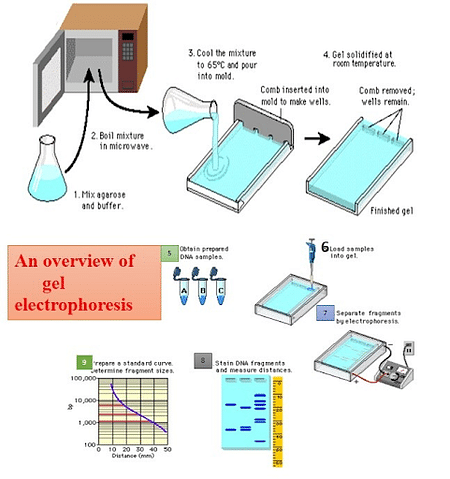
Gel electrophoresis is a process of separating DNA molecules. They are separated on the basis of their size and charge.This process works on the principle of difference in the electric charge of molecules.In this process,a gel medium is prepared.

The gel can be of two types i.e.agarose or polyacrylamide. A semi-solid gel medium is being made as the molecules are needed to pass through the medium at the same time and not move away from their well column. That's why a semi-solid medium will help the molecule to move at the same time and not disperse entirely. In the process of electrophoresis Agarose gel is used. Agarose gel has a greater range of separation but low resolving power for DNA molecules, whereas polyacrylamide gel for the separation of protein molecules because they have high resolving power.
Gel Preparation
By using a buffer solution the gel is prepared so that the molecules can move through the gel. Gel electrophoresis techniques require power connections and well combs. The DNA molecules are negatively charged, hence the side of the well comb has a positive terminal and the opposite side has a negative terminal. The negatively charged DNA molecules move from the positive terminal to the negative terminal when the current is passed through the gel. The big fragments of DNA or protein molecules migrate so fast just because they have a higher negative charge. This principle is helpful in separating those molecules of DNA or protein on the basis of molecular weight.
Things to Remember
- SDS-PAGE is an electrophoresis technique that is used to separate the charged protein molecules kept in an electric field. The protein molecules are separated based on their molecular weight.
- SDS-PAGE stands for Sodium Dodecyl Sulfate and Polyacrylamide Gel. Both of them together make the SDS-PAGE.
- This process is widely used in genetics, forensics, biotechnology, and molecular biology.
- To complete this process, some materials are required. They are polyacrylamide gel, power suppliers, electrophoresis chambers, a sample of the protein, stain and destain buffer, protein ladder, etc. With the help of these things, the protein molecules can be separated.
- SDS-PAGE has so many applications. This is used in peptide mapping, estimation of the size of the protein, measuring the molecular weight of the molecules, and in the identification of the purity of proteins.
Also Read:
Sample Questions
Ques. What do you mean by SDS-PAGE? (2 marks)
Ans. SDS stands for sodium dodecyl sulfate (also known as sodium lauryl sulfate) and PAGE stands for polyacrylamide gel. The whole purpose of this technique is to separate protein. Only based on molecular weight (i.e. length of polypeptide chain). The basis of separation is not influenced by the charge or shape of the protein. The two main processes are gel preparation and protein sample preparation
Ques. What do you mean by gel electrophoresis? (2 marks)
Ans. Gel electrophoresis is a technique used to separate molecules like DNA, RNA, protein, etc. Each molecule has its kind of gel. Agarose gel is used to separate larger molecules like DNA, RNA based on size. Another is polyacrylamide gel used to separate smaller molecules like proteins, based on molecular weight. The gel is applied with an electric current. Since nucleotides are negatively charged, they move from the negative to the positive side (anode) in the electric field.
Ques. What are the applications of SDS-PAGE? (2 marks)
Ans. SDS-PAGE application is given below:
- Estimate purity of the protein is the primary application.
- Knowing the molecular weight of the protein.
- Detecting protein subunit.
- Helpful in peptide mapping.
- To know the composition of the polypeptide.
- Useful in western blotting.
- Used in HIV tests.
Ques. What is protein-molecule? (2 marks)
Ans. Protein is an essential part of our diet. Protein molecules are made up of subunits called amino acids. A string of amino groups joined by peptide bonds to form protein. The structure consists of a carboxylic group, an R group, and an amino group. There are a total of 21 amino acids, so protein is a heteropolymer.
Ques. What are the things required for the process of SDS-PAGE? (3 marks)
Ans. Requirements for SDS-PAGE.
(i) Gel Preparation
- Separating gel PH-8.8
- Stacking gel PH- 6.8 (both gels consists of acrylamide, bis acrylamide, ammonium persulphate, TEMED)
(ii) Protein Sample Preparation
- SDS(sodium dodecyl sulfate)
- Beta-mercaptoethanol
- Glycerol
- Bromophenol blue
(iii) Comb to create well on gel
(iv) Electrode
(v) Running buffer PH-8.3 (tris glycine chloride)
Ques. What are the types of electrophoresis? (2 marks)
Ans. Electrophoresis is mainly of two types.
- Polyacrylamide gel electrophoresis- used for protein molecules separation based on molecular weight.
- Agarose gel electrophoresis- used for larger molecules like DNA RNA. Based on their size, the smaller the farther it moves towards the anode side. Agarose gel is a natural polymer from seaweeds.
Ques. What does SDS-PAGE stand for? (2 marks)
Ans. SDS-PAGE stands for sodium dodecyl sulfate and polyacrylamide gel. It is used to separate protein molecules based on molecular weight.
Ques. How are the protein molecules separated in the process of electrophoresis? (2 marks)
Ans. Protein molecules are separated based on molecular weight. SDS (sodium dodecyl sulfate) denatures protein ( tertiary protein becomes simple primary protein ) and SDS also makes primary protein uniformly negatively charged. Then a gel called polyacrylamide is supplied with an electric current. Since protein is negatively charged, it gets attracted towards the positive side of the electrode (anode). The smaller the molecule (i.e less weight) of protein will be closer to the anode side.
For Latest Updates on Upcoming Board Exams, Click Here: https://t.me/class_10_12_board_updates
Check-Out:



Comments