



Education Journalist | Study Abroad Lead
Sense organs are the specialized organs that respond to external stimuli by communicating impulses to the sensory nervous system. An integral part of human bodies, these sense organs help humans sense the environment around them. A network of sense organs along with the nerves helps in interpreting data in response to a physical phenomenon.
- External stimuli are received by our body mainly through five specialized organs, known as Sense Organs.
- They receive stimuli and encrypt the information in the form of a neural signal which is then forwarded to the nervous system.
- This involves a complex system of neural networks, consisting of receptors, sensory nerves, motor nerves, mixed nerves and effector organs.
- Sense Organs are an integral part of our lives that makes us aware of our surroundings.
Key Terms: Sense organs, Receptors, Sense organs Diagram, Yellow spot, Auditory receptors, Nerve Impulse, Five Sense Organs
What are Sense Organs?
[Click Here for Sample Questions]
Sense organs are a vital part of the human body. They provide data for interpretation through various organs and a network of nerves in a response to a particular phenomenon. The sense organs govern our association and our intersection with the environment. The five sense organs Eyes, Nose, Ears, Tongue and skin contain receptors that relay information through the sensory neurons to appropriate places within the nervous system.
We have five sense organs, which are:
These five sense organs have receptors to relay information to the nervous system. The receptors are of two types – general and special receptors.
- General receptors are present all throughout the body.
- Special receptors include chemoreceptors, photoreceptors and mechanoreceptors.
Also read:
Five Sense organs
[Click Here for Previous Year Questions]
We have 5 Sense Organs in our body that receive and transmit sensory information to the brain. These senses provide organisms with information necessary for perception. The five sense organs are:
- Eyes – The organ for vision
- Ears – The organ for sound
- Nose – The organ for smell
- Tongue – The organ for taste
- Skin – The organ for touch
Eyes – Sight or Ophthalmoception
The eyes are the visual sensory organs that are responsible for vision. It is sensitive to light images. The receptors in the eyes create the perception of image when stimulated by light. The colour of the eyes depends upon the melanin in the body.
- Eyes are protected by eyelids and eyelashes. Light passes through the pupil into the lens.
- The pupil is surrounded by an iris, which is the coloured part of the eye that controls the diameter and size of the pupil.
- Accommodation is the dilation and constriction of pupils.
- Behind the eye’s lens is gelatinous material known as the vitreous humour which gives shape to our eyeball and transmits light to the retina.
- The human eye has a convex lens which forms real images from the light falling on it.
- These images are projected on the yellow spot of the retina where the visual receptors of the eye Rod and Cones are present.
- Rods are found at the edges of the retina and have sensors that work in low light. They help in peripheral vision.
- Cones are cells that work to detect the colour and fine details, hence they work best in bright light. Three types of cones are there in our eyes – blue, green, and red.
- Colour blindness is a condition that occurs when any one of the 3 cones is not present.
- There is a region, called the Blind spot in the retina that receives no light at all.
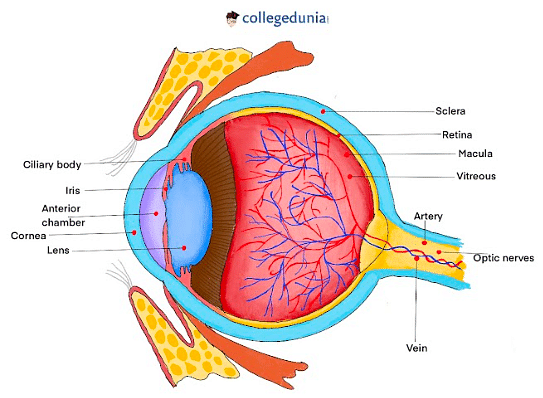
Eyes Diagram
Ears – Hearing or Audioception
The ears are the auditory sense organs of the body that help us perceive sounds around us. The External Auditory Canal has ceruminous glands producing ear wax, also known as cerumen. It prevents the entry of insects into the eardrum and keeps it lubricated.
- The ears are divided into 3 sections – the outer ear, the inner ear, and the middle ear.
- The vibrations of the Eardrum are carried by the Auditory ossicles (malleus, incus and stapes).
- The membrane transmits vibrations to the fluids in the respective chambers of the cochlea.
- Successive vibrations upon reaching the floor of the Cochlea, make the sensory hair of receptor cells vibrate.
- The receptor cells convert the energy of sound waves into nerve impulses of the Auditory nerve, then transmitted to the brain.
- Apart from the sensation of sound, the ear helps in maintaining the body's balance.
- The vestibule is responsible for static equilibrium and linear acceleration while the Semicircular canal is responsible for dynamic equilibrium.
- The ear diagram is as shown below –
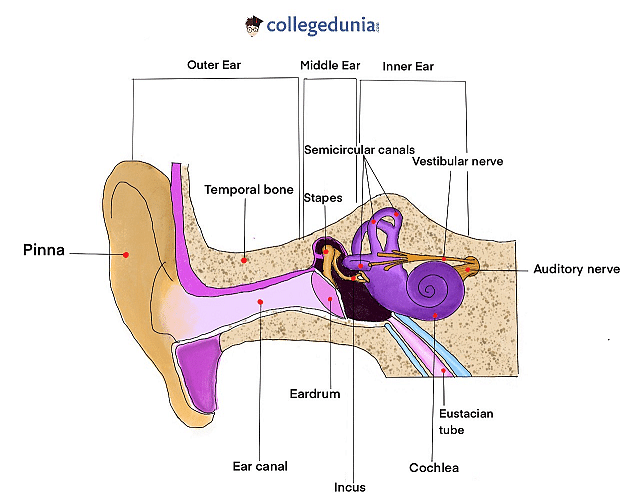
Diagram of Ear
Nose – Smell or Olfalcoception
The human nose is an olfactory sense organ including receptor cells which are responsible for the sense of smell, known as olfaction, and for the sense of taste to some extent (when we eat).
- The olfactory receptor cells occur in the olfactory epithelium of the nasal chambers.
- They have cilia that project into the nasal cavity.
- Olfactory cells are stimulated when smell enters the nasal cavities through the gaseous medium.
- We can feel this smell when this stimulus is carried to the olfactory centre of the brain via the olfactory nerves.
- Olfactory cells have protein receptors i.e. they detect the subtle difference in chemicals.
- The chemicals attach themselves to the cilia, conducting a nerve impulse to the brain.
- Our brain translates these impulses into different cells.
- When humans suffer from cold, the body generates mucus that blocks our sense of smell, hence the food tastes bland to us.

Nose Diagram
Skin – Touch or Tactioception
Skin is the largest organ of the body that relates to the sense of touch, known as tactioception. The skin contains many general receptors that detect pressure, heat, touch and pain. Skin receptors generate an impulse, and carry it to the spinal cord and then to the brain. Present throughout our body, the skin mainly comprises two layers-
- Epidermis – The outer layer
- Dermis – The inner layer containing the sweat glands, sebaceous glands and hair follicles.
The skin serves the following functions:-
- Protection – Skin serves to protect from injury as it invokes appropriate responses to noxious stimuli.
- Thermoregulation – When the body temperature rises, the sweat glands of the skin secrete a lot of sweat and hence bring down the body temperature. This is known as Thermoregulation.

Skin Diagram
Tongue – Taste or Gustaoception
The tongue is the organ of taste that helps to perceive various flavours and tastes. It consists of specialized receptors called gustatory receptors which are found in the taste buds of the tongue. Taste buds are present between the papillae present on the tongue. When stimulated, it comes in contact with food particles. When this taste impulse is transmitted to the brain, then we can feel the taste of the food particles.
- The sense of taste is called gustaoception.
- Taste buds on the tongue have chemoreceptors that work similarly to the chemoreceptors in the nose.
- Taste buds are of 4 types to detect different tastes such as sweetness, sourness, bitterness and saltiness.
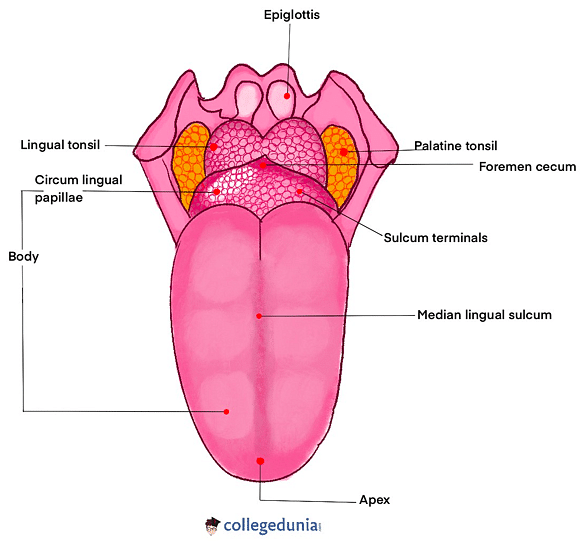
Also Read:
Other Sense Organs
[Click Here for Sample Questions]
Other than the five sense organs, there are two more that help us orient with the world. They are as follows:
Vestibular System
The vestibular system is a sensory system of the body responsible for transmitting information about motion, the position of the head, and spatial orientation to our brain. This system helps in:
- Maintaining body posture.
- Maintaining body balance.
- Stabilizing body and head during movement.
- Identifying orientation and body posture in relation to the environment.
Therefore, the vestibular system aids in equilibrium and normal movement.
Proprioception system
The proprioception system is the conscious or unconscious awareness we have of our joint positions. This system helps humans identify their joints, muscles, and limbs located in three-dimensional space. A few examples of the proprioception system include –
- Balancing on one leg
- Touching nose with our eyes closed
- Walking without constantly looking at our feet.
Things to Remember
- The five sense organs are eyes, ears, tongue, skin, and nose.
- Receptors are responsible for receiving external stimuli and converting them into appropriate nerve impulses which are then sent to the brain for processing.
- The human eye is like a lens-focused camera. The Yellow spot of the retina transmits a point-to-point image to the brain.
- The human ear along with the sensation of sound helps to maintain body balance while stationary and while moving.
- The nose along with a sensation of smell helps to taste the food.
- The tongue detects taste through taste buds which comprise gustatory receptors.
- The skin serves for protection and Thermoregulation.
Previous Year Questions
- Myelin sheath is produced by… [NEET 2017]
- Receptor sites for neurotransmitters are present on… [NEET 2017]
- Injury to vagus nerve in human is not likely to affect… [NEET 2004]
- A gymnast is able to balance his body upside down even in the total darkness because of… [NEET 2015]
- Bowman's glands are located in the… [NEET 2007]
- Identify the parts of the sagittal section of human brain… [NEET 2013]
- Difference between rod cells and cone cells of our retina is… [NEET 2008]
- Afferent nerve fibre carries impulses from… [NEET 1992]
- Alzheimer disease in humans is associated with the deficiency of… [NEET 2009]
- Destruction of the anterior horn cells of the spinal cord would result in loss of… [NEET 2015]
Sample Questions
Ques: When we enter a cinema hall, why are we not able to see anything for a while? (2 marks)
Ans: This happens because of the Accommodation of the eyes. Whenever we move from a place of normal lighting to a place of darkness our eyes accommodate and the pupils dilate. During that interval, we feel unable to see anything.
Ques: Why are the ears also known as the organs of balance? (2 marks)
Ans: Ears help to maintain the balance of our body and make us conscious of our balance. The Vestibule is responsible for static equilibrium (stationary) and linear acceleration while the Semicircular canal is responsible for dynamic equilibrium (movement or motion).
Ques: Name the three ossicles of the ears. How do they contribute to the mechanism of hearing? (2 marks)
Ans: The three small bones present in the middle ear are collectively called the ossicles. The three ossicles of the ear are the malleus, incus and stapes. These ossicles amplify and transmit vibrations to the inner ear.
Ques: The External Auditory Canal serves to protect the Ear. How? (2 marks)
Ans: The inner lining of the External Auditory Canal has ceruminous glands which secrete cerumen or ear wax which is very sticky in nature. It helps to prevent the entry of insects, provides lubrication and protection to the eardrum
Ques: Usually when one has a cold and cough, he/she is not able to taste the food well. Why? (2 marks)
Ans: It is so because then they have nasal congestion they are not able to take in the aroma of food through their nostrils. The gustatory receptors in the nose smell as well as help to taste food, but due to nasal congestion these receptors are not stimulated properly and so the person is not able to taste the food properly.
Ques: Why do we sweat a lot during summer? (2 marks)
Ans: We sweat a lot during summers because, with the rising temperature outside, our body temperature also begins to rise above normal. To bring our body temperature down, the sweat glands in the skin begin to secrete more sweat causing loss of water which tends to bring down the temperature of the body.
Ques: Where are the specialized receptors in the ears that sense sound? (1 mark)
Ans: The Auditory receptors also known as ‘hair cells’ are present in the Organ of Corti inside the Cochlea causing the Sense of hearing.
Read More:



Comments