



Education Journalist | Study Abroad Lead
Silicic acid is a compound of silicon, hydrogen, and oxygen. It is considered as the parent component from which is derived the large family-the silicates-of minerals, esters, and salts. The chemical formula of silicic acid is H4SiO4. It is also named as monosilicic acid formula or orthosilicic acid formula. Silicic acid can be obtained as an unstable solution in water.
| Table of Content |
Keyterms: Silicon, Silicic Acid, Silicate solution, Sodium Silicate, Hydrogen, Oxygen, Minerals, Esters, Salts
Silicic Acid Formula
[Click Here for Sample Questions]
Silicic acid is a vital supplement in the sea. The chemical formula of the component is H4SiO4. Its molecular weight is 96.113 g/ mol and the complexity is 19.1. It possesses a single covalent bond and the conjugate base is orthosilicate.
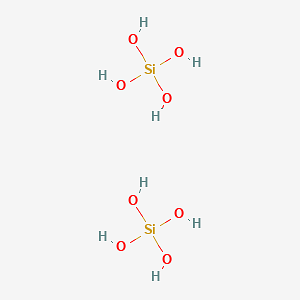
Silicic Acid
The acid can only be prepared as an unstable solution in water. Many esters of silicic acid that are made from alcohols and silicon tetrachloride, are thermally stable liquids engaged as hydraulic fluids and lubricants.
Read More:
| Related Articles | ||
|---|---|---|
| Dichloroacetic Acid | Gluconic Acid | Glutaric Acid |
| Hydrofluoric Acid | Hyponitrous Acid | Selenic Acid |
| Carboxylic Acid | Classification of Organic Compounds | Malonic Acid |
Physical Properties of Silicic Acid
[Click Here for Sample Questions]
- The acid exists in two forms, crystalline and amorphous. Crystalline is obtained by a precipitation interaction and amorphous is considered as a rock gem.
- The acid corrosive, in its undefined structure is white (SiO3).
- It is also insoluble in water and unflavoured in its undefined structure.
- In the translucent state, the component does not break up by any oxyacids.
- When an acid or its solution is added to a silicate solution, the hydrate is aided in a thick structure and then dried and cooled with huge energy turns into an insoluble substance.
Chemical Properties of Silicic Acid
[Click Here for Sample Questions]
Silicic acid tends to lose its primary proton when it moves towards pH 10. Some of the chemical reactions of silicic acid are as follows.
- The reaction of silicic acid with itself when the solvency is exceeded to form shapeless silica hydrate.
- Silicic acid reacts with aluminium hydroxide to form aluminium silicate hydroxide.
- Its reaction with overabundant molybdate creates heteropolyacids like silicomolybdate.
Uses of Silicic Acid
[Click Here for Sample Questions]
The chemical is being used in toothpaste gel or free pieces of streaked toothpaste. Orthosilicic corrosive is good bioavailable silicon for the treatment of various ailments like arthritis, alzheimers, coronary illness, stroke, hypertension, atherosclerosis, etc. Orthosilicic corrosive is also used to improve bone development, hair strength and thickness.
Things to Remember
- The silicic acid formula is also known as monosilicic acid formula or orthosilicic acid formula.
- It is a compound of silicon, hydrogen, and oxygen. The chemical formula of silicic acid is H4SiO4.
- The acid exists in both crystalline and amorphous forms. The silicic acid is also insoluble in water and unflavoured in its undefined structure (SiO 3).
- Silicic acid is used in toothpaste gel and free pieces of streaked toothpaste.
- The component is also used in bone development and hair growth.
Also Read:
Sample Questions
Ques: Explain the benefits of silica supplements? (3 marks)
Ans: Silica is a combination of silicon and oxygen (SiO 2). It has three fundamental crystalline assortments: quartz, tridymite, and cristobalite. The benefits of silica as an anti-inflammatory compound are as follows:
- It lowers blood pressure and bad cholesterol
- It stimulates metabolism and fades age spots
- Heavy metal chelation
- Regulates bowels
- Improves hair, skin, nail and joint health
- It helps to prevent kidney stones
Ques: Are silicic acid and silicon dioxide the same? (2 marks)
Ans: Silicic acid gel or silicon dioxide are inorganic substances. Silicon forms in nature as silicon dioxide or the equivalent silicic acids formed by the hydration of the oxide.
Ques: What is the pH of silicic acid? (2 marks)
Ans: Sodium metasilicate dissolves in water to silicic acid at a pH value of 11.5–12.5. It also can subsequently be acidified.
Ques: Explain silicic acid sodium salt? (2 marks)
Ans: Silicic acid, sodium salt is the combination of oligomers of the tetrahedral orthosilicate anion SiO 4 with sodium cations as the counter ion.
Ques: Why is sodium silicate used in detergents? (2 marks)
Ans: It is a common building agent used in almost all commercial detergents. Sodium silicate prevents mineral deposits on surfaces after washing. Sodium silicate with a surfactant can pull dirt away from the clothes.
Ques: Explain the preparation of H2SO3? (3 marks)
Ans: It is the chemical formula of sulphuric acid. It is prepared by dissolving sulfur dioxide in water. The reaction is reversible, hence the acid readily decomposes back into the reactants. Sulfurous acid is a dibasic acid. Sulfurous acid reacts with bases to create bisulfite and sulfite salts.
Ques: Can salicylic acid be used for skin lightening? (2 marks)
Ans: No, it is not a skin lightening agent. However, salicylic acid can exfoliate the skin’s surface and remove dead skin cells.
Ques: Explain the properties of silicic acid? (2 marks)
Ans: The chemical formula of silicic acid is H4SiO4. The molecular weight is 96.113 g/ mol and the conjugate base is orthosilicate. It possesses a single covalent bond and the complexity is 19.1. Silicic acid is a vital supplement in the sea.
Ques: Is silicic acid good for plants? (2 marks)
Ans: Silicic acid has a significant effect on nutrient uptake. Silicon acts as a mechanical or physical barrier in cell walls. It helps in nutritional value, and overall improved health of plants.
Ques: What happens when silicic acid is heated? (3 marks)
Ans: Silicic acids can be obtained by acidifying some silicate salts like sodium silicate in an aqueous solution. When heated they lose water and form silica gel.
For Latest Updates on Upcoming Board Exams, Click Here: https://t.me/class_10_12_board_updates
Check-Out:



Comments