



Content Curator
Sin 120 value is √3/2 or 0.8660254. Sin 120 value can be calculated using the unit circle and various trigonometry angles such as 60°, 180°, and others.
- The angles and sides of a right-angle triangle are the subjects of trigonometry. It is one of the branches of mathematics that uses trigonometry to find the missing sides and angles of a triangle.
- The value of sin 120 degrees is known to be 0.8660254. . .
- Sin 120 degrees, in the case of radians, can be written as sin (120° × π/180°), which is, sin (2π/3) or sin (2.094395. . .).
Sin 120 degrees can also be expressed in terms of:
- Sin 120°: 0.8660254. . .
- Sin 120° in fraction: √3/2
- Sin (-120 degrees): – 0.8660254. . .
- Sin 120° in radians. sin (2π/3) or sin (2.0943951 . . .)
Check Also: NCERT Solutions for Class 11 Mathematics Trigonometric Functions
| Table of Content |
Key Terms: Sine, Sine 120, Trigonometry, Trigonometric Functions, Cos, Tan, Hypotenuse, Angle, Trigonometric Ratios, Value Table, Adjacent side, Opposite Side, Right-Angle Triangle
Sine Meaning
[Click Here for Sample Questions]
Sine is a trigonometric function of an angle in mathematics. For a right triangle, the sine of an acute angle is defined as the ratio of the length of the opposite side to the length of the triangle's longest side for the stated angle (the hypotenuse).
- The sine function is typically used to determine the unknown angle or sides of a right triangle. In the case of a right triangle, assume ABC, with an angle α, the sine function will be: Sin α = Opposite/Hypotenuse
- In a broader sense, the definition of sine (and other trigonometric functions) can be extended to any real number expressed in terms of the length of a specific line segment in a unit circle.
- The sine function is often used to describe periodic phenomena such as sound and light waves, harmonic oscillator location and velocity, sunlight intensity and day length, and average temperature variations over time.

Sine of an angle
Also Read:
Sin 120 Value
[Click Here for Previous Year Questions]
The value of sin 120 degrees can be calculated using a unit circle or other trigonometric angles like 60, 180, and so on.
- The value of sin 120 value, in terms of decimal, is 0.866025403.
- Sin 120 degrees can also be represented by using the equivalent of the given angle (120 degrees) in terms of radians (2.09439 . . .).
Since we are aware of the degree-to-radian conversion, θ in radians = θ in degrees × (pi/180°)
⇒ 120 degrees = 120° × (π/180°) rad
= 2π/3 or 2.0943 . . .
Thus,
sin 120° = sin(2.0943) = √3/2 or 0.8660254. . .
In the cartesian plane, let's consider the value of 120 degrees. The cartesian plane has four quadrants, as we all know. The second quadrant contains a value of 120 degrees. Because the sine function takes a positive value in the second quadrant, the value of sin 120 degrees should also be positive.
The value of sin 120° can be computed using the unit circle. We know that the radius of a circle is equal to the hypotenuse of a right triangle, which is 1. We take x = cos and y = sin from the cartesian plane.
The value of sin 60° is equal to the value of sin 120, as seen in the diagram above.
That is to say, sin 60 = sin 120 = √3/2.
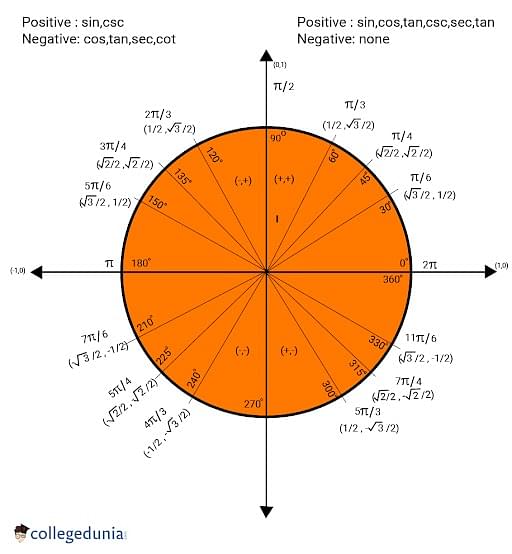
Cartesian Plane
Solved ExamplesQues. Find the value of sin 120° if cosec 120° is 1.1547. Ans. Because, sin 120° = 1/cosec 120° Then, it can be said that: ⇒ sin 120° = 1/1.1547 = 0.866 Ques. Show the sin 120 value in terms of Cosec 120°. Ans. Because the cosecant function can be expressed as the reciprocal of the sine function, it can also be represented as sin 120° as 1/cosec(120°). The value of cosec 120° is equivalent to 1.15470. |
Also Read: Remainder Theorem
Sin 120 Value Derivation
[Click Here for Sample Questions]
The value of Sin 120 can be derived by using two methods:
Method 1
Another way to calculate the value of sin 120 degrees is to use the other angles of the sine functions from the trigonometry table, such as 60 degrees and 180 degrees.
We are aware of this,
120° = 180° – 60°
We also know that
sin (180°- a) = sin a
Now,
(180° – 120°) = sin 120°
As a result,
sin 120° = sin 60°
Use the value of sin 60° from the trigonometry table, which is √3/2.
As a result, sin 120 degrees has a value of √3/2.
Trigonometric Functions Detailed Video Explanation
Method 2
We may find the value of sin 120 degrees by using the value of cosine function relations.
We can find the sin 120 value by using the trigonometry formula:
sin (90 + a) = cos a
We have,
Sin (90° + 30°) = cos 30°
That is,
sin 120° = cos 30°
We know that,
cos 30° = √3/2
As a result,
sin 120° = √3/2
Also Read:
Trigonometry Ratio Table
[Click Here for Previous Year Questions]
For reference, the values of other essential trigonometric angles for various ratios are given here.
| Angles in Degrees | 0° | 30° | 45° | 60° | 90° |
|---|---|---|---|---|---|
| Sin | 0 | 12 | 1√2 | √32 | 1 |
| Cos | 1 | √32 | 1√2 | 12 | 0 |
| Tan | 0 | 1√3 | 1 | √3 | Not Defined |
| Cosec | Not Defined | 2 | √2 | 2√3 | 1 |
| Sec | 1 | 2√3 | √2 | 2 | Not Defined |
| Cot | Not Defined | √3 | 1 | 1√3 | 0 |
Sin 120° of Trigonometric Functions
[Click Here for Sample Questions]
By using trigonometry formulas, the sin 120 degrees can be indicated as:
- ± √(1-cos²(120°))
- ± tan 120°/√(1 + tan²(120°))
- ± 1/√(1 + cot²(120°))
- ± √(sec²(120°) - 1)/sec 120°
- 1/cosec 120°
Note: Because 120° falls in the 2nd Quadrant, which results in the final value of sin 120° to be positive.
In fact, trigonometric identities can also be used to denote sin 120°,
- sin(180° - 120°) = sin 60°
- -sin(180° + 120°) = -sin 300°
- cos(90° - 120°) = cos(-30°)
- -cos(90° + 120°) = -cos 210°
Check More:
Things to Remember
- Angles in trigonometry are commonly expressed in radians or degrees. 0°, 30°, 45°, 60°, 80°, 120°, 180°, and other trigonometric angles are often utilised.
- Trigonometry is widely employed in a variety of industries, including architecture, navigation systems, and the detection of sound waves, among others.
- The sine is a trigonometric function of an angle in mathematics. In the context of a right triangle, the sine of an acute angle is defined as the ratio of the length of the opposite side to the length of the triangle's longest side for the stated angle (the hypotenuse).
- Sin 120 value can be calculated using the unit circle and various trigonometry angles such as 60°, 180°, etc.
- The sine function is often used to describe periodic phenomena such as sound and light waves, harmonic oscillator location and velocity, sunlight intensity and day length, and average temperature variations over time.
For Latest Updates on Upcoming Board Exams, Click Here: https://t.me/class_10_12_board_updates
Previous Year Questions
- If the angles of elevation of the top of a tower from three collinear… (JEE Main 2015)
- ABCD is a trapezium such that AB and CD are parallel… (JEE Main 2013)
- Let a vertical tower AB have its end A on the level ground. Let… (JEE Main 2017)
- If 0≤x<π/2, then the number of values of x for which... (JEE Main 2019)
- Let P = {θ: sinθ − cosθ =√2 cosθ} and… (JEE Main 2016)
- The general solution of sin 3x + sinx… (AMUEEE 2013)
- Consider a triangular plot ABC with sides AB = 7m… (JEE Main 2019)
- If the angles A,B, and C of a triangle are in an… (JEE Advanced - 2010)
- The number of solutions of 2 sinx + cosx = 3 is… (WBJEE 2011)
Sample Questions
Ques. Determine the value of 5 sin(120°)/7 cos(-30°). (2 marks)
Ans. After using trigonometric identities, we are aware that sin(120°) = cos(90° - 120°) = cos(-30°).
⇒ sin(120°) = cos(-30°)
⇒ The Value of 5 sin(120°)/7 cos(-30°)
= 5/7
Ques. Explain the law of sines and its formula. (4 marks)
Ans. The ratio of the length of a triangle's sides to the sine of the opposite angle is known as the law of sine. The sine law applies to all three sides of a triangle, regardless of their sides or angles.
a/Sin α = b/Sin β = c/Sin γ
The Sine rule can be used to find the unknown length of an angle in a right-angle triangle. The law of sine is also known as the sine rule, sine law, or sine formula.
The formula for the Sine Law
a/Sin α = b/Sin β = c/Sin γ
a: b:c = Sin α = Sin β = Sin γ
a/b = Sin α/Sin β
b/c =Sin β/Sin γ
It denotes that dividing ∠ α by the sine of is equal to dividing sine b by the sine of and also equals dividing sine c by the sine of ∠γ.
Ques. Calculate the value of Sin 31/3. (2 marks)
Ans. We know that after a 2 interval, the value of sin x repeats.
Therefore
sin\(\frac{31\pi}{3}\)
sin \(10\pi + \frac{\pi}{3}\)
sin \(\frac{\pi}{3}\)
= \(\frac{\sqrt 3}{2}\)
Ques. What does sin (0.05) represent? (3 marks)
Ans. For modest values of , sin = , where it is measured in radians.
Case 1: The angle is stated in radians.
sin (0.05) ≈ 0.05.
Case 2: The angle is stated in degrees.
0.05°=0.05 × \(\frac{\pi}{180}\)
= \(\frac{\pi}{3600}\) radian
≈ 0.000873 radian
Thus, sin (0.05°) ≈ 0.000873
Ques. Determine the value of sin A + cos A if sin A – cos A= (√3-1)/2. (3 marks)
Ans. We know that sin A – cos A = (√3-1)/2
(sin A + cos A)2 + (sin A + cos A)2 = 2
= (sin A + cos A)2 = \(2 - \left( \frac{\sqrt{3} - 1}{2} \right)^2\)
= (sin A + cos A)2 = \(2 - \frac{4-2\sqrt{3}}{4}\)
= (sin A + cos A)2 = \(\frac{8-4+2\sqrt3}{2}\)
= (sin A + cos A)2 = \(\frac{2+\sqrt3}{2}\)
= (sin A + cos A)2 = \(\frac{3.7322}{2}\)
= sin A + cos A ≈ 1.366
Ques. Determine the value of sin 15°. (2 marks)
Ans. We know that
si15°=si45°-30°
= sin45° cos 30°- cos45° sin30°
= \(\frac{1}{\sqrt{2}} \times{\frac{\sqrt3}{2}} - \frac{1}{\sqrt{2}} \times\frac{1}{{2}}\)
= \(\frac{\left( \sqrt{3} - 1 \right) }{2\sqrt{2}}\)
Ques. Prove that sin sin (x + y) = sin sinx cos cosy + cos cosx sin sin y. (3 marks)
Ans. We already know that,
sin (x+y) = cos\((\frac{\pi}{2}-(x+y))\)
=cos cos \((\frac{\pi}{2}-x)-y)\)
=cos cos \((\frac{\pi}{2}-x)\) cos cosy + sin sin \((\frac{\pi}{2}-x)\) sin siny
=sin sinx cos cosy + cos cosx sin siny
Ques. Prove that sin sin3x = 3sin sinx – 4x. (3 marks)
Ans. We know that,
sin sin3x=sin sin(2x+x)
=sin sin 2x cos cos x + cos cos 2x sin sinx
=2sin sin x cos cos x cos cosx + (1-2x) sin sinx
=2sin sin x (1-x) + sin sin x-2x
=2sin sin x-2x + sin sin x-2x
=3sin sin x-4x
Ques. Show that \(\frac{\text{sin sin (x+y)}}{\text{sin (x-y)}} = \frac{\text{tan tanx + tan tany}}{\text{tan tanx - tan tany}}\) = tan x + tan y tan x – tan y. (3 marks)
Ans. We know that,
LHS = \(\frac{\text{sin sin (x+y)}}{\text{sin sin (x-y)}}\) = \(\frac{\text{sin sin x cos cos y + cos cos x sin sin y}}{\text{sin sin x cos cos y - cos cos x sin sin y)}}\)
Divide numerator and denominator by cos x cos y
We get,
\(\frac{\text{sin sin (x+y)}}{\text{sin sin (x-y)}}\) = \(\frac{\text{tan tanx + tan tany}}{\text{tan tanx - tan tany}}\)
Ques. Explain \(\frac{\text {sin sin5x – 2sin sin3x + sin sinx}}{\text {cos cos5x - cos cosx}} = \text{tan tanx}\). (3 marks)
Ans. Given that,
LHS = \(\frac{\text {sin sin5x – 2sin sin3x + sin sinx}}{\text {cos cos5x - cos cosx}}\) = \(\frac{\text {sin sin5x + sin sinx – 2sin sin3x}}{\text {cos cos5x - cos cosx}}\)
= \(\frac{\text {2sin sin3x + cos cos2x – 2sin sin3x}}{\text {-2sin sin3x - sin sin2x}}\) = \(-\frac{\text {sin sin3x (cos cos2x – 1)}}{\text {sin sin3x sin sin2x}}\)
= \(\frac{2x}{\text {sin sin2x}}\) = \(\frac{2x}{\text {2sin sinx cos cosx}}\)
= \(tanx = RHS\)
Ques. Solve the equation sin sin 2x- sin sin 4x + sin sin 6x = 0. (4 marks)
Ans. This equation can also be written as
sin sin 2x- sin sin 4x + sin sin 6x = 0
Or
2 sin sin 4x cos cos 2x – sin sin 4x = 0
i.e.,
sin sin 4x(2cos cos 2x-1)=0
Therefore
sin sin 4x = 0 or cos cos 2x = \(\frac{1}{2}\)
That is
sin sin 4x = 0 or cos cos 2x = cos cos \(\frac{\pi}{3}\)
Hence
4x = \(\frac{n\pi}{4}\) or 2x = 2nπ ± \(\frac{\pi}{3}\), where n∈ Z
i.e.,
x = \(\frac{n\pi}{4}\) or x = nπ ± 6, where n∈Z
Also Read:



Comments