



Education Content Expert
Cone is a three-dimensional shape that has a circular base and a pointed edge at the top called the apex. A cone can be thought of as a triangle that is rotated about one of its vertices. There are two types of cones namely the right circular cone and the oblique cone. Common examples of cones include ice cream cones, party hats, and traffic cones.
Cone Formula refers to a predefined set of formulas for the calculation of the surface area and volume of a cone. The curved surface area of cone is πrl whereas the total surface area of cone is πr(l + r), where r is the radius, and l refers to the slant height. The volume of cone is ⅓ πr2h, where h is the height of the cone and r is the radius.
Read More: NCERT Solutions for Class 10 Mathematics Surface Areas and Volumes
| Table of Content |
Key Terms: Cone, Cone Formula, Curved Surface Area of Cone, Volume of Cone, Surface Area of Cone, Slant Height, Radius
Cone Definition
[Click Here for Sample Questions]
Cone is a three-dimensional shape in Geometry that has a circular base where a set of line segments, connect all of the points on the base to a common point called the apex or the vertex. A cone has one face, one vertex, and no edges. Examples of cones are birthday caps, a tent, ice cream cones, etc.
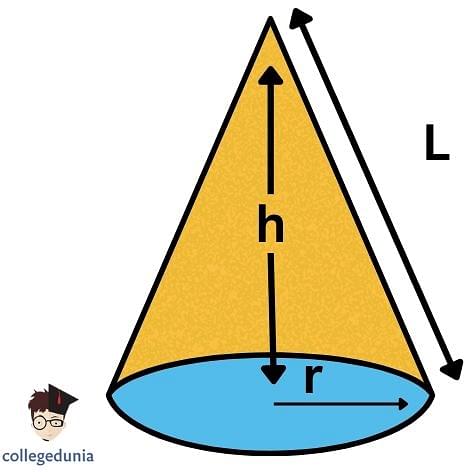
There are three elements of a cone which are its radius, height, and slant height.
- Radius (r) is defined as the distance between the center of the circular base to any point on the boundary of the base.
- Height (h) of the cone is the distance between the apex of the cone to the center of the circular base.
- Slant Height (l) is the distance between the apex of the cone to any point on the circumference of the cone. It is calculated as l2 = r2 + h2.
Cone
Read More:
| Related Topics | ||
|---|---|---|
| Frustum of Cone | Surface Area of Right Circular Cone | Difference between Area and Volume |
| Volume of a Sphere | Area of a Sector | Area of a Triangle |
Types of Cone
[Click Here for Sample Questions]
There are two main types of cones in Geometry:
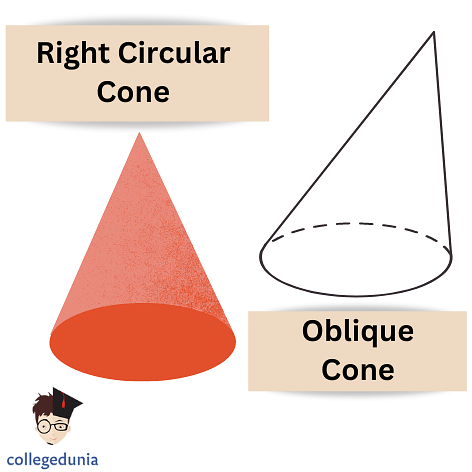
- Right Circular Cone
- Oblique Cone
Right Circular Cone
The right circular cone is the most common type of geometric cone.
- It is a type of cone that has a line that touches the top point of the cone in a perpendicular.
- In this, the line passes through the center of the circle.
- The apex of the cone lies just above the center of a circular base.
- Examples of the right circular cones are ice cream, traffic cones, etc.
Oblique Cone
The oblique cone is the other type of cone in geometry that is tilted or slanted.
- The base and the apex of the oblique cone are not perpendicular to each other.
- The top point of the cone is not perpendicular to the base.
- In this cone, the vertex of the cone does not lie above the centre of the circular base.
- An example of an oblique cone is a geometrical conical figure.
Read More: Surface Areas and Volumes Important Questions
Cone Formula
[Click Here for Sample Questions]
Cone formula refers to a set of formulas that are used to calculate the surface area and volume of a cone. The various cone formulas are
- Curved Surface Area of Cone Formula
- Total Surface Area of Cone Formula
- Volume of Cone Formula
These are the three formulas that are used to calculate the area, volume, and various dimensions of a given cone.
Curved Surface Area of Cone
[Click Here for Sample Questions]
The curved surface area of cone refers to the area enclosed by the curved part of the cone.
Curved Surface Area of Cone = πrl square units
Where
- r = Radius of Cone
- l = Slant Height of Cone
Derivation of CSA of Cone Formula
To derive the curved surface area of a cone, we will divide the given cone into a circular base and the top slanted part. The area of the slanted part gives us the curved surface area.
CSA of Cone Formula
Area of the Circular Base: The area of the circular base is given as
Area of a circle = πr2
If we open the curved top and cut it into small pieces so that each cut portion is a small triangle, whose height is the slant height l of the cone.

Area of the Circular Base
So, the area of each triangle = 1/2× base of each triangle × l.
Therefore,
Area of the curved surface = Sum of Areas of all the Triangles
=½ × b1 × l + ½ × b2 × l+ ½ × b3 × l+ ………+ ½ × bn × 1
=1/2l (b1 + b2 + b3 +……+bn)
=1/2l
Lastly,
Length of Entire curved Boundary = Circumference of base = 2πr
Thus,
Area of the curved surface = ½ × l × 2πr = πrl
Hence derived.
Thus, the curved surface area of a cone is calculated as πrl.
Read More: MCQs On Surface Area And Volume
Total Surface Area of Cone
[Click Here for Sample Questions]
The total surface area of a cone is the sum of the area of the circular base and the area of the curved part of the cone.
Total Surface Area (TSA) of Cone = Area of the Base (Circle) + Curved Surface Area of the Cone (CSA)
TSA = πr2 + πrl = πr (l + r) square units
Total surface area is sometimes referred to as only the surface area of a cone.
Derivation of TSA of Cone Formula
According to the definition of the total surface area of a cone,
Total Surface Area of a Cone = Area of the Circular Base + CSA of Cone
Total Surface Area of a Cone = πr2 + πrl = πr (l + r)
Thus, the total surface area of a cone = πr (l + r)
Volume of Cone
[Click Here for Sample Questions]
The volume of a cone refers to the space occupied by the cone.
Volume of Cone = (1/3) πr2h cubic units
Where
- π = Value of pi.
- r = Radius of the circular base.
- h = Height of the cone.
The volume of a cone is also one-third of the volume of a cylinder.
Volume of Cone = (1/3) × Volume of Cylinder
Read More:
Solved Examples on Cone Formula
Example 1: What will be the curved surface of a cone having a base radius of 5 cm and a slant height of 20 cm? (π = 22/7)
Solution: Given parameters are,
- Radius (r) = 8 cm
- Slant height (l) = 20 cm
Using the curved surface area of a cone formula,
CSA of Cone = πrl
CSA of Cone = 22/7 × 5 × 20 = 314.08 cm2
Thus, the curved surface area of the given cone is 314.08 cm2.
Example 2: Sheetal observes a conical tent during her camping trip and approximates that the height of the tent is three times the radius of the tent which is given as 3 m. Calculate what will be the volume of the tent.
Solution: According to the question, the height of the tent is three times the radius.
So,
h = 3r
h = 3 x 3 = 9 m
Volume of Cone = (1/3) πr2h
Substituting the value of h = 9, we get,
Volume of Conical Tent = (1/3) πr2 × 9
= (1/3) x 22/7 x 3 x 3 x 9
= 84.82 cm3
Therefore, the volume of the tent is 84.82 cm3.
Example 3: There is a conical birthday cap with a radius of 3 units and a height of 4 units. What will be the slant height of the birthday cap?
Solution: Given that,
- Radius (r) = 3 units
- Height (h) = 4 units
Using slant height of a cone formula,
l2 = r2 + h2
32 + 42 = 9 + 16
l2 = 25
l = √25
l = 5
Thus, the slant height of the birthday cap is 5 units.
Things to Remember
- Cone is a 3D shape with a circular base and a pointed edge at the top called the apex.
- There is 1 face, 1 vertex, and no edges in a cone.
- The right circular cone and the oblique cone are the two types of cone.
- The total surface area of a cone is πr (l + r) square units.
- The curved surface of a cone is πrl square units.
- The volume of a cone is given as (1/3) πr2h cubic units.
- The slant height of a cone can be calculated using the formula l2 = r2 + h2.
Sample Questions
Ques. What will be the total surface area of a cone, if the radius is 8.2 cm and the height is 16 cm? (3 Marks)
Ans. Given parameters are
- Radius= 8.2 cm
- Height= 16 cm
- Slant Height =?
l2 = r2 + h2
l=162 + 8.22
l=17.98cm
Total surface area of cone = πr(l+r) = 3.14 x 8.2(17.98 + 8.2)
= 674.4cm2
Thus, the total surface area of the given cone is 674.4cm2.
Ques. What is the ratio of the volume of a cone to the volume of a cylinder? (3 Marks)
Ans. In order to find out the ratio, we first need to find the volume of the cone and the cylinder. Using the cone formula and cylinder formula, we get
- Volume of Cone = (1/3)πr2h
- Volume of Cylinder = πr2h
Thus, the ratio of the volume of a cone and volume of a cylinder = (1/3)πr2h : πr2h
Volume of cone: Volume of cylinder = 1/3: 1 = 1:3
Hence, we can say that the ratio of the volume of a cone to the volume of a cylinder is 1:3.
Ques. What will be the slant height of a cone if the total surface area of the cone is 616 in2 and the radius is given as 7 inches? (3 Marks)
Ans. According to the given question,
- Total Surface Area of Cone = 616 in2
- Radius of Cone = 7 inches
- Let the slant height be x.
Substituting the given values in the surface area of the cone formula,
Total Surface Area of Cone = πr (r + l) = (22/7) × 7 × (7 + x) = 616
22 × (7 + x) = 616
7 + x = 28
x = 21 inches
Thus, the slant height of the cone is 21 inches.
Ques. Calculate the height of the cone whose radius is 7 inches and curved surface area is 550 in2 . (π = 22/7) (3 Marks)
Ans. Given that,
- Radius of cone = 7 in
- Curved Surface Area = 550 in2
Let the value of slant height be l and the height of cone be h.
Substituting the given values in the curved surface area of the cone formula,
πrl = (22/7) × 7 × l = 550 in2
22 × l = 550
l = 550/22 = 25 inches
l = √(h2 + r2)
h = √(l2 - r2) = √(252 - 72)
h = √576 = 24 inches
Thus, the slant height and the height of the given cone are 25 inches and 24 inches respectively.
Ques. What is the slant height of the cone? (2 Marks)
Ans. The slant height of a cone is the distance from the apex or top of the cone to a point on the circumference of the base. The slant height can be calculated by the square root of the sum of the squares of the radius and the height of the cone.
Ques. Calculate the total surface area of a cone with a radius of 14 units and a slant height of 8 units. (Use π = 22/7) (3 Marks)
Ans. Given that,
- Radius of Cone (r) = 14 units
- Slant Height (l) = 8 units
Putting the values in the total surface area of the cone formula,
πr (r + l) = (22/7) × 14 × (14 + 8) = 22 × 2 × 22
= 968 square units
Thus, the total surface area of the given cone is 968 square units.
Ques. Amrita is filling a conical bag with gems. The capacity of the bag is 24π in3. What will be the height of the conical bag if its radius is 3 inches? (3 Marks)
Ans. It is given that,
- Radius of Cone = 3 in
- Volume of Cone = 24π in3
- Let the height of the cone be x inches.
Putting the values in the volume of cone formula,
Volume of Cone = (1/3)πr2h
= (1/3)× π × (3)2 × x = 24π in3
3x = 24
x = 8 inches
Therefore, the height of the conical bag is 8 inches.
Ques. Calculate the volume of a cone whose diameter is 7 inches and height is 12 inches. (3 Marks)
Ans. Given dimensions of the cone are
- Diameter of Cone = 7 in
- Radius of Cone = 7/2 in
- Height of Cone = 12 in
Substituting the above values in the volume of cone formula,
Volume of Cone = (1/3)πr2h = (1/3) × (22/7) × (7/2)2 × (12) = 154 in3
Thus, the volume of the given cone is 154 in3.
Ques. What will be the radius of a cone whose volume and height are 132 cubic units and 14 units respectively? (3 Marks)
Ans. Given that,
- Volume of Cone = 132 cubic units
- Height of Cone = 14 units
Putting the values in the volume of cone formula,
Volume of cone = (1/3)πr2h
132 = (1/3) × (22/7) × r2 × (14)
r2 = (132 × 7 × 3)/(22 × 14)
r2 = 9
r = 3
Therefore, the radius of the given cone is 3 units.
Ques. What is meant by the base area of a cone? (1 Mark)
Ans. The base of the cone shows the area covered by the circular base of the cone. The base area of a cone is calculated using the formula A = πr2, where r is the radius of the base of the cone.
Ques. List the differences between the right circular cone and oblique cone. (3 Marks)
Ans. The differences between the right circular cone and the oblique cone are as follows:
| Right Circular Cone | Oblique Cone |
|---|---|
| The cone that has its vertex opposite to the circular base is a right circular cone. | The cone that does not have its vertex directly opposite to the circular base is an oblique cone. |
| In a right circular cone, the line representing the height of the cone passes through the center of the base circle and is perpendicular to the radius. | In an oblique cone, the line representing the height of the cone does not pass through the center of the base circle. |
Read More:



Comments