



Content Curator
Tartaric acid is an organic acid present in various vegetables and fruits, including bananas, grapes, citrus, and tamarinds. It is a white crystalline diprotic aldaric acid. Tatric acid is also known as Racemic acid or 2, 3-dihydroxy-succinic acid. Tatric acid is one of the favorite acids among the winemakers. In this article, we will learn about tartaric acid, properties of tartaric acid, uses of tartaric acid and its health hazards.
| Table of Content |
Keywords: Acid, vegetables, fruits, bananas, grapes, citrus, tamarinds, crystalline diprotic aldaric acid, Racemic acid
Tatric Acid
[Click Here for Sample Questions]
- Tartaric Acid is a carboxylic acid.
- The chemical formula for tartaric acid is C4H6O6.
- It is used in the production of carbon dioxide.
- It can be found in the form of white crystals.
- Other names of tatric acid are racemic acid or 2, 3-dihydroxy-succinic acid.

History of Tartaric Acid
[Click Here for Sample Questions]
- Jean Baptiste Biot was the first to observe a written record of the tartaric acid extraction in 1832. He noticed tartaric acid's capacity to spin-polarized light.
- In 1847, Louis Pasteur resumed his studies by looking at the chiral forms of sodium ammonium tartrate crystals.
- Pasteur was the first to create a pure sample of levo-tartaric acid by manually sifting the variously shaped crystals.
Also Read:
Properties of Tartaric Acid
[Click Here for Sample Questions]
- The Molecular Weight/ Molar Mass of Tartaric acid is 150.087 g/mol.
- The Boiling Point of tartaric acid is 275 °C.
- The Melting Point is 171 to 174 °C.
- It is a white granular to the crystalline substance that is odorless and has an excellent acidulous taste.
- It has a melting point of 173.625 degrees Fahrenheit.
- It has a flashpoint of 210 degrees Fahrenheit.
- It is water-soluble.
- It has a molecular weight of 150.087 g/mol.
- It weighs 1.79 g/mol.
- The density of tatric acid is 1.79 g/mol.
- Tartaric acid is a reactive substance found in nature.
- The following is an example of tartaric acid as a reactive molecule:
HO2CCH(OH)CH(OH)CO2H + H2O2 → HO2CC(OH)C(OH)CO2H + 2H2O
Structure of Tartaric Acid
[Click Here for Sample Questions]
Stereoisomers are the molecules with the same composition but different spatial orientations. Tartaric acid is a chiral molecule with three stereoisomers; D-tartaric acid, L-tartaric acid, and meso-tartaric acid, each with slightly different structure.
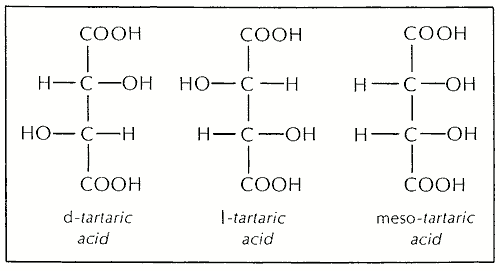
D-tartaric acid and L-tartaric acid are mixed in equal amounts to make racemic tartaric acid.
Preparation of Tartaric Acid
[Click Here for Sample Questions]
The most frequent isomer of tartaric acid is L-(+)-tartaric acid, which is generated in enormous amounts.
Calcium tartrate is converted to L-(+)-tartaric acid by treating it with aqueous sulfuric acid:
Ca(O2CCH(OH)CH(OH)CO2) + H2SO4 → HO2CCH(OH)CH(OH)CO2H + CaSO4
Uses of Tartaric Acid
[Click Here for Sample Questions]
- Tartaric acid enhances the flavor of oral medicines and chelate metal ions like magnesium and calcium.
- It is used as a leavening agent in recipes, along with baking soda.
- It has antioxidant properties.
- Tartaric acid is one of the most important acids in wine.
- It imparts a sour flavor to meals.
- It is occasionally used to make people vomit.
- Tartaric acid is used in the production of silver mirrors.
- It is used in the coloring of textiles in its ester form.
- Tartaric acid is widely used in the leather tanning process.
- It is also found in sweets.
- It is utilized as a food stabilizer in cream form.
Read More: Difference between Baking Soda and Baking Powder
Health Hazards of Tartaric Acid
[Click Here for Sample Questions]
- Tartaric acid is safe for human ingestion in small dosages and is used in various food items.
- It can be hazardous in excessive amounts.
- When ingested in high doses, it can lead to paralysis and death.
Applications of Tartaric Acid and its Derivatives
[Click Here for Sample Questions]
- Tartaric acid and tartaric acid derivatives have a wide range of applications in the pharmaceutical industry.
- It is used in the manufacture of effervescent salts. For example, to enhance the flavor of oral medicines when combined with citric acid.
- In cough syrup, the potassium antimony derivative of tartaric acid known as tartar emetic is an expectorant in modest dosages.
- It also has a variety of industrial applications.
- The acid is used as a chelating agent in the agricultural and metals industries to add micronutrients to soil fertilizer and clean metal surfaces made of these metals' aluminum, iron, copper, and alloys.
Things to Remember Based on Tartaric Acid
- Tartaric Acid is a carboxylic acid with a chemical formula C4H6O6.
- It is widely used in the production of carbon dioxide.
- It is a white crystalline diprotic aldaric acid that is odorless and has an excellent acidulous taste.
- Other names of tatric acid are racemic acid or 2, 3-dihydroxy-succinic acid.
- Tartaric acid may be inhaled and absorbed into the body.
- Tartaric acid can induce a burning feeling as well as breathing difficulties.
- It can cause skin irritation and redness when it comes into contact with the skin.
- It can irritate the eyes and produce significant redness and discomfort.
- The Boiling Point of tartaric acid is 275 °C while its melting point is 171 to 174 °C.
- It has a flashpoint of 210 degrees Fahrenheit.
- It has a molecular weight of 150.087 g/mol and weighs 1.79 g/mol.
- The density of tatric acid is 1.79 g/mol.
- Calcium tartrate is converted to L-(+)-tartaric acid by treating it with aqueous sulfuric acid.
Also Read:
Important Questions Based on Tartaric Acid
Ques: Name the acid present in the following: ( All India 2015, 2 Marks)
(i) Tomato
(ii) Vinegar
(iii) Tamarind
Ans:
- Oxalic acid
- Acetic acid
- Tartaric acid
Ques: Name the natural source of each of the following acid: (All India 2014, 2 Marks)
(i) Citric acid.
(ii) Oxalic acid.
(iii) Lactic acid.
(iv) Tartaric acid.
Ans:
- Lemon
- Tomatoes
- Curd
- Tamarind.
Ques: Is tartaric acid a strong acid or a weak acid? (2 Marks)
Ans: Tartaric acid is the most commonly recommended acid for must alterations. It is a more powerful acid than malic or citric acid, and it's less vulnerable to microbial breakdown during alcoholic and malolactic fermentations. Tartaric acid is a potassium salt that crystallizes.
Ques: What is the purpose of tartaric acid? (2 Marks)
Ans: Tartaric acid is a necessary food ingredient generally used with baking soda to act as a leavening agent in recipes. Except for untreated foods, they may be utilized in any food. Natural sources of tartaric acid include grapes, apricots, oranges, bananas, avocados, and tamarinds.
Ques: What makes tartaric acid different from citric acid? (2 Marks)
Ans: The main difference between tartaric and citric acid is that tartaric acid is found naturally in grapes, whereas citric acid is found naturally in citrus fruits. Tartaric acid and citric acid are two plant acids that are commonly utilized as natural food additives. Both tartaric acid and citric acid are antioxidants.
Ques: What does tartaric acid come from? (2 Marks)
Ans: Tartaric acid is a crystalline organic white diprotic acid. Many fruits, including grapes, bananas, and tamarinds, naturally contain the chemical, and it is also one of the major acids in wine.
Ques: (i) Give the constituents of baking powder, (ii) Why does cake or bread swell on adding baking powder? Write a chemical equation. (All India 2013, 3 Marks)
Ans:
- The constituents of baking powder are sodium hydrogen carbonate and tartaric acid.
- On adding baking powder, the cake o bread swells because of the presence of CO2
2NaHCO3 (s) → (heat) Na2CO3 (s) + CO2 (g) + H2O (l)
Ques: Does tartaric acid help in making cake or bread fluffy ? Explain. (3 Marks)
Ans: No, tartaric acid does not help in making cake and bread fluffy because it cannot liberate carbon dioxide during baking.
It reacts with Na2CO3 to form Di-Sodium Tartrate. If it is not done, Na2CO3 will impart a bitter taste to the cake.

Also Read:



Comments