



Education Journalist | Study Abroad Lead
S-Block Elements comprises all the elements in Group 1 and Group 2 of the Modern Periodic Table. The elements of group 1 has one electron (s1) and group 2 has two electrons (s2) in their sub-shell. The s-block comprises 14 elements namely hydrogen (H), lithium (Li), helium (He), sodium (Na), beryllium (Be), potassium (K), magnesium (Mg), rubidium (Rb), calcium (Ca), caesium (Cs), strontium (Sr), francium (Fr), barium (Ba), and radium (Ra). Hydrogen has a controversial position as it has only one electron in its outer shell. It can occupy group 1 as well as group 17. Group 1 is called alkali metals and Group 2 is called alkaline earth metals. The alkali metals contain a single valence in the outer shell and since the outer shell is loosely held making it electropositive. Due to this they are not available in a free state in nature and are mostly unreactive in nature.
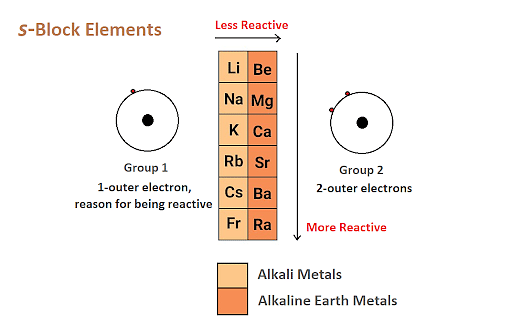
S-Block Elements
Very Short Answer Questions (1 Mark Questions)
Ques. Why are lithium salts mostly hydrated?
Ans. Lithium has the lowest size among all alkali metals. It has the capacity to polarise water molecules more easily than other alkali metals because of its property. Li+ ions have the highest degree of hydration, and lithium salts, such as lithium chloride (LiCl) and 2H2O, are hydrated.
Ques. Why are Group I elements known as the most electropositive element?
Ans. Group 1 elements are most electropositive in nature due to the loosely held s-electron in its outermost valence shell. They readily give up an electron, forming monovalent M+ ions.
Ques. Why are melting and boiling points of alkali metals low?
Ans. The alkali metals have a big atomic size and they have only one valence electron, thus their melting and boiling points are low, indicating that they have weak metallic bonding.
Ques. What is the meaning of the diagonal relationship in the periodic table?
Ans. The diagonal relationship in the period table is due to similar ionic sizes and/or charge/radius ratios.
Ques. Why is lithium kept under kerosene oil?
Ans. Lithium is kept under kerosene oil because it strongly reacts with oxygen and water.
Ques. Name the lightest metal.
Ans. Lithium is the lightest metal on earth having a density of 0.543g/cm3.
Ques. What is sodium amalgam?
Ans. Sodium amalgam is formed when sodium metal which is discharged at the cathode reacts with mercury.
Ques. Why is sodium hydrogen carbonate known as baking powder?
Ans. It is known as baking powder because on heating, it decomposes and generates bubbles of carbon dioxide gas (CO2) which leaves holes in cakes and bread.
Ques. Why does table salt get wet in the rainy season?
Ans. Table salt has impurities like CaCl2 and MgCl2, which are both deliquescent in nature that absorb moisture from the air when it rains.
Ques. What is the formula of soda ash?
Ans. Soda ash which is known as sodium carbonate is prepared by the Solvay process in large quantities. Its formula is Na2CO3.
Ques. Mention the main compounds which constitute Portland cement.
Ans. The main compounds of Portland Cements are 26 of dicalcium silicate (Ca2SiO4), 51 of tricalcium silicate (Ca3SiO5) and 11 of tricalcium aluminate (Ca3Al2O5).
Ques. Anhydrous calcium sulphate cannot be used as plaster of Paris. Give a reason.
Ans. Anhydrous calcium sulphate has been used as a drying agent by taking up water readily. It cannot be replaced with the plaster of Paris because it does not have the same setting and hardening property.
Ques. What is milk of lime?
Ans. The lime milk of lime means slaked lime suspension in water.
Ques. Why is beryllium not attacked by an acid easily?
Ans. Beryllium is not attacked by an acid easily because of the presence of an oxide film that develops on the beryllium metal. Hence acid is less likely to be attacked by it.
Ques. Why are lithium compounds soluble in organic solvents?
Ans. Lithium compound has a strong covalent character due to its high polarising power. As a result, it is soluble in organic solvents.
Ques. Name the elements (alkali metals) which form superoxide when heated in excess of air.
Ans. The elements are Potassium, rubidium and caesium.
Ques. Which element is found in chlorophyll?
Ans. The element is magnesium.
Ques. List down the metal which floats on the water without any reaction with water.
Ans. Lithium without reacting with water floats on it.
Ques. What is the general electronic configuration of alkali metals in their outermost shells?
Ans. The general electronic configuration of alkali metals in their outermost shells is ns1 where n = 2 to 7.
Ques. What is dead burnt plaster?
Ans. Anhydrous calcium sulphate (CaSO4) is also referred to as dead burnt plaster.
Ques. Give reason why the alkaline earth metals are called s–block elements?
Ans. The last electron in the electronic configuration occupies the s orbital of its valence shells and therefore alkaline earth metals are known as s–block elements.
Ques. Why is Calcium preferred over sodium to remove the last traces of moisture from alcohol?
Ans. Sodium and calcium both react with water to form hydroxide. But calcium doesn’t react with alcohol to generate calcium alkoxide.
Read More: Alcohols Phenols and Ethers
Short Answer Questions (2 Marks Questions)
Ques. Why does lithium have strong reducing power in an aqueous solution?
Ans. The strong reducing power of lithium in an aqueous solution can be explained by the terms of electrode potential, which measures an element's potential to lose electrons easily. The three criteria by which it is measured are listed down –
Li(s) → Li(g) ………. Sublimation enthalpy
Li(g) → Li+(g) + e– ……… Enthalpy of ionization
Li+(g) + H2O → Li+(aq) ……… Enthalpy of hydration
Lithium has the highest hydration enthalpy owing to its tiny size. It also has the highest ionisation enthalpy among alkali metals. However, hydration enthalpy is more than ionisation enthalpy. Hence due to its high enthalpy of hydration, lithium is the most powerful reducing agent in an aqueous solution.
Ques. Alkali metal when heated in air form various oxides. Mention the oxides formed by Li, Na and K.
Ans. The reactivity with oxygen increases when the atomic size of an alkali metal decreases. So the oxides formed by the three metals are
- Li produces lithium oxide (Li2O)
- Sodium produces sodium peroxide (Na2O2) with a trace of sodium oxide
- Potassium produces only potassium superoxide (KO2)
The superoxide ion, O2–, only becomes stable in the presence of massive cations like K, Rb, and others.
Ques. Lithium shares summer semblance with magnesium In properties. Mention Two such properties and share their resemblance.
Ans. Lithium is similar to magnesium in its charge size ratio. The association between lithium and magnesium is referred to as the diagonal relationship. Two features which show their resemblance are:
- Both Chlorides soluble are deliquescent and soluble in alcohol and pyridine due to their covalent character.
- They both break down and release CO2 when Li and Mg carbonates are heated.
Li2CO3 → Li2O + CO2
MgCO3 → MgO + CO2
Ques. List an element from Group 2 of the modern periodic table which forms an amphoteric oxide and a water-soluble sulphate.
Ans. The name of the element is Beryllium. It is a group 2 element that generates an amphoteric oxide and a water-soluble sulphate. The formula of Beryllium oxides is BeO. All other alkaline earth metal oxides are basic but BeO is amphoteric. It means that it reacts with both acids and bases.
Beryllium sulphate is a white substance and it crystallises as hydrated salts (BeSO4.4H2O). BeSO4 is fairly soluble in water (small size) due to its highest hydration energy in the group. It is easily soluble because the hydration energy is much greater than lattice energy.
Ques. Discuss the trend of the following:
(i) Thermal stability of carbonates of Group 2 elements in periodic table.
(ii) The solubility and the nature of oxides of Group 2 elements in periodic table.
Ans. (i) Group 2 metals known as alkaline earth metals create carbonates with the general formula MCO3. When it is heated, they disintegrate to give carbon dioxide and metal oxides. The carbonates’ thermal stability progress through the group like
BeCO3 < MgCO3 < CaCO3 < SrCO3 < BaCO3.
(ii) All oxides are basic and ionic, except BeO, which is amphoteric and covalent. As size of the cation increases, the lattice energy of oxides reduces. All oxides are water-soluble and they release a lot of heat when they dissolve with an exception of BeO and MgO. The high lattice energy of BeO and MgO is the result of their insolubility.
Ques. Why are BeSO and MgSO, readily soluble in water while CaSO4, SrSO4 and BaSO4, are Insoluble?
Ans. BeSO4 and MgSO4 are readily soluble in water due to their high hydration enthalpies and CaSO4, SrSO4, and BaSO4 are insoluble due to their low hydration enthalpies. The hydration enthalpies of BeSO4 and MgSO4 are very high because of the small size of the Be2+ and Mg2+ ions. They are able to overcome the lattice enthalpy which makes their sulphates soluble in water.
CaSO4, SrSO4, and BaSO4 have insufficient hydration enthalpies which help in overcoming their lattice enthalpies and this results in them being water-insoluble.
Ques. All compounds of alkali metals are easily soluble in water but lithium compounds are more soluble in organic solvents. Explain.
Ans. The two factors that cause the lithium compounds to develop covalent character (Fajan’s rule) are as follows-
- Smallest size of the Li+ ion among all alkali metals
- Is high polarising power
Ques. In the Solvay process, can we obtain sodium carbonate directly by treating the solution containing (NH4)2CO3 with sodium chloride? Explain.
Ans. One cannot obtain sodium carbonate directly by treating the (NH4)2CO3 solution with NaCl, sodium chloride. Carbon dioxide when passed through a concentrated sodium chloride solution and saturated with ammonia (the Solvay process) results in ammonium carbonate and ammonium hydrogen carbonate. Ammonium hydrogen carbonate crystals separate and are heated to generate sodium carbonate.
The NH3 Is extracted from the NH4Cl-containing solution, then heated and treated with Ca(OH)2. The reaction of (NH4)2CO3 with NaCl produces two products, Na2CO3 and NH4Cl, which are water-soluble and therefore the equilibrium does not change to the right.
(NH4)2CO3 + 2NaCl + Na2CO3 + 2NH4Cl
Read More: Enthalpy and Entropy
Long Answer Questions (3 Marks Questions)
Ques. Mention the Lewis structure of O2– ion and calculate what will be the oxidation state of each oxygen atom? What will be the average oxidation state of oxygen in this ion?
Ans. The oxidation state of an oxygen atom with no negative charge is 0 as it has 6 electrons.
The oxygen atom changes to 7 electrons when a single negative charge is added. Hence oxygen atom’s oxidation state changes to -1.
Thus, the average oxidation state = (-1 + 0)/2 = -1/2.
Ques. Give reason why beryllium and magnesium do not impart colour to the flame in the flame test.
Ans. The Bunsen flame shows the colour of all alkaline earth metals, excluding Be and Mg. The different colours are a result of electronic excitation and de-excitation.
Be and Mg, due to their small sizes, hold their electrons tightly and therefore they need a lot of excitation energy and therefore do not excite the flame’s energy, resulting in no flame colour.
Ques. What is the structure of the BeCl2 molecule in a gaseous and solid-state?
Ans. Beryllium chloride exists as a dimer (Be2Cl4) in the gaseous form. It dissociates into a monomer at a temperature of roughly 1200K and has a linear shape. Four Cl atoms surround the Be atom, of which two are covalently bonded and rest two are coordinately bonded.
Ques. Give the important uses of sodium carbonate.
Ans. Some major uses of sodium carbonate are listed as follows:
- It is used in the industrial manufacturing of glass, soap, borax and caustic soda.
- Sodium carbonate is used in softening, laundering and cleaning.
Ques. (i) Name the metal amongst alkaline earth metals whose salt does not impart colour to a non-luminous flame.
(ii) What is the formula of caustic potash?
Ans. (i) Among all the elements present in the alkaline earth metals, the metal in which salt does not give colour to a non-luminous flame is beryllium.
(ii) The formula of caustic potash is KOH. It is also known as potassium hydroxide, which is an organic compound.
Ques. Give two uses:
(i) Caustic soda
(ii) Quick Lime
Ans. The uses are as follows:
- Caustic soda
- It is utilized in petroleum refining and bauxite purification.
- It is used in the production of soap, paper, synthetic silk, and a variety of chemicals.
- Quick Lime
- It helps in the production of sodium carbonate from caustic soda.
- It is also used in the production of dyeing materials.
Very Long Answer Questions ( 5 Marks Questions)
Ques. The s-block elements are characterised by their larger atomic sizes, lower ionisation Enthalpies, invariable +1 oxidation state and solubilities of their oxo salts. While focusing upon these features, describe the nature of their oxides, halides and oxo salts.
Ans. Alkali metals form cations due to their low ionisation energy and large atomic size. Therefore the compounds are ionic.
Alkali metals produce normal oxides with the general formula M2O. Li produces the typical oxide Li2O when heated in air. Two further types of oxygen are peroxide and superoxide. The alkali metal oxides are very basic and soluble in water and due to the increased ionic character, the basic character of oxide gradually increases from Li2O to Cs2O.
All alkali metal halides are ionic except lithium halides. Lithium halides are covalent in nature because of the polarising power of Li+. Alkali metal halides have a general formula of MX due to +1 oxidation. Due to low ionisation energy, ionic halides are formed. Solid carbonates have the general formula M2CO3 which is formed by all alkali metals.
All the carbonates are stable except Li2CO3, which is unstable and decomposes due to the strong polarising capacity of Li+. With the exception of Li+, all alkali metals create solid bicarbonates, MHCO3. All alkali metals form nitrates with the formula MNO3. They are electrovalent chemicals, colourless and water-soluble.
Ques. Present a comparative account of the alkali and alkaline earth metals with respect to the following characteristics:
- Tendency to form ionic/covalent compounds
- Nature of oxides and their solubility in water
- Formation of oxo salts
- Solubility of oxo salts
- Thermal stability of oxo salts
Ans. (A) Alkali Methods
- All alkalis produce ionic compounds with the exception of lithium.
- As one moves down from the group, the solubility of the alkali metal oxides increases.
- Oxosalts like carbonates, sulphates, and nitrates, are formed by all alkali metals.
- Carbonates and sulphates have increasing solubility as they progress down the group.
- Li carbonates and sulphates disintegrate when they are heated. But carbonates and sulphates of other metals become more stable as one progresses down the group.
(B) Alkaline Earth Metals
- All alkaline earth metals form ionic compounds with the exception of Be.
- The solubility of oxides of Mg, Ca, Sr, and Ba increases from Mg to Ba. However, BeO is covalent and water-insoluble.
- Oxosalts like carbonates, sulphates, and nitrates, are formed by all alkaline earth metals
- Carbonates and sulphates become less soluble as they move through the group
- Alkaline earth carbonates and sulphates disintegrate when heated but their thermal stability increases.
Read More: Ionic Bond (Electrovalent Bond)
Ques. When a metal of group 1 was dissolved in liquid ammonia, the following observations were obtained:
(i) Blue solution was obtained initially.
(ii) The blue colour changed to bronze colour upon concentrating the solution. How do you account for the blue colour of the solution? List down the name of the product formed on keeping the solution for some time.
Ans. i) When an alkali metal is dissolved in liquid ammonia, the solution’s blue colour proves the existence of an ammoniated electron, which absorbs energy in the visible region of light and therefore gives a blue colour.
ii) The blue colour turns to bronze when metal ion clusters in concentrated solutions. After some time, the blue solution releases hydrogen by amide formation.
Ques. The stability of peroxide and superoxide of alkali metals increases as we go down the group. Explain.
Ans. The stability of peroxide or superoxide increases, i.e. KO2 < RbO2 < CsO2 when the size of the metal ion increases. Alkali metals react with oxygen to create various oxides because of the strong positive charge around each alkali metal cation. The smallest ion is Li+ and it prevents the O2- ion from reacting with O2. Even though Na+ shows a greater positive field than Li, its positive field is weaker. It will not stop the conversion of O2- to O22-.
The largest ions which are K+, Rb+, and Cs+, allow O22- to combine with O2 and form superoxide ion O2-.
Ques. When water is added to compound (A) of calcium, a solution of compound (B) is formed. It turns milky due to the formation of Compound (C) when carbon dioxide is passed into the solution. Milkiness disappears due to the formation of compound (D) if the excess carbon dioxide is passed into the solution. Identify the compounds A, B, C and D. Explain why the milkiness disappears in the last step.
Ans. Compound B shows the presence of milkiness after the addition of CO2 which shows that B is lime water, Ca(OH)2 and compound C is CaCO3. Compound B is made by mixing H2O with compound A, which quicklime, CaO.
The reactions are as follows -
CaO + H2O → Ca(OH)2
Ca(OH)2 + CO2 → CaCO3 + H2O
Milkiness vanishes (D) when an excess CO2 passes in soluble calcium bicarbonate.
CaCO3 + CO2 + H2O → Ca(HCO3)2
Ques. Lithium hydride can be used to prepare other useful hydrides. Beryllium hydride is one of them. Suggest a route for the preparation of beryllium hydride starting from lithium Hydride. Write chemical equations involved in the process.
Ans. Heating powdered beryllium with dihydrogen cannot form BeH2. It can be only made from equivalent halides by reducing them with complicated alkali metal hydrides like lithium aluminium hydride.
When beryllium hydride is made from lithium hydride, the following reaction occurs –
8LiH + Al2Cl6 → 2LiAlH4 + 6LiCl
2BeCl2 + LiAlH4 → 2BeH2 + LiCl + AlCl3
Ques. Ions of an element of group 1 participate in the transmission of nerve signals and transport of sugars and amino acids into cells. The element gives a yellow colour to the flame in the flame test and thus forms an oxide and a peroxide with oxygen. What is the element and write a chemical reaction to show the formation of its peroxide. Give reason why does the element impart colour to the flame.
Ans. The presence of the yellow flame in the flame test shows that the alkali metal is sodium. It, further, combines with oxygen to generate sodium peroxide Na2O2 and sodium oxide Na2O.
4Na + O2 → 2Na2O
2Na + O2 → Na2O2
2Na2O + O2 → 2Na2O2
It shows that the ionisation Enthalpy of sodium is low. When sodium metal or its salt is burnt in Burson flame, flame energy excites the outermost electron, which returns to its original location emitting the absorbed energy as visible light with the complementary colour of the absorbed colour visible. This is the reason why the flame becomes yellow when sodium is present.
Related Links:



Comments