


The valency of sodium is

Collegedunia Team logo

Collegedunia Team

Content Curator

The valency of sodium (Na) is 1.

Valency refers to the ability of an element to form chemical bonds with other elements. It is determined by the number of electrons in the outermost shell (valence shell) of an atom.

In the case of sodium, it has an electron configuration of [Ne] 3s1, where [Ne] represents the electron configuration of a neutral neon atom. Sodium has only one electron in its valence shell, which means it can form one chemical bond with another element.

To calculate the valency of an element, you can use the following steps:

  1. Determine the electron configuration of the element: In this case, the electron configuration of sodium is [Ne] 3s1.
  2. Count the number of electrons in the valence shell: The valence shell of sodium is the 3s orbital, which has only one electron.
  3. The valency of an element is equal to the number of electrons in the valence shell that are available for bonding. In the case of sodium, its valency is 1.

So, the valency of sodium (Na) is 1.
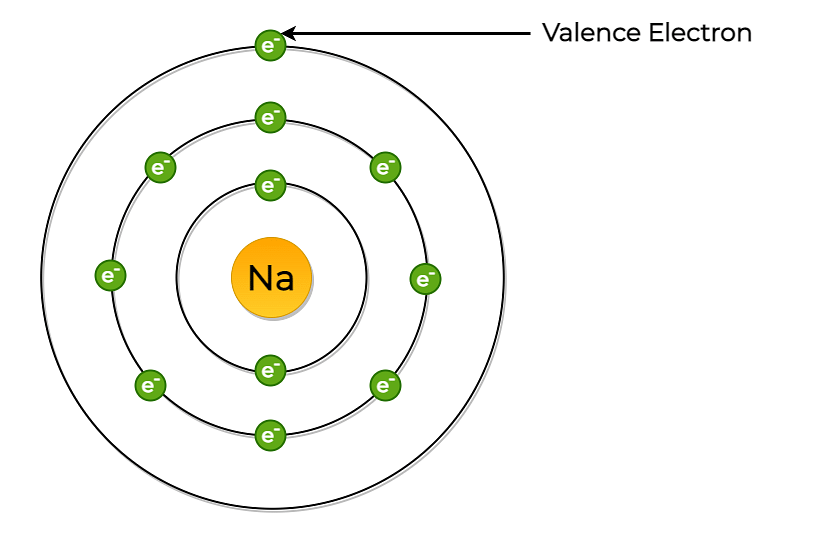
Valency of Sodium

Valency of Sodium

Also read:

CBSE CLASS XII Related Questions

  • 1.
    From the given data of \(E^{\circ}\) values, answer the following questions :
    (I) Why \(E^{\circ}_{M^{2+}/M}\) show irregular trend in the above values ?
    (II) Why is \(E^{\circ}_{Cu^{2+}/Cu}\) value exceptionally positive ?
    (III) Why \(E^{\circ}_{Mn^{2+}/Mn}\) value is highly negative ?


      • 2.

        A reaction \( \mathrm{A \rightarrow B} \) follows second order kinetics. How will the rate of reaction be affected if the concentration of (i) A is increased by three times, and (ii) A is reduced to half ?


          • 3.
            Consider the decomposition of hydrogen peroxide \( (\mathrm{H_2O_2}) \) as per the equation given below : \[ 2\mathrm{H_2O_2} \xrightarrow[\text{Alkaline medium}]{I^-} 2\mathrm{H_2O} + \mathrm{O_2} \] The mechanism for this reaction was found to be : Step I : \( \mathrm{H_2O_2} + I^- \longrightarrow \mathrm{H_2O} + IO^- \) (slow) Step II : \( \mathrm{H_2O_2} + IO^- \longrightarrow \mathrm{H_2O} + I^- + \mathrm{O_2} \) (fast) (a) Write the rate law expression. (b) Determine the order of reaction with respect to \( \mathrm{H_2O_2} \), \( I^- \) and overall order of reaction. (c) What is the molecularity of the reaction in Step II ?


              • 4.

                (a) Define 'Denatured Protein' with an example.

                (b) What happens when glucose reacts with HCN ? Write the reaction involved.

                (c) Name the disease caused by the deficiency of Vitamin C.


                  • 5.
                    Write the name of basic building units of proteins and nucleic acids. How can you differentiate between Fibrous and Globular proteins on the basis of their structures ?


                      • 6.

                        (i) Why do Zr and Hf exhibit similar properties ?

                        (ii) "\( E^\circ \) for \( \mathrm{Mn^{3+}/Mn^{2+}} \) couple is more positive than that for \( \mathrm{Fe^{3+}/Fe^{2+}} \)." Justify the statement.

                        [Atomic number : Mn = 25, Fe = 26]

                          CBSE CLASS XII Previous Year Papers

                          Comments


                          No Comments To Show
