



Education Content Expert
Trigonometric Ratios of Standard Angles are the six trigonometric ratios for the standard angles 0°, 30°, 45°, 60° and 90°. Trigonometry is a branch of mathematics that studies the relationships between the sides and angles of a right-angled triangle.
- Trigonometric Ratios of Standard Angles are used to relate the sides of a right triangle to the angles of the triangle.
- There are six trigonometric ratios namely Sine, Cosine, Tangent, Cotangent, Secant, and Cosecant.
- Sine, Cosine, and Tangent are primary trigonometric ratios.
- Cosec, Sec, and Cot are other important trigonometric ratios that can be derived using sin, cos, and tan respectively.
- These ratios are defined for acute angle (Less than 90o) in a right-angled triangle.
- They are typically denoted using the symbols sin θ, cos θ, and tan θ, where θ represents the angle measure.
- The standard angles of trigonometric ratios are 0°, 30°, 45°, 60° and 90°.
- Standard angles can also be expressed in Radians such as 0, π/6, π/4, π/3, and π/2.
Read More: NCERT Solutions for Class 11 Mathematics Trigonometric Functions
Key Terms: Trigonometric Ratios, Right-angled Triangle, Hypotenuse, Sine, Cosine, Tangent, Cotangent, Secant, Cosecant
What are Trigonometric Ratios?
[Click Here for Sample Questions]
Trigonometric Ratios are the ratios of the length of sides of a right-angled triangle in Trigonometry. Trigonometric ratios relate the ratio of sides of a right triangle to the respective angle.
There are six Trigonometric Ratios namely:
- Sine (sin)
- Cosine (cos)
- Tangent (tan)
- Cotangent (cot)
- Secant (sec)
- Cosecant (cosec)
Sine (sin), Cosine (cos), and Tangent (tan) are the primary trigonometric ratios while Cotangent (cot), Secant (sec), and Cosecant (cosec) can be derived from sin, cos, and tan respectively.
Trigonometric Functions Detailed Video Explanation
Read More:
Trigonometric Ratios Definition
[Click Here for Previous Years’ Questions]
In trigonometry, there are six trigonometric ratios namely Sine, Cosine, Tangent, Cotangent, Secant, and Cosecant. They are used to determine the ratios of any two sides of a right-angled triangle in terms of their respective angles. The values of trigonometric ratios can be calculated using the measure of an acute angle, θ.
Consider a right-angled triangle ABC with an acute angle, θ at C.
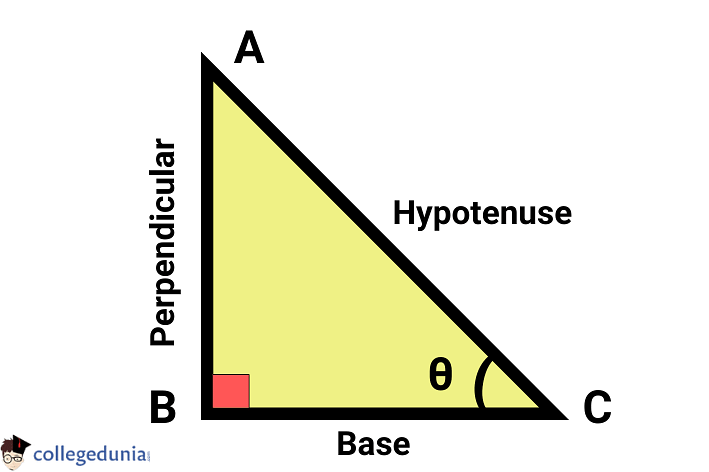
Right-angled Triangle ABC
The six trigonometric ratios can be thus defined as:
- Sine: Sine Ratio is defined as the ratio of the perpendicular to the hypotenuse. In the given triangle, sin θ = AB/AC.
- Cosine: Cosine Ratio is defined as the ratio of the base to the hypotenuse. In the given triangle, cos θ = BC/AC.
- Tangent: Tangent Ratio is defined as the ratio of the perpendicular to the base. In the given triangle, tan θ = AB/BC.
- Cosecant: Cosecant Ratio is defined as the ratio of the hypotenuse to the perpendicular. In the given triangle, cosec θ = AC/AB.
- Secant: Secant Ratio is defined as the ratio of the hypotenuse to the base. In the given triangle, sec θ = AC/BC.
- Cotangent: Cotangent Ratio is defined as the ratio of the base to the perpendicular. In the given triangle, cot θ = BC/AB.
Trigonometric Ratios Formulas
[Click Here for Sample Questions]
Trigonometric Ratios are defined as the ratio of any two sides of the right-angled triangle. Given below are the basic trigonometric ratios formulas:
- sin θ = Perpendicular/Hypotenuse
- cos θ = Base/Hypotenuse
- tan θ = Perpendicular/Base
- sec θ = Hypotenuse/Base
- cosec θ = Hypotenuse/Perpendicular
- cot θ = Base/Perpendicular
It can be noticed that some trigonometric ratios are reciprocal of others such as sin θ is a reciprocal of cosec θ, cos θ is a reciprocal of sec θ, tan θ is a reciprocal of cot θ, and vice-versa. Thus, it results in another set of trigonometric ratios formulas:
- sin θ = 1/cosec θ
- cos θ = 1/sec θ
- tan θ = 1/cot θ
- cosec θ = 1/sin θ
- sec θ = 1/cos θ
- cot θ = 1/tan θ
Read More: Trigonometric Formulas
Trigonometric Ratios of Standard Angles
[Click Here for Previous Years’ Questions]
Sine, Cosine, Tangent, Cotangent, Secant and Cosecant are the six trigonometric ratios. The standard angles for these trigonometric ratios include 0°, 30°, 45°, 60° and 90°. The values of the standard angles of trigonometric ratios can easily be checked from the Trigonometry Table.
Here are the values of Trigonometric Ratios of Standard Angles in Trigonometry:
| Trigonometry Ratios Table | |||||
|---|---|---|---|---|---|
| Angles (In Degrees) | 0° | 30° | 45° | 60° | 90° |
| Angles (In Radians) | 0° | π/6 | π/4 | π/3 | π/2 |
| sin θ | 0 | 1/2 | 1/√2 | √3/2 | 1 |
| cos θ | 1 | √3/2 | 1/√2 | 1/2 | 0 |
| tan θ | 0 | 1/√3 | 1 | √3 | ∞ |
| cot θ | ∞ | √3 | 1 | 1/√3 | 0 |
| cosec θ | ∞ | 2 | √2 | 2/√3 | 1 |
| sec θ | 1 | 2/√3 | √2 | 2 | ∞ |
Trigonometric Ratios of Standard Angles Derivation
[Click Here for Sample Questions]
Trigonometric Ratios of Standard Angles can be derived using sine, cosine, and tangent ratios.
- Sine of an angle is defined as the ratio of the length of the side opposite the angle to the length of the hypotenuse.
- Cosine of an angle is defined as the ratio of the length of the side adjacent to the angle to the length of the hypotenuse.
- Tangent of an angle is defined as the ratio of the length of the side opposite the angle to the length of the side adjacent to the angle.
Using these definitions, it is possible to derive the trigonometric ratios for standard angles by constructing a right triangle with specific angle measures and calculating the corresponding side lengths.
Trigonometrical Ratio of 45°
Let ABC be a right-angled isosceles triangle with ∠B = 90° and ∠A = ∠C = 45°. Let BC = AC = α.

Right-angled Isosceles Triangle ABC
Thus,
H2 = P2 + B2
(AC)2 = (AB)2 + (BC)2
(AC)2 = α2 + α2
(AC)2 = 2 α2
∴ AC = α√2
Using ∠C as a point of reference, the trigonometric ratios for 45° are:
- Sin 45 = AB/AC = α/α√2 = 1/√2
- Cot 45 = BC/AC = α/α√2 = 1/√2
- Tan 45 = AB/BC = α/α = 1
- Cosec 45 = AC/AB = α√2/α = √2
- Sec 45 = AC/AB = α√2/α = √2
- Cot 45 = BC/AB = α/α = 1
Trigonometrical Ratio of 60°
Assume ABC is an equilateral triangle with ∠A = ∠B = ∠C = 60°

Equilateral Triangle ABC
Thus, AB = BC = CA = 2α
Let's now draw AD perpendicular to BC so that it looks like this:

Equilateral Triangle ABC
Therefore, BD = DC = a , And ∠BAD = ∠DAC = 30°
Now, in right-angled ΔADC,
(AC)2 = (AD)2 + (DC)2
(AD)2 = (AC)2 + (DC)2
= (2α)2 - (α)2 = 4α2 - α2 = 3 α2
∴ AD = α√3
Now, to find the trigonometric ratio for 60°, let's take ∠C = 60° as the reference angle, we get,
- Sin 60 = AD/AC = α√3/2α = √3/2
- Cos 60 = DC/AC = α/2α = ½
- Tan 60 = AD/DC = α√3/2α = √3
- Cosec 60 = AC/AD = 2α/α√3 = 2/√3
- Sec 60 = AC/DC = 2α/α = 2
- Cot 60 = DC/AD = α/α√3 = 1/√3
Read More: Trigonometric Functions Important Questions
Trigonometrical Ratio of 30°
Using ∠DAC = 30° in the above triangle as the reference angle, the trigonometric ratio for 30° can be obtained.
- Sin 30 = DC/AC = α/2α = 1/2
- Cos 30 = = AD/AC = α√3/2α = √3/2
- Tan 30 = = DC/AD = α/α√3 = 1/√3
- Cosec 30 = AC/DC = 2α/α = 2
- Sec 30 = AC/AD = 2α/α√3 = 2/√3
- Cot 30 = AD/DC = α√3/2α = √3
Trigonometrical Ratio of 0°
Let ABC be a right-angled triangle with ∠B = 90° and ∠C = θ.
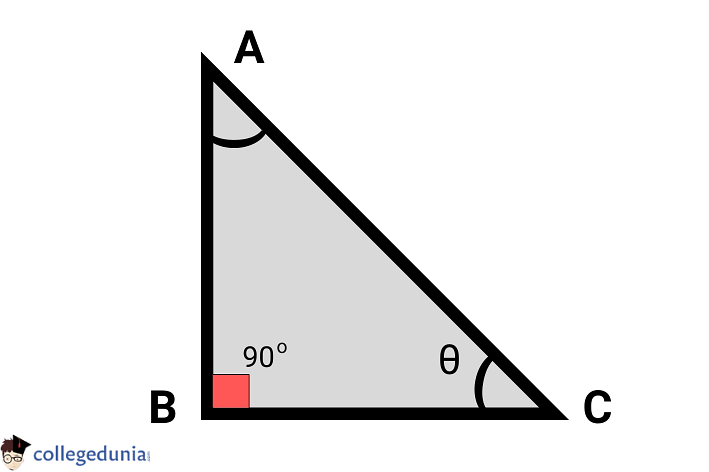
Right-angled Triangle ABC
If θ tends to 0°
i.e., AC corresponds with BC at θ → 0°.
or, AC ≈ BC
so, AC = BC = a (say)
Using Pythagoras' theorem now
h2 = p2 + b2
or, (AC)2 = (AB)2 + (BC)2
or, a2 = (AB)2 + a2
or, (AB)2 = a2 - a2 = 0
∴ AB = 0
Thus, the trigonometric ratios for 0° are:
- Sin 0 = p/h = AB/AC = 0/α = 0
- Cos 0 = b/h = BC/AC = α/α =1
- Tan 0 = p/b = AB/BC = 0/α = 0
- Cosec 0 = h/p = AC/AB = a/0 = ∞
- Sec 0 = h/b = AC/BC = α/α = 1
- Cot 0 = b/p = BC/AB = α/0 = ∞
Check More:
Trigonometrical Ratio of 90°
Let ABC be a right-angled triangle with the reference angles ∠B = 90° and ∠C = θ.
Right-angled Triangle ABC
If θ tends to 90°
i.e., AC corresponds with BC at θ → 90°.
or, AC ≈ BC
so, AC= BC = a (say)
Using Pythagoras' theorem now
H2 = P2 +B2
(AC)2 = (AB)2 + (BC)2
a2 = (BC)2 + a2
(BC)2 = a2 - a2 = 0
∴ BC = 0
Thus, the trigonometric ratios for 90° are:
- Sin 90 = p/h = AB/AC = α/α = 1
- Cos 0 = b/h = BC/AC = 0/α = 0
- Tan 0 = p/b = AB/BC = α/0 = ∞
- Cosec 0 = h/p = AC/AB = α/α = 1
- Sec 0 = h/b = AC/BC = α/0 = ∞
- Cot 0 = b/p = BC/AB = 0/α = 0
Things to Remember
- Trigonometric Ratios are ratios used to relate the ratio of sides of a right triangle to the respective angle.
- Sine, Cosine, Tangent, Cotangent, Secant, and Cosecant are six major trigonometric ratios.
- Trigonometric Ratios of Standard Angles are defined for acute angles 0°, 30°, 45°, 60° and 90°.
- Sine (sin θ) is the ratio of the perpendicular to the hypotenuse.
- Cosine (cos θ) is the ratio of the adjacent side to the hypotenuse.
- Tangent (tan θ) is the ratio of the perpendicular to the adjacent side.
- Cosecant (cosec θ) is the ratio of the hypotenuse to the perpendicular.
- Secant (sec θ) is the ratio of the hypotenuse to the adjacent side.
- Cotangent (cot θ) is the ratio of the adjacent side to the perpendicular.
For Latest Updates on Upcoming Board Exams, Click Here: https://t.me/class_10_12_board_updates
Previous Years’ Questions
- If cosec θ − cot θ = 2017, then quadrant in which θ lies is… (TS EAMCET - 2017)
- Find the value of cos(29π/3)... (JKCET - 2014)
- A value of θ satisfying sin 5θ − sin3θ + sinθ = 0 such that…
- In any triangle ABC, the simplified form of… (KCET - 2011)
- Consider a triangular plot ABC with sides AB = 7m, BC = 5m… (JEE Main - 2019)
- If the sum of all the solutions of the equation… (JEE Main - 2018)
- Let a vertical tower AB have its end A on the level ground. Let… (JEE Main - 2017)
- Which one of the following is not true… (AMUEEE - 2013)
- The number of solutions of the equation ∣cotx∣… (COMEDK UGET - 2015)
- What is the value of sin1950∘ − cos1950∘…
Sample Questions
Ques. What are Standard Angles in Trigonometry? (3 Marks)
Ans. In trigonometry, there are certain standard angles for which the trigonometric ratios can be calculated. Standard Angles in Trigonometry are the acute angles of a right-angled triangle. There are five standard angles in trigonometry as follows:
- 0 Degrees (0°)
- 30 Degrees (30°)
- 45 Degrees (45°)
- 60 Degrees (60°)
- 90 Degrees (90°)
Ques. What are Trigonometric Ratios? (3 Marks)
Ans. Trigonometric Ratios are defined as the ratios of the length of sides of a right-angled triangle in trigonometry. Trigonometric Ratios relate the ratio of sides of a right triangle to the respective angle. There are six trigonometric ratios in Trigonometry which are as follows:
- Sine (sin)
- Cosine (cos)
- Tangent (tan)
- Cotangent (cot)
- Secant (sec)
- Cosecant (cosec)
Ques. Calculate (tan 30о + sin 60о). (3 Marks)
Ans. Using the Trigonometric Ratios Table, we get
- tan 30о = 1/√3
- sin 60о = √3/2
According to the question,
(tan 30о + sin 60о) = ?
Substituting the values,
= 1/√3 + √3/2
On rationalizing the denominator,
= (2+√3.√3)/2√3
= 2+3/2√3
= 5/2√3
Thus, (tan 30о + sin 60о) is equal to 5/2√3.
Ques. What is the value of sin 45о – cos 45о? (3 Marks)
Ans. Using the Trigonometric Ratios Table, we get
- Sin 45 = 1/√2
- cos 45 = 1/√2
As per the question,
sin 45о – cos 45о = ?
Substituting the values,
1/√2 – 1/√2 = 0
Thus, sin 45о – cos 45о is 0.
Ques. Calculate (sin2 30° + sin2 45° + sin2 60°). (3 Marks)
Ans. Using the Trigonometric Ratios Table, the values are:
- sin 30° = 1/2
- sin 45° = 1/√2
- sin 60° = √3/2
sin230° + sin245° + sin260°
= (½)2 + (1/√2)2 + (√3/2)2
= ¼ + ½ + ¾
= (1+2+3)/4
= 6/4
= 3/2
Thus, (sin2 30° + sin2 45° + sin2 60°) is equal to 3/2.
Ques. The value of tan 30°/cot 60° is:
(a) 1/√2
(b) 1/√3
(c) √3
(d) 1 (2 Marks)
Ans. (d) 1
Explanation: Using the Trigonometric Ratios Table,
- tan 30o = 1/√3
- cot 60o = 1/√3
Hence,
tan 30o/cot 60o = (1/√3)/(1/√3) = 1
Ques. (sin 45° + cos 45°) has a value of:
(a) 1/√2
(b) √2
(c) √3/2
(d) 1 (2 Marks)
Ans. (b) √2
Explanation: Using the Trigonometric Ratios Table,
- sin 45o = 1/√2
- cos 45o = 1/√2
sin 45o + cos 45o = 1/√2 + 1/√2
⇒ sin 45o + cos 45o = 2/√2 = √2
Thus, sin 45o + cos 45o is equal to √2.
Ques. tan2 30° – 4 sin2 45° is equal to
(a) 1
(b) 7/3
(c) – 5/3
(d) – 11/3 (2 Marks)
Ans. (c) – 5/3
Explanation: Using the Trigonometric Ratios Table,
- tan 30o = 1/√3
- sin 45o = 1/√2
tan2 30° – 4 sin2 45° = (1/√3)2 – 4 × (1/√2)2
1/3 – 4 × 1/2
= – 5/3
Thus, tan2 30° – 4 sin2 45° is equal to -5/3
Ques. If the value of A is 30°, the value of 2 Sin A Cos A is:
(a) 1/√2
(b) √3/2
(c) 1/2
(d) 1 (2 Marks)
Ans. (b) √3/2
Explanation: Using the Trigonometric Ratios Table,
- sin 30 = 1/2
- cos 30 = √3/2
2 Sin A Cos A = 2 × 1/2 × √3/2 = √3/2
Thus, the value of 2 Sin A Cos A when A is 30° is √3/2.
Ques. If sin α = 1/2, then what will be the value of (3 cos α – 4 cos3α)? (2 Marks)
Ans. Since sin α = 1/2
sin 30 = 1/2
α = 30
Now, 3 cos 30 – 4 cos3 30
= 3(√3)/2 – 4(√3/2)3
= 3x √3/2 – 4(3x √3)/8
= 12x √3/8 – 12x √3/8
= 0
Check-Out:



Comments