



Education Journalist | Study Abroad Lead
Convex Lens is a type of converging lens that converges light rays going parallel to its primary axis. They are thicker at the centre and narrower on the bottom and top edges. When concurrent light beams travel through the lens, the refracted rays converge at a single point known as the principal focus. The angle at which light rays enter a convex lens is determined by the object's distance from the lens. These lenses can be used in various places however the most significant application of a convex lens is in the human eye. Besides, convex lenses are used in microscopes, telescopes, projectors, etc.
| Table of Content |
Key Terms: Convex Lens, Plano-Convex Lens, Biconvex Lens, Microscopes, Human Eye, Light Rays, Refraction, Telescopes
Uses of Convex Lens
[Click Here for Sample Questions]
Some of the most important uses of Convex Lens are discussed below in detail:
- Eyeglasses
Convex lenses are used in eyeglasses for people who are farsighted or have hypermetropia. This condition causes people to focus the image at a greater distance behind the retina making it difficult for them to focus on objects closer to their eye. This is caused due to the decreased ability of the lens to refract light.
This is where the convex lenses play a role, these lenses assist the eyes by bending the light rays which shortens the focal point before reaching the eye lens resulting in the image being properly placed on the retina.
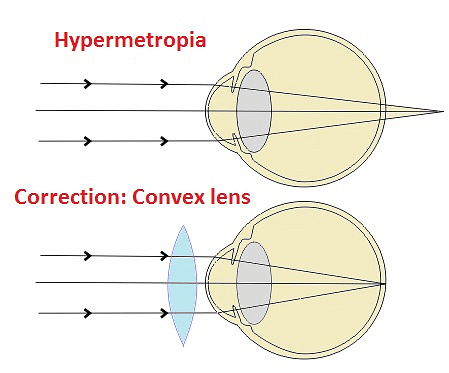
Correction of Hypermetropia By Convex Lens
- Microscopes
Microscopes are used to magnify very small objects such as bacteria, microbes etc. Convex lenses play a role by converging all the light rays to one point and hence magnifying the image. A combination of three convex lenses is used in a basic microscope in order to achieve this effect.
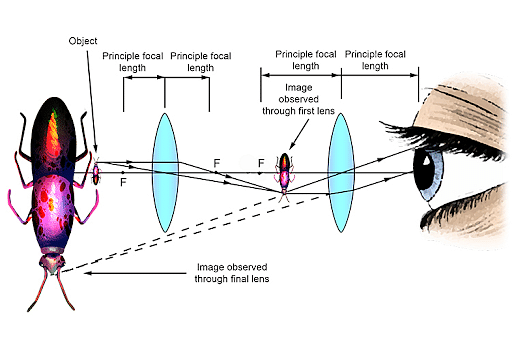
Use of Convex Lens in Microscopes
- Magnifying Glasses
The magnifying glass directs all the incoming light to the focal point which is situated directly in front of the lens. When the object’s distance from the lens is lesser than the focal length the magnifying lens is said to be at the optimal distance and the image is hence magnified. The greatest magnification is achieved when the object is placed at the focal point.
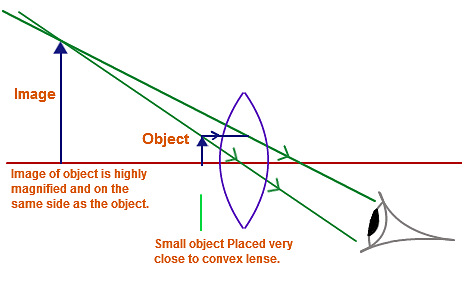
Magnification Through Convex Lens
- Camera Lenses
Convex lenses are commonly used in cameras to not only help focus but also magnify images. With the help of a combination of 3 lenses (convex-concave-convex) wherein one of the convex lenses is used to adjust the magnification of the image by the means of moving closer to or away from the said object.

Convex Lens in Camera Lens
- Telescopes
Telescopes help in viewing distant objects such as meteors, stars and planets. They are of two types of telescopes one being refracting and another reflecting. Mirrors are used by reflecting telescopes, whereas, refracting telescopes use convex lenses. A refracting telescope is made up of two convex lenses. The first lens is used for converging the light rays while the second lens is used to magnify the image.
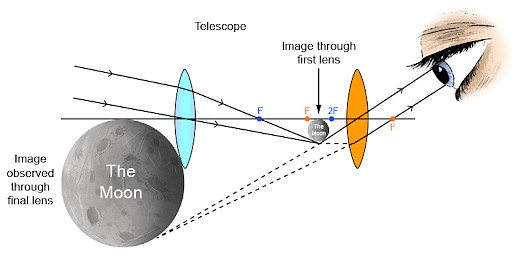
Use of Convex Lens in Telescopes
- Projectors
Projectors are devices that can display images or videos on large displays. The idea underlying a projector's operation is the magnification of the picture or video displayed on the film. When an object is one to two focal lengths away from the lens, the picture formed by the lens is magnified, real, and inverted. In order for the projected image to be presented correctly, the film must be inserted into the projector upside down.

Convex Lens in Projectors
Read more:
| Related Links | ||
|---|---|---|
| Toric Lens | Macro Lens | Power of a Lens |
| Uses of Microscope | Uses of Convex Mirror | Refraction |
Types of Convex Lens
[Click Here for Sample Questions]
Convex lenses can be of three types- plano-convex, biconvex and concave-convex.
- Plano-Convex Lens
A plano-convex lens bends outward from one side to the other. These lenses are designed to allow unlimited use of the same light in non-sensitive applications.

Plano-Convex Lens
- Biconvex Lens
These are also called double convex lenses. These are curved outwards from both sides and have a shorter focal length than that of plano-convex but are equal in diameter and surface radius.
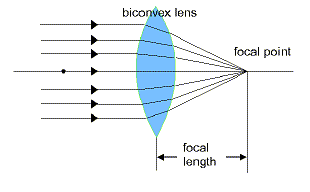
Biconvex Lens
- Concave-Convex Lens
These lenses are a hybrid of concave and convex lenses that turn inward from one edge and outward from the other. They are mostly used to control laser beams.
Things to Remember
- Convex lenses are broader from the centre and thin at the top and bottom edges.
- Convex lenses are of three types: Plano-Convex, Biconvex and Concave-Convex.
- Convex lenses can help in magnifying focusing objects and images.
- The uses of convex lenses can be in optical devices such as telescopes and projectors.
- Hypermetropia can be assisted by the help of convex lenses by focusing the image properly on the retina.
Read more:
Sample Questions
Ques. Why do we prefer a convex mirror as a rear-view mirror in vehicles? And how is the image of the object when using a convex lens? (3 Marks)
Ans. Convex lenses give out an erect image and have a wider field of view as they are curved outwards, The dimensions of the image formed by the convex mirror are usually smaller than the dimensions of the object or vehicle which allows the driver to see most of the traffic behind him. The kind of image formed by a convex lens is an inverted, real image of the object.
Ques. List and explain three uses of convex lenses. (3 Marks)
Ans. The three uses of convex lenses are:
- They are used in camera lenses for their ability to focus light and magnify pictures.
- They are used in telescopes and microscopes to focus all light on a specific point and hence magnify the image.
- They are used in eyeglasses for the correction of hypermetropia or farsightedness
Ques. A student focuses the image of a well-illuminated distant object on a screen using a convex lens. After that, the student steadily moves the object towards the lens and focuses its image each time on the screen by adjusting the lens. (3 Marks)
(i) In which direction does he move the lens- towards the screen or away from the screen?
(ii) What happens to the size of the image-does it decreases or increases?
(iii) What happens to the image on the screen when he moves the object very close to the lens?
Ans. (i) The student moves the lens away from the screen as the distance between the screen and the lens is to be increased for the image to be proper.
(ii) The size of the image decreases as the lens keeps moving away.
(iii) The image on the screen disappears as the distance between the lens and the object is too less.
Ques. Which lenses are used in projectors and what is the principle behind their working? (3 Marks)
Ans. Projectors use convex lenses in order to magnify an image or a video provided to it. The working principle behind a projector is magnification, however, the object must be one to two focal lengths away from the lens. The projector also requires the image or film to be provided invertedly for the final output to be proper.
Ques. How can hypermetropia be assisted by using convex lenses? Explain using a diagram. (3 Marks)
Ans. A convex lens of adequate power can be used to correct hypermetropia. The convex lens helps the eyes by bending light rays, shortening the focal point before it reaches the eye lens and also converging light rays, forming the final image from the human eye lens properly on the retina.

Hypermetropia be assisted by using convex lenses
Ques. Explain how convex lenses are used in binoculars. (3 Marks)
Ans. Two convex lenses are placed, one in front of the other. The first lens/objective collects light rays from a distant object and focuses them a short distance behind the lens. The objective lens is so named because it is closest to the object you're looking at. The second lens captures the picture and magnifies it. It's known as the eyepiece. Light beams from a distant object can overlap when they pass through a convex lens, making the image look inverted. So, binoculars have a pair of prisms to rotate the image 180 degrees.
Ques. What are the types of convex lenses and what are their uses? (3 Marks)
Ans. There are three types of convex lens namely Plano-convex, biconvex and convex-concave.
Magnifiers, telescopes, collimators, condensers, imaging tools and so many more optical devices use convex lenses. Biconvex lenses are employed as burning glasses and for other real-life applications such as magnifying/condensing lenses and magnifiers. A combination of the concave-convex lenses is used in cameras to magnify and focus images properly.
For Latest Updates on Upcoming Board Exams, Click Here: https://t.me/class_10_12_board_updates
Also Check:



Comments