



Education Journalist | Study Abroad Lead
The animal kingdom is a vast region in which all animals are categorized based on their anatomical characteristics. It can be difficult to memorize and remember the entire animal kingdom's classification. This is where you may access the best animal kingdom mind map created by qualified biology lecturers. The fundamentals of classification have been so well churned into a mind map that they have become implanted in your memory. It can be used to record animal kingdom characteristics, organization, classes, and phyla, among other things.
Also Read: Classification of Animal Kingdom
| Table of Content |
What is a Concept Map?
[Click Here for Sample Questions]
As previously said, the animal kingdom is extremely diverse. In comparison to a human, it is estimated that there are 200 million insects. Consider the size of the animal kingdom as a whole. When there is no specific process to follow, defining the many sorts of genus and species might take a long time. This is where the animal kingdom classification map can come in handy. It functions as a universal language, allowing any animal enthusiast, student, or zoologist to comprehend which species is being discussed.
You'll need the help of a mind map of the animal kingdom to comprehend and remember this massive classification. Experts created the mind map in such a way that pupils may readily memorize the phyla, classes, and species without difficulty. It is made up of basic and unique traits that aid in the identification of animals. In fact, it will assist us in properly remembering all of the current phyla, species, and classification hierarchies.
To create a well-defined concept map of animal kingdom classification, various concepts are used. Based on the attributes used to define the map, this allows students and mentors to communicate effectively. This map is made up of a flow chart in which the classes are established and put according to their unique characteristics. What you must keep in mind are the features. A handful of the most important ones can aid you in distinguishing between the various classifications in the animal kingdom idea map.
Also Read:
| Related Articles | ||
|---|---|---|
| Difference Between Moth and Butterfly | Living Fossils | Difference Between Reptiles and Amphibians |
| Mammalia | Taxonomy | Taxonomic Hierarchy of Plants and Animals |
How to create a Concept Map?
[Click Here for Sample Questions]
The hierarchy of the anatomical traits of the animals is one of the most recognized conceptions. The vertebral column is the starting point. The existence or absence of the spinal column becomes significant in the majority of the maps.
Another animal kingdom classification idea map is based on the presence and distinction of bodily cavities. We reached the phylum Chordata after further separating the animal kingdom and identified the presence of creatures with vertebral columns. You may quickly fill the concept map of animal kingdom classification in any acceptable format using this idea.
Read more: Phylum Chordata Classification
Advantages of Concept Map
[Click Here for Sample Questions]
The following are some of the benefits of using a concept map:
- Understanding Every Organizational Level on the Map- The idea map for multicellular animals uses four different layers of an organization. The first is on a cellular scale. The tissue level is the second. The organ level of organization is the third, and the organ system level is the fourth. This level of organization addresses the creatures' most important characteristics.
- Ease of Defining a Species' Position in the Classification Map - When you look at a concept map, you'll see that the classifications are based on a specific set of characteristics. If an animal's characteristics have been mentioned, you may easily take the suggestions and evaluate the criteria to classify that species step by step. It indicates that mind mapping the classification will provide the simplest platform for determining the animal's location. Its genus and species, as well as the phylum, are simply defined.
- Layers of Germs- Animal taxonomy is also determined by the embryonic layers. Diploblastic (two layers) and triploblastic (three layers) are the two classes (three layers).
- Concentrating on R. H. Whittaker's Proposed Map- The syllabus is primarily concerned with classifying multicellular animals into major categories. R H Whittaker proposed the five-kingdom scheme. He was a well-known ecologist who developed a remarkable idea map of the animal kingdom using an amazing method. It undoubtedly aids ecologists, students, researchers, mentors, and other academicians in identifying and describing the animal phylum and classification.

Five Kingdom Classification
- Body Symmetry- The symmetry of an animal's body can be used to classify it. Asymmetrical, bilaterally symmetrical, and radically symmetrical bodily symmetry are the three forms.
Concept Map of the Animal Kingdom
[Click Here for Sample Questions]
Below are given some of the concept maps of the animal kingdom:
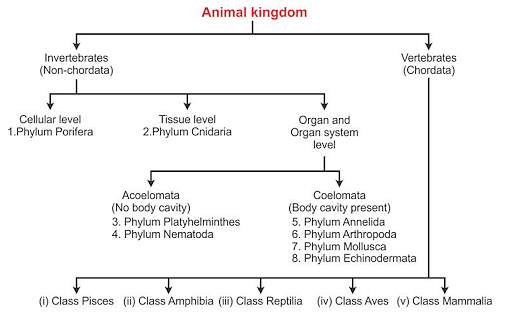
Concept maps of the animal kingdom
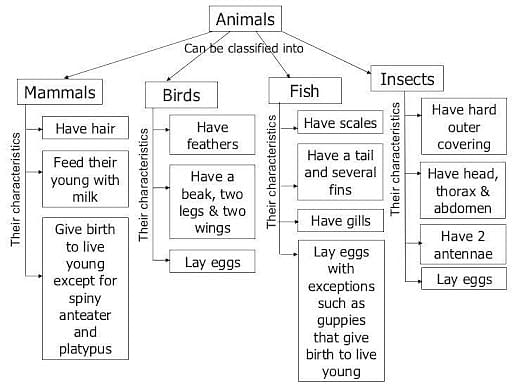
Animal's Classification
Also Read: Five Kingdom Classification
Things to Remember
- The animal kingdom is extremely diverse. In comparison to a human, it is estimated that there are 200 million insects. This is where the animal kingdom classification map can come in handy. It functions as a universal language, allowing any animal enthusiast, student, or zoologist to comprehend which species is being discussed.
- It is made up of basic and unique traits that aid in the identification of animals.
- To create a well-defined concept map of animal kingdom classification, various concepts are used. Based on the attributes used to define the map, this allows students and mentors to communicate effectively.
- This map is made up of a flow chart in which the classes are established and put according to their unique characteristics.
- The hierarchy of the anatomical traits of the animals is one of the most recognized conceptions. The vertebral column is the starting point. The existence or absence of the spinal column becomes significant in the majority of the maps.
- The idea map for multicellular animals uses four different layers of the organization. The first is on a cellular scale. The tissue level is the second. The organ level of organization is the third, and the organ system level is the fourth.
- Mind mapping the classification will provide the simplest platform for determining the animal's location. Its genus and species, as well as the phylum, are simply defined.
- Animal taxonomy is also determined by the embryonic layers. Diploblastic (two layers) and triploblastic (three layers) are the two classes (three layers).
- The syllabus is primarily concerned with classifying multicellular animals into major categories. R H Whittaker proposed the five-kingdom scheme.
- The symmetry of an animal's body can be used to classify it. Asymmetrical, bilaterally symmetrical, and radically symmetrical bodily symmetry are the three forms.
Do Check Out :
Sample Questions
Ques. What Is the Animal Kingdom's Classification Based on Its Organization? (1 mark)
Ans. The animal kingdom is divided into two sub-kingdoms based on their organisation: metazoan (multicellular organisms) and protozoa (protozoa) (unicellular entities).
Ques. What are some examples of warm-blooded and cold-blooded animals? (2 marks)
Ans. Warm-blooded creatures include birds and mammals.
Cold-blooded animals include all amphibians, such as frogs, toads, and salamanders, as well as aquatic animals like alligators, crocodiles, sharks, lizards, fish, snakes, turtles, and tortoises, and insects like dragonflies and bees.
Ques. What are the characteristics of triploblastic animals? (2 marks)
Ans. Triploblastic animals are those that have three germ layers: ectoderm, mesoderm, and endoderm. Triploblastic animals include Molluscs, Worms, Arthropods, Echinodermata, and Vertebrates, which are all multicellular animals.
Ques. What role do feathers play in the lives of birds? (3 marks)
Ans. Feathers can be found in all kinds of birds (Aves).
- They are epidermal growths seen on both the wings and the tail that produce the characteristic outer coating of the bird's body.
- Feathers assist birds in a variety of ways, including flying control.
- To protect themselves from predators, they use camouflage.
- Different feather patterns and attractive colours are part of the sexual dimorphism in many bird species.
- Birds are protected from water and cold temperatures, and their eggs and young are also protected.
- Feathers are utilised by some birds, such as the owl and the woodpecker, for balancing while walking on the ground, climbing trees, and hearing and making varied noises including drumming, buzzing, and whistling.
Ques. What categories do we use to categorise animals? What are the several ways that creatures are classified into phyla? (3 marks)
Ans. The level of bodily organisation, symmetry, the existence or absence of coelom, and similarities in the circulatory, digestive, respiratory, and reproductive systems, among other factors, are used to classify animals.
Animals are classified into phyla based on their body organisation, symmetry, body cavity, notochord, and other characteristics.
Ques. What is the categorisation of the five kingdoms? Which animal group has the most members? (3 marks)
Ans. R. H. Whittaker established the five-kingdom classification based on cell structure, mechanism of nourishment, body organisation, and evolutionary relationship. Monera, Protista, Fungi, Plantae, and Animalia are their names.
Insects are the largest group of animals in the Arthropoda phylum.
Ques. What Is the Best Way to Classify Animals? A snail belongs to which animal classification? (3 marks)
Ans. Animals are classified into distinct phyla and subphyla in the animal kingdom based on their physical traits.
Snail Scientific Classification\Kingdom – Animalia
Phylum – Mollusca
Class – Gastropoda
Order – Achatinoidea
Scientific Name – Achatinoide
Snails and slugs are represented in the Phylum Mollusca by the Class Gastropoda. The majority of gastropods have a single spirally coiled shell from which they can remove their bodies. Most members of the Mollusca class Gastropoda with coiled shells are referred to as snails. Gastropoda is the phylum Mollusca's largest and most diversified class, with around 75,000 extant species.
For Latest Updates on Upcoming Board Exams, Click Here: https://t.me/class_10_12_board_updates
Check-Out:



Comments