



Education Journalist | Study Abroad Lead
Isobars are atoms of different elements with the same mass number but different atomic numbers. The electronic configurations of isobars are different from each other.
Examples of Isobars
An example of isobars include –
- Argon (Ar1840)
- Potassium (K1940)
- Calcium (Ca2040)
In these isobars, the atomic number of the 3 elements are 18, 19, and 20. While all these atoms have the same mass number i.e. 40.
So they have the same mass number but different atomic numbers and electronic configurations, hence they are isobars.
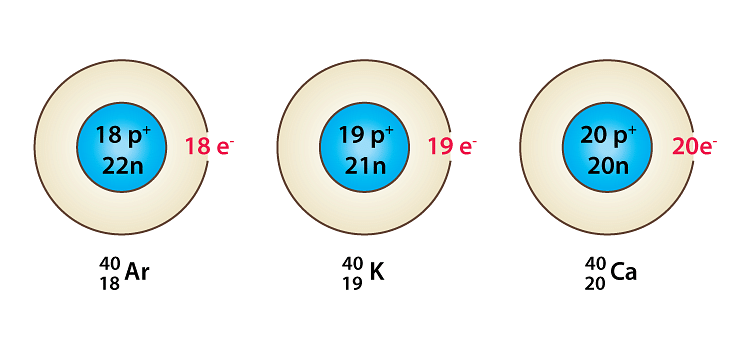
Electronic Configuration for Isobars
The electronic configuration of these isobars is –
As the number of electrons in these isobars is different, hence they have distinct electronic configurations.
Properties of Isobars
Isobars have different chemical properties due to a difference in the number of electrons in their shells.
- An additional number of neutrons balances the difference in the number of nucleons.
- Another example of Isobars is iron and nickel.
- Both of the elements have 58 as the mass number.
- The atomic number of iron and nickel is 26 and 28 respectively.
Read more:



Comments