




JEE Advanced Thermodynamics accounts for roughly 8%–12% of the Physics paper and 6%–8% of the Chemistry paper. Across Paper 1 and Paper 2 together, expect 5 to 7 questions, worth roughly 18 to 26 marks, from thermal concepts.
The JEE Advanced thermodynamics syllabus spans Thermal Physics in Physics and Chemical Thermodynamics in Physical Chemistry. The two subjects use different sign conventions and test different process types.
- Physics has 5 major topic areas:
- Thermal Expansion
- Calorimetry
- Heat Transfer
- KTG
- Laws of Thermodynamics
- Blackbody Radiation
- Chemistry has 3 major topic areas: System Properties and First Law, Thermochemistry and Enthalpy, and Second Law and Spontaneity.
- Laws of Thermodynamics carry the highest Physics weightage. This area contributes approximately 5%–6%, with around 2 questions.
- Entropy and Gibbs Energy lead in Chemistry. They account for approximately 3%–4% weightage, with 1–2 expected questions.
- KTG contributes around 2%–3% in Physics. Focus on degrees of freedom, gas mixtures, specific heats and molecular speeds.
- Sign conventions differ between the 2 subjects. Physics uses
 , while Chemistry uses
![U=q+w]() .
 .
Related Links:
- Thermodynamics JEE Advanced Previous Year Questions with Solutions and Weightage
- JEE Advanced Syllabus 2027: Subject-Wise Topics, Chapter-Wise Weightage and PDF Download
- JEE Advanced 2027 Preparation Tips: Timetable, Section-Wise Tips & Best Books
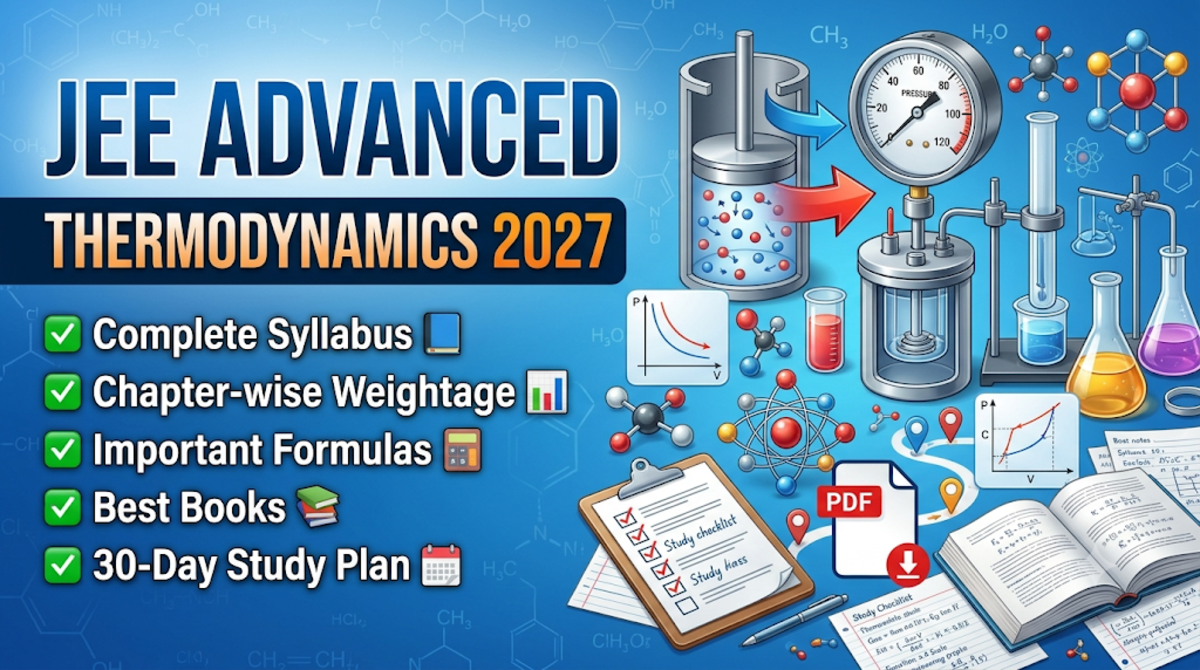
Key Summary
- Physics thermodynamics covers 5 topics: Thermal Expansion & Calorimetry, Heat Transfer, Kinetic Theory & Gas Laws, Laws of Thermodynamics, and Blackbody Radiation.
- Chemistry thermodynamics covers 3 topics: System Properties & First Law, Thermochemistry & Enthalpy, and Second Law & Spontaneity.
- Laws of Thermodynamics & Processes is the biggest Physics block, at 5%–6%.
- Second Law, Entropy & Gibbs Energy is the biggest Chemistry block, at 3%–4%.
- The 30-day plan ends with PYQs from 2015–2026, a mixed mock test, and a final revision of formula sheets.
JEE Advanced Thermodynamics Syllabus 2027
The JEE Advanced thermodynamics syllabus for 2027 is split across two subjects.
- Physics (Thermal Physics) focuses on the mechanical behaviour of heat, ideal gases, and thermal energy transfer.
- Chemistry (Physical Chemistry) focuses on energy changes during chemical reactions, state functions, and the criteria for spontaneity.
- The First Law in Physics applies strictly to ideal gases.
- Work in Chemistry covers pressure-volume work only.
- Blackbody Radiation is a Physics-only topic. It includes Kirchhoff's law, Wien's displacement law, and Stefan's law.
| Subject | Topic | Important Subtopics |
|---|---|---|
| Physics: Thermal Physics & Thermodynamics | Thermal Expansion & Calorimetry | Thermal expansion of solids, liquids and gases; calorimetry; latent heat |
| Heat Transfer | One-dimensional heat conduction; elementary convection and radiation; Newton's law of cooling | |
| Kinetic Theory & Gas Laws | Ideal gas laws; specific heats (Cv and Cp) of monoatomic and diatomic gases; bulk modulus of gases | |
| Laws of Thermodynamics | Equivalence of heat and work; First Law and its applications to ideal gases; isothermal and adiabatic processes; Second Law; reversible and irreversible processes; Carnot engine and efficiency | |
| Blackbody Radiation | Absorptive and emissive powers; Kirchhoff's law; Wien's displacement law; Stefan's law | |
| Chemistry: Chemical Thermodynamics | System Properties & First Law | Intensive and extensive properties; state functions; First Law; internal energy; pressure-volume work; heat |
| Thermochemistry & Enthalpy | Enthalpy; heat capacity; standard states; Hess's law; enthalpy of reaction, fusion, vaporization and lattice enthalpy | |
| Second Law & Spontaneity | Second Law of Thermodynamics; entropy; Gibbs energy; thermodynamic criteria for equilibrium and spontaneity |
Ques. What is the JEE Advanced thermodynamics syllabus?
Ans. Thermal Physics in Physics and Chemical Thermodynamics in Physical Chemistry, with 5 Physics topics and 3 Chemistry topics.
Ques. Is thermodynamics asked in both Physics and Chemistry in JEE Advanced?
Ans. Yes. It appears in both, with different focus and different sign conventions.
Check Out:
- Chemical Thermodynamics: JEE Advanced Previous Year Questions with Solutions and weightage
- Download JEE Advanced 2026 Question Paper with Solutions: Access JEE Advanced Previous Year Papers (2007-2025) in PDF Format
Difference Between JEE Advanced Thermodynamics: Chemistry and Physics
The two subjects in JEE Advanced approach systems, processes, and applications from different angles.
- Physics covers heat engines, cyclic processes, and mechanical work; Chemistry focuses on reaction energy and spontaneity.
- Physics primarily deals with ideal gases; Chemistry covers solids, liquids, solutions, and reaction systems.
- Physics includes PV and mechanical work; Chemistry focuses on PV work against external pressure.
- Physics emphasises reversible processes; Chemistry covers irreversible and free expansions.
- Physics applies it to Carnot cycles and engine efficiency; Chemistry uses entropy and Gibbs energy to determine spontaneity.
- Physics includes heat transfer, calorimetry and thermal expansion; Chemistry covers thermochemistry, Hess's law, bond energy and lattice enthalpy.
Sign conventions are the most common source of errors. Check the section before applying formulas.
| Parameter | Physics Thermodynamics | Chemistry Thermodynamics |
|---|---|---|
| First Law Formula | Q = ΔU + W | ΔU = q + w |
| Work Done BY the System | Positive (+W). Expansion gives positive work | Negative (−w). Expansion gives negative work |
| Work Done ON the System | Negative (−W). Compression gives negative work | Positive (+w). Compression gives positive work |
| Work Formula (Reversible) | W = +∫P dV | w = −∫P_ext dV |
| Heat Absorbed by System | Positive (+Q) | Positive (+q) |
| Heat Released by System | Negative (−Q) | Negative (−q) |
Ques. What is the difference between Physics and Chemistry thermodynamics in JEE Advanced?
Ans. Physics uses Q = ΔU + W with work done by the gas as positive. Chemistry uses ΔU = q + w with work done on the system as positive.
Check Out:
- Thermodynamics Important Questions
- JEE Advanced Chapter-Wise Weightage 2027: Important Topics, Mark Distribution & Previous Year Question Analysis
- JEE Advanced 2026 Question Paper (Available)- Download Paper 1 and Paper 2 Question Paper with Answer Key
This YouTube Video by the channel “Eduniti - Physics by Mohit Goenka_IITKGP” presents detailed solutions to four important Thermodynamics and Heat Transfer questions from JEE Advanced 2025. Mohit Goenka explains key Physics concepts, including Carnot engines, adiabatic processes, piston-cylinder equilibrium, and radiant power transfer, through step-by-step solutions.
JEE Adv 2025 Solutions | Thermodynamics & Heat Transfer 4Q | Advanced PYQs | Eduniti | Mohit Sir
JEE Advanced Question Paper with Solution PDF
| Paper Name | Question Paper Link | Solutions Link |
|---|---|---|
| JEE Advanced 2026 Question Paper – Paper 1 | Download PDF | Check Solutions |
| JEE Advanced 2026 Question Paper – Paper 2 | Download PDF | Check Solutions |
| JEE Advanced 2025 Question Paper – Paper 1 | Download PDF | Check Solutions |
| JEE Advanced 2025 Question Paper – Paper 2 | Download PDF | Check Solutions |
| JEE Advanced Question Paper 2024 – Paper 1 | Download PDF | Check Solutions |
| JEE Advanced Question Paper 2024 – Paper 2 | Download PDF | Check Solutions |
| JEE Advanced 2024 AAT Question Paper | Download PDF | Check Solutions |
JEE Advanced Thermodynamics Chapter-wise Weightage
Thermodynamics accounts for roughly 8%–12% of the Physics paper and 6%–8% of the Chemistry paper. The combined expectation is 5 to 7 questions, or roughly 18 to 26 marks.
Physics: Thermal Physics & Thermodynamics (8%–12% Weightage)
- Physics thermal topics give 3 to 4 questions across both papers combined.
- Questions often blend sub-chapters into a single multi-concept numerical or paragraph problem.
- Laws of Thermodynamics & Processes is the heaviest sub-chapter, at 5%–6% with 2 questions.
- KTG gives about 1 question, at 2%–3%.
- Heat Transfer & Radiation and Calorimetry & Thermal Expansion each give 0–1 question.
| Sub-Chapter | Approx. Weightage | Expected Questions | High-Yield Focus Areas |
|---|---|---|---|
| Laws of Thermodynamics & Processes | 5%–6% | 2 questions | First Law with ideal gases, cyclic processes (P-V, P-T, V-T graphs), and Carnot engine efficiency |
| Kinetic Theory of Gases (KTG) | 2%–3% | 1 question | Degrees of freedom, gas mixtures (Cv and γ of mixtures), and RMS/average molecular speeds |
| Heat Transfer & Radiation | 2%–3% | 0–1 question | Composite rods in series/parallel, Stefan-Boltzmann law, and Newton's law of cooling |
| Calorimetry & Thermal Expansion | 1%–2% | 0–1 question | Phase change mixtures, latent heat, and thermal stress in constrained rods |
Chemistry: Chemical Thermodynamics (6%–8% Weightage)
- Chemical thermodynamics gives 2 to 3 questions across Paper 1 and Paper 2.
- It is one of the highest-priority topics in Physical Chemistry, alongside Electrochemistry and Equilibrium.
- Second Law, Entropy & Gibbs Energy is the heaviest sub-chapter, at 3%–4% with 1–2 questions.
- First Law & Work Calculations gives about 1 question, at 2%–3%.
- Thermochemistry & Enthalpy gives 0–1 question, at 1%–2%.
| Sub-Chapter | Approx. Weightage | Expected Questions | High-Yield Focus Areas |
|---|---|---|---|
| Second Law, Entropy & Gibbs Energy | 3%–4% | 1–2 questions | ΔS for phase changes and irreversible gas expansions, ΔG = ΔH − TΔS, and spontaneity conditions |
| First Law & Work Calculations | 2%–3% | 1 question | Reversible vs. irreversible isothermal/adiabatic work, free expansion, and ΔU vs. ΔH relations |
| Thermochemistry & Enthalpy | 1%–2% | 0–1 question | Hess's law, bond dissociation enthalpy, Kirchhoff's equation, and Born-Haber cycle (lattice enthalpy) |
Ques. What is the JEE Advanced thermodynamics weightage?
Ans. About 8%–12% of the Physics paper and 6%–8% of the Chemistry paper, or 5 to 7 questions across both papers.
Ques. Which thermodynamics sub-chapter has the highest weightage?
Ans. Laws of Thermodynamics & Processes in Physics, at 5%–6%.
- Difference between Isothermal and Adiabatic Process
- Second Law of Thermodynamics: Definition, Equation, Statement
| Resource | Link |
|---|---|
| NCERT Solutions | Thermodynamics Class 11 NCERT Solutions |
| Handwritten Notes | Thermodynamics Class 11 Handwritten Notes |
| Formula Sheet | Thermodynamics Class 11 Formula Sheet |
| NCERT Book PDF | Thermodynamics Class 11 Book PDF |
How to Prepare for JEE Advanced Thermodynamics: Subject-wise Strategy 2027
Treat Physics and Chemistry as two separate problem-solving domains. Do not study them as one combined chapter.
- Physics Focus: JEE Advanced tests the application of thermal laws to mechanics and graph interpretation.
- Build Strong Fundamentals: Use H.C. Verma Vol. 2 for calorimetry, heat transfer, KTG and the First Law. Solve objective and subjective exercises.
- Practise Graph Conversions: Convert P-V diagrams into P-T and V-T graphs. Learn to identify isobaric, isochoric and isothermal processes.
- Chemistry Focus: Prioritise sign conventions, unit conversions and irreversible processes.
- Master Irreversible Expansion: Practise free expansion and expansion against constant external pressure. Calculate system, surroundings and total entropy changes.
- Connect Thermochemistry to Equilibrium: Practise Hess's Law, Born-Haber cycles and Kirchhoff's equation alongside Gibbs energy and chemical equilibrium.
- Check Units: Convert enthalpy from kJ/mol to J/mol when using entropy in J/(K·mol).
| Preparation Area | Physics Thermodynamics | Chemistry Thermodynamics |
|---|---|---|
| Foundation Building |
|
|
| Graph Interpretation |
|
|
| Numerical Practice |
|
|
| Sign Conventions |
|
|
| Important Concepts |
|
|
| Advanced Practice |
|
|
| Concept Integration |
|
|
| Common Errors to Avoid |
|
|
Ques. How to prepare for JEE Advanced thermodynamics?
Ans. Study Physics and Chemistry separately. Master graph conversions and piston problems in Physics, and irreversible processes, entropy, and spontaneity in Chemistry.
Common Traps
- Slope comparison on P-V diagrams. At the same point, the adiabatic curve is steeper than the isothermal curve. The isothermal slope is −P/V. The adiabatic slope is −γP/V.
- Efficiency trap in cyclic processes. Use η = W_net/Q_in. Count only the segments where heat enters the gas.
- Free expansion of an ideal gas. q = 0, w = 0, ΔU = 0, ΔT = 0, and ΔS_system > 0.
- Unit mismatch in ΔG. ΔH is in kJ/mol and ΔS is in J/K·mol. Convert before using ΔG = ΔH − TΔS.
As per a Reddit discussion, students discuss the following tips for thermodynamics:
- The user emphasizes that quick "one-shot" revision videos are not enough for Thermodynamics, especially for Chemistry. It requires a deep, conceptual understanding to clear JEE Advanced.
- Chemistry Thermodynamics is much broader and more detailed than Physics. While you might manage quick revision for Physics, Chemistry requires full, in-depth coverage.
- You shouldn't skip concepts like Carnot engines or entropy. In Physics, topics like irreversible processes and detailed entropy are minimal, so understanding Carnot engines properly requires learning the complete core concepts.
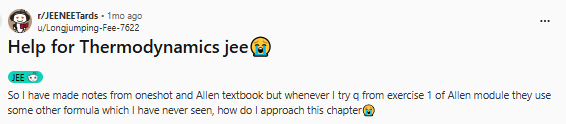
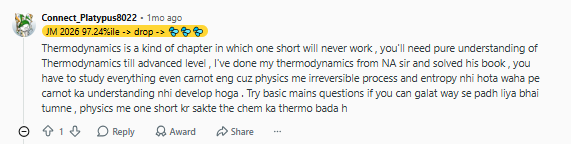
Source: Reddit
Ques. What is the sign convention for work in JEE Advanced Physics thermodynamics?
Ans. Work done by the system is positive, and the First Law is written as Q = ΔU + W.
Check Out:
- JEE Advanced 2025 Question Paper- Download Paper 1 and Paper 2 Question Paper with Answer Key
- JEE Advanced 2024 Question Paper (Available)- Download Paper 1 and Paper 2 Question Paper with Answers and Solution PDF
JEE Advanced Thermodynamics Question Types 2027
JEE Advanced thermodynamics questions repeat a small set of formats. The table lists them for JEE Advanced thermodynamics questions in Physics and in Chemistry.
- Physics questions test multi-step setups and graphical reasoning. They rarely test a single formula.
- Chemistry questions test state vs. path functions, sudden irreversible changes, and thermochemical cycles.
- Question formats include paragraph, matrix-match, and integer-type questions.
| Subject | Question Type | What It Tests |
|---|---|---|
| Physics | Cyclic process on a P-V diagram | Conversion to P-T and V-T graphs, heat absorbed vs. rejected, efficiency η = W_net/Q_in |
| Physics | Coupled piston | Pistons attached to springs, vertical cylinders with heavy pistons, U-tubes with fluids: FBD plus the First Law |
| Physics | Gas mixtures and polytropic processes | Cv and γ of mixtures, PV^x = const, limiting-case checks |
| Physics | Heat transfer and radiation | Composite rods, Stefan-Boltzmann law, Newton's law of cooling |
| Chemistry | Irreversible expansion | Sudden single-step expansion against constant P_ext, w = −P_ext ΔV |
| Chemistry | Free expansion | q = 0, w = 0, ΔT = 0, ΔS_sys > 0 |
| Chemistry | Entropy and Gibbs energy | ΔS_sys, ΔS_surr, ΔS_total, spontaneity from ΔG |
| Chemistry | Thermochemistry chains | Hess's Law, Born-Haber cycles, and Kirchhoff's equation combined with ΔG° = −RT ln K |
Also Read:
| First Law of Thermodynamics | Zeroth Law of Thermodynamics | Adiabatic Process |
| Isothermal Process | Hess's Law of Constant Heat Summation | Standard Enthalpy of Formation |
Best Books and Study Resources for JEE Advanced Thermodynamics
Use one book per level. Start with H.C. Verma for Physics and NCERT for Chemistry. Move to D.C. Pandey (Waves & Thermodynamics) and Narendra Avasthi for advanced practice.
- H.C. Verma Vol. 2 builds clarity in calorimetry, KTG, and the First Law.
- D.C. Pandey, Waves & Thermodynamics, gives structured JEE-level practice with multiple-correct, integer-type, and comprehension questions.
- Physics Galaxy Vol. 2 (Ashish Arora) gives detailed theory and JEE Advanced-level examples.
- Irodov builds advanced analytical skills. Use it selectively.
- Narendra Avasthi improves calculation accuracy and exposes conceptual traps in Chemical Thermodynamics.
- NCERT Class 11, Part 1 covers standard definitions, state conventions, and foundational thermochemistry.
Physics Thermodynamics Books
| Book | Best For |
|---|---|
| Concepts of Physics Vol. 2 – H.C. Verma | Building conceptual clarity in calorimetry, Kinetic Theory of Gases (KTG) and the First Law of Thermodynamics |
| Understanding Physics: Waves & Thermodynamics – D.C. Pandey | Structured JEE-level practice, including multiple-correct, integer-type and comprehension questions |
| Physics Galaxy Vol. 2 – Ashish Arora | Detailed theoretical explanations and JEE Advanced-level illustrative examples |
| Problems in General Physics – I.E. Irodov | Developing advanced analytical and problem-solving skills |
Chemistry Thermodynamics Books
| Book | Best For |
|---|---|
| Problems in Physical Chemistry for JEE (Main & Advanced) – Narendra Avasthi | Improving calculation accuracy and understanding conceptual traps in Chemical Thermodynamics and Thermochemistry |
| NCERT Chemistry Class 11, Part 1 | Understanding standard definitions, state conventions and foundational thermochemistry concepts |
| Physical Chemistry – P. Bahadur | Additional practice in thermochemistry and numerical problem-solving |
| Physical Chemistry – O.P. Tandon | Strengthening conceptual understanding and practising additional thermodynamics problems |
Ques. Which book is best for thermodynamics for JEE Advanced?
Ans. H.C. Verma Vol. 2 and D.C. Pandey (Waves & Thermodynamics) for Physics, and NCERT plus Narendra Avasthi for Chemistry.
Ques. Is D.C. Pandey good for thermodynamics?
Ans. Yes. Understanding Physics: Waves & Thermodynamics gives structured JEE-level practice with multiple-correct, integer-type, and comprehension questions.
Also Check:
- JEE Advanced 2023 Question Paper Available: Download Paper 1 and Paper 2 Question Paper with Answer Key and Solution PDF
- JEE Advanced 2022 Question Papers: Download Paper and Answer Key PDFs
How to Practice JEE Advanced Thermodynamics Numericals and PYQs
Follow this sequence on every practice problem before touching a calculator.
- Tag the subject and lock the sign. Write Q = ΔU + W for Physics or ΔU = q + w for Chemistry at the top of the rough space.
- Identify system and process constraints. List what stays constant (T, P, V, or Q). Note whether the path is reversible or irreversible. Note whether the container is rigid, diathermic (conducting), or adiabatic (insulated).
- Standardise units immediately. Convert temperatures to Kelvin and pressures to Pascals (or atm consistently). Align Joules and kiloJoules before using ΔG = ΔH − TΔS or PV = nRT.
- Sanity-check the sign. In Physics, gas expansion must give +W. In Chemistry, it must give −w.
| Practice Area | Physics Numericals and PYQs | Chemistry Numericals and PYQs |
|---|---|---|
| Question Approach | Focus on multi-step problems involving thermodynamic processes, mechanics and graph interpretation. | Focus on state and path functions, irreversible processes and thermochemical calculations. |
| Graph-Based Problems | Convert cyclic P-V diagrams into P-T and V-T graphs. Identify heat absorption ( ) and heat rejection (  ). |
Use cycle diagrams to distinguish state functions such as U, H and S from path functions. |
| Advanced Numerical Practice | Practise coupled piston problems involving springs, vertical cylinders and U-tube fluids. Draw free-body diagrams before applying the First Law. | Solve 15–20 PYQs on irreversible expansion, constant external pressure and adiabatic free expansion. |
| Formula and Concept Checks | Check limiting cases in polytropic processes for isobaric and for isothermal processes. | Practise calculating entropy changes along convenient reversible paths between the same initial and final states. |
| Multi-Concept Questions | Practise gas mixtures, cyclic processes and heat-engine efficiency calculations. | Combine Hess's Law, Born-Haber cycles and Kirchhoff's equation with chemical equilibrium. |
| Important Precautions | Check heat absorption and rejection before calculating net work and engine efficiency. | Check stoichiometric coefficients when scaling enthalpy and Gibbs energy changes. |
Ques. How many thermodynamics PYQs should I solve for JEE Advanced Chemistry?
Ans. At least 15–20 on irreversible and free expansion setups, plus thermochemistry chains.
Ques. Where can I find JEE Advanced thermodynamics PYQ for Physics?
Ans. Use JEE Advanced papers from 2015–2026, grouped by cyclic processes, coupled pistons, and gas mixtures.
Also Check:
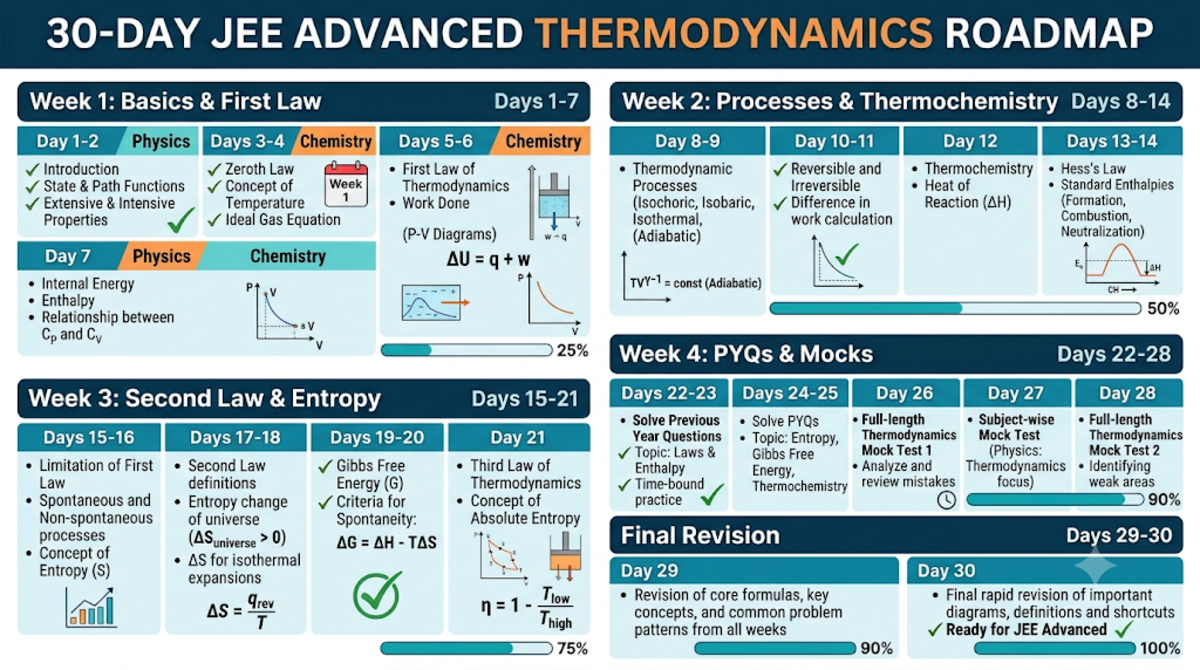
30-Day Preparation Plan for JEE Advanced Thermodynamics
Keep separate Physics and Chemistry formula sheets, especially for work and heat sign conventions. Spend the final week on JEE Advanced PYQs and timed problem-solving.
- Lock the subject before every equation. Verify whether the question is Physics or Chemistry to fix the work sign.
- Internal energy and heat keep the same signs in both subjects. ΔU = nCvΔT in both.
- Master graph conversions in Physics. JEE Advanced favours questions that convert a cyclic process from a P-V diagram to V-T or P-T and ask where heat is absorbed or rejected.
- Prioritise irreversible processes in Chemistry. Questions often test sudden expansion against constant external pressure and ΔS_surr.
- Watch for cross-chapter linking. In Physics, thermodynamics pairs with Fluid Mechanics (pistons against liquid pressure) and Mechanics. In Chemistry, ΔG links to Chemical Equilibrium and Electrochemistry.
| Week / Days | Physics Preparation | Chemistry Preparation | Key Practice Target |
|---|---|---|---|
| Week 1: Basics & First Law | Days 1–3: Thermal expansion, calorimetry, KTG and gas mixtures | Days 4–6: System properties, First Law, work and enthalpy | Day 7: Revise sign conventions and mistakes |
| Week 2: Processes & Thermochemistry | Days 8–10: Polytropic processes, graphs and heat transfer | Days 11–13: Hess’s Law, Born-Haber cycles, bond enthalpy and Kirchhoff’s equation | Day 14: Take a 1-hour test and update the error log |
| Week 3: Second Law & Entropy | Days 15–17: Carnot engines, refrigerators and piston problems | Days 18–20: Entropy, Gibbs energy, spontaneity and equilibrium | Day 21: Prepare a formula and unit-conversion sheet |
| Week 4: PYQs & Mocks | Days 22–25: Solve Physics Thermodynamics and KTG PYQs | Days 22–25: Solve Chemistry Thermodynamics PYQs | Days 26–28: Practise mixed question types and 15 IIT-JEE problems |
| Final Revision | Day 29: Attempt a 60-minute mixed mock | Day 30: Revise formulas, sign conventions, and errors | Focus on accuracy and time management |
JEE Advanced Thermodynamics FAQs
Ques. How much is the JEE Advanced thermodynamics weightage?
Ans. About 8%–12% of the Physics paper and 6%–8% of the Chemistry paper, or 5 to 7 questions worth 18 to 26 marks.
Ques. What is in the JEE Advanced thermodynamics syllabus?
Ans. Thermal Physics (expansion, calorimetry, heat transfer, KTG, laws of thermodynamics, blackbody radiation) and Chemical Thermodynamics (First Law, thermochemistry, entropy, Gibbs energy).
Ques. Is the First Law the same in JEE Advanced Physics and Chemistry?
Ans. No. Physics uses Q = ΔU + W. Chemistry uses ΔU = q + w.
Ques. Which JEE Advanced thermodynamics chemistry topics are most important?
Ans. Second Law, Entropy and Gibbs Energy, followed by First Law and work calculations, and thermochemistry.
Ques. Which JEE Advanced thermodynamics physics topics are most important?
Ans. Laws of Thermodynamics and processes, followed by Kinetic Theory of Gases.
Ques. Which is better for waves and thermodynamics, Cengage or D.C. Pandey?
Ans. Both are chapter-wise practice series. Choose one as the primary series and stay with it. This article's book table lists D.C. Pandey (Waves & Thermodynamics).



Comments