




To use CBSE Class 10 sample papers effectively, treat each paper as a full 3-hour exam, then spend equal time analysing it. Solving fewer papers with a proper review works better than rushing through many without checking weak spots.
Start only after covering 80-100% of the syllabus, and begin with the official CBSE Academic Sample Question Papers. Aim for 5-8 papers per subject, and log every lost mark in a mistake notebook.
- Complete 80–100% of the syllabus before attempting full-length sample papers to avoid gaps in preparation.
- Finish NCERT exercises and chapter-wise PYQs first to understand standard question patterns and concepts.
- Attempt each paper in one uninterrupted 3-hour sitting, preferably during the actual board exam slot of 10:30 AM to 1:30 PM.
- Follow board-style presentation by writing numbered points, underlining important keywords, maintaining word limits, and drawing labelled diagrams.
- Solve 5–8 sample papers per subject and evaluate every paper using the official CBSE marking scheme rather than awarding marks based only on whether the final answer is correct.
- Maintain a mistake notebook and categorise lost marks into conceptual gaps, careless errors, missing keywords/steps and time-management issues.
Related Links:
- CBSE Class 10 Question Paper: Download PDF & Check CBSE Previous Year Question Papers with Solution
- CBSE Class 10 Syllabus 2027: Subject-wise Topics, Deleted Chapters and PDF Download
- CBSE Class 10 Mock Test 2027
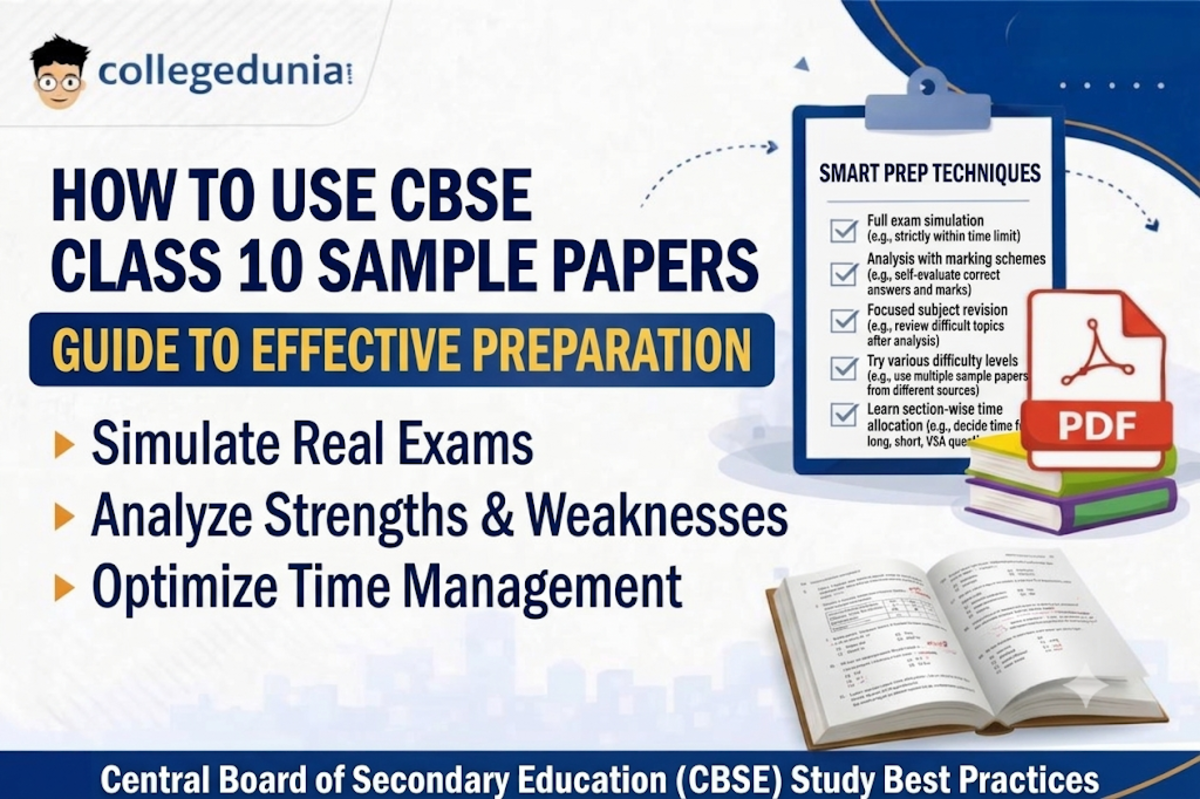
Key Summary
- CBSE Class 10 sample papers should be attempted after completing 80-100% of the syllabus, NCERT exercises, and chapter-wise PYQs.
- Solve each paper in one sitting, with a timer and without notes, preferably in the board exam slot (10:30 AM to 1:30 PM).
- Use the 15-minute reading time to sort questions into easy, manageable and tough, and to choose internal choices.
- Grade every paper with the official CBSE marking scheme, and log each lost mark as a Conceptual Gap, Silly Mistake, Keyword/Step Loss, or Time/Question Choice error.
- Solve 5-8 papers per subject (about 25-40 in total), and revise weak chapters for 1-2 days before the next paper.
How to Use CBSE Class 10 Sample Papers Effectively?
Using CBSE Class 10 sample papers effectively means following three stages: start at the right time, attempt under exam conditions, and analyse every paper. Skipping any stage reduces the value of the paper.
- Before: Finish the syllabus, NCERT exercises, and PYQs.
- During: Follow the real exam format, timing, and presentation.
- After: Grade strictly, log mistakes, and revise before the next paper.
| Stage | What to Do |
|---|---|
| Before the paper | Complete 80-100% of the syllabus, NCERT and chapter-wise PYQs |
| During the paper | Strict 3-hour timer, no phone or notes, board-style writing |
| After the paper | Official marking scheme, mistake notebook, 1-2 days of revision |
Ques. How to use CBSE Class 10 sample papers for board exam preparation?
Ans. Solve them after completing the syllabus, attempt each one in exam conditions, grade it with the CBSE marking scheme and revise the weak chapters before the next paper.
Ques. Are CBSE sample papers enough for Class 10 boards?
Ans. They are not enough alone. Use them along with NCERT exercises and chapter-wise PYQs.
Download the CBSE Class 10 Sample Papers PDF 2026-27
| Subject | Sample Question Paper |
|---|---|
| Science | Download PDF |
| English (Language & Literature) | Download PDF |
| English (Communicative) | Download PDF |
| Hindi A | Download PDF |
| Hindi B | Download PDF |
| Mathematics (Basic) | Download PDF |
| Mathematics (Standard) | Download PDF |
| Social Science | Download PDF |
When to Start Solving CBSE Class 10 Sample Papers?
Start solving full-length sample papers only after the syllabus is almost complete. Early attempts expose unstudied chapters and cause unnecessary panic.
- Syllabus first: Complete 80-100% of the syllabus.
- NCERT and PYQs first: Finish NCERT exercises and chapter-wise PYQs, so you already know the standard question patterns.
- Start with official papers: Use the official CBSE Academic Sample Question Papers to understand the latest blueprint. You do not need 20 books.
| Prerequisite | Requirement |
|---|---|
| Syllabus coverage | 80-100% |
| NCERT exercises | Completed |
| Chapter-wise PYQs | Completed |
| First paper source | Official CBSE Academic Sample Question Papers |
As per Reddit discussions, below are some tips to apply for your CBSE Class 10 preparation:
- A Class 10 passout notes that they solved only 2–3 sample papers properly (under full exam conditions), while casually going through PDFs of sample papers to see a variety of questions. This helped them score 98–99 in Maths and 96% overall.
- Another commenter advises finishing the NCERT textbook thoroughly first (covering one full chapter per day) before touching sample papers.
- When short on time, solve as many sample papers and PYQs (Previous Year Questions) as possible, aiming for at least 2 full papers with a strict timer.
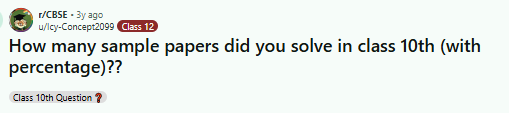


Source: Reddit
Ques. When should I start CBSE Class 10 sample papers?
Ans. After you have completed 80-100% of the syllabus, NCERT exercises and chapter-wise PYQs.
Ques. Which sample papers should I solve first?
Ans. The official CBSE Academic Sample Question Papers, as they follow the latest blueprint.
Also Check:
- CBSE Class 10 Exam Pattern 2027: Subject-wise Marks, Question Types & Marking Scheme
- CBSE Class 10 Preparation Tips 2027: Subject-Wise Guidelines, Sample Papers
- CBSE Class 10 Hindi Question Paper Available- Download Previous Year Papers with Solutions (2024-2020)
How to Attempt a CBSE Class 10 Sample Paper?
Attempt each sample paper as if it were the board exam. Do not check solutions, pause or split it into sittings.
- Exam conditions: Sit at a desk without a phone, notes or breaks. Use a strict timer, ideally in the actual board exam slot (10:30 AM to 1:30 PM).
- Reading window: Read the whole paper in the 15 minutes. Mark questions as easy, manageable or tough, and choose internal choices early.
- Board-style presentation: Write in numbered points, underline key terms, follow word limits and draw neat, labelled diagrams in pencil.
| Element | Rule |
|---|---|
| Duration | One uninterrupted 3-hour sitting |
| Timing | Board exam slot, 10:30 AM to 1:30 PM |
| Reading time | 15 minutes, to categorise questions and pick internal choices |
| Writing style | Numbered points, underlined key terms, labelled diagrams |
Ques. Should I attempt sample papers in a timed sitting?
Ans. Yes. Use a strict 3-hour timer in one sitting, preferably in the board exam slot.
Ques. How to use the 15-minute reading time in sample papers?
Ans. Read the full paper, mark questions as easy, manageable or tough, and decide your internal choices before you start writing.
How to Analyse Your Performance After Solving CBSE Class 10 Sample Papers?
Analysis decides how much a sample paper improves your score. Grade the paper first, then log mistakes and revise.
- Use the official marking scheme: Check not only the final answer, but also the step-wise keywords and formulas needed for full marks.
- Keep a mistake notebook: Record every lost mark by error type.
- Revise before the next paper: Spend 1-2 days on the weak chapters from your notebook.
| Step | Action |
|---|---|
| 1 | Grade the paper with the official CBSE marking scheme |
| 2 | Log every lost mark in the mistake notebook |
| 3 | Revise weak chapters for 1-2 days |
| 4 | Attempt the next paper |
Ques. How to analyse a CBSE Class 10 sample paper?
Ans. Grade it with the official marking scheme, classify each lost mark by error type and revise those chapters before the next paper.
How to Categorise Every Lost Mark in CBSE Class 10 Sample Papers?
Maintain one table per paper in your mistake notebook. The pattern across papers shows what to fix.
- Conceptual Gap: Go back to NCERT immediately.
- Silly Mistake: Note the exact trigger, such as rushed mental math.
- Keyword/Step Loss: Learn the exact NCERT terms and match the marking scheme.
- Time/Question Choice: Set section-wise time limits.
| Error Type | What It Looks Like | Action Plan |
|---|---|---|
| Conceptual Gap | No idea how to start, or a forgotten core formula or rule | Re-read the NCERT section and solve 10-15 chapter-wise questions before the next mock |
| Silly / Careless Mistake | Calculation errors, sign mistakes, misreading "incorrect" or "not" | Note the trigger and write intermediate steps |
| Keyword / Step Loss | Right concept, but marks lost against the marking scheme | Memorise exact NCERT terms and rewrite the answer in bullet points matching the rubric |
| Time / Question Choice | Ran out of time, or chose the harder internal option | Set section-wise time limits (for example, cap Section A MCQs at 25 minutes) and use the reading time better |
Ques. What should be in a mistake notebook for CBSE Class 10?
Ans. The question, the error type (Conceptual Gap, Silly Mistake, Keyword/Step Loss or Time/Question Choice) and the corrective action.
Ques. Should I review MCQs that I guessed correctly?
Ans. Yes. A correct guess can hide a conceptual gap, so revisit these questions.
Check Out:
- CBSE Class 10 Science Question Paper Available- Download Previous Year Papers with Solutions (2025-2020)
- CBSE Class 10 Grading System 2027: 9-Point Scale A1 to E, CGPA Calculation and Percentage Formula
How Many CBSE Class 10 Sample Papers Should You Solve Before Boards?
Solve 5-8 full-length sample papers per subject, which is about 25-40 papers across 5 subjects. Solving 6 papers with a full analysis beats rushing through 15 without a review.
- Maths needs the most papers, for speed, accuracy and case-study practice.
- Science and SST need a mid-range count.
- Languages need fewer papers, mainly for reading speed and format.
| Subject | Recommended Papers | Reason |
|---|---|---|
| Mathematics (Standard / Basic) | 8-10 | Speed, calculation accuracy, competency and case-study questions |
| Science | 6-8 | Numericals, ray and circuit diagrams, chemical equations, NCERT terminology |
| Social Science | 5-6 | Point-wise answers, 5-mark time management, map work |
| English and Hindi / Second Language | 4-5 each | Reading speed for unseen passages, formats and word limits |
Ques. How many sample papers should I solve for CBSE Class 10?
Ans. 5-8 per subject, or about 25-40 in total. Maths needs 8-10.
Ques. Is it better to solve more sample papers or analyse fewer?
Ans. Analyse fewer. Six papers with a thorough mistake review beat fifteen without one.
This YouTube video by the channel “GREEN Board” discusses the CBSE Class 10 sample papers and strategy to attempt sample papers effectively and efficiently. It also mentions how many sample papers a student should attempt in order to get a good score in the exams.
Subject-Wise Strategy to Solve CBSE Class 10 Sample Papers
Each subject needs a different focus while solving sample papers. Use these points for presentation and accuracy.
- Mathematics: Solve every step on paper. Give extra time to competency-based and case-study questions.
- Science: Focus on balanced chemical equations, ray and circuit diagrams, and exact NCERT terminology in Biology.
- Social Science: Write structured bullet points with subheadings, and complete map work with the paper.
- English and Hindi: Time the reading and writing sections strictly, so there is a buffer for literature answers.
| Subject | Presentation and Accuracy Tips |
|---|---|
| Mathematics |
|
| Science |
|
| Social Science |
|
| English |
|
| Hindi |
|
Ques. How to solve CBSE Class 10 Maths sample papers?
Ans. Solve every step on paper, write the formulas and Given/To Prove lines, keep a rough-work column, and box the final answer.
Ques. How to solve Social Science sample papers?
Ans. Write bullet points (3 for 3 marks, 5 for 5 marks), underline key terms and complete the map work carefully.
CBSE Class 10 Year-wise Question Paper Download
Common Mistakes to Avoid While Solving CBSE Class 10 Sample Papers
Most mistakes fall under practice, grading, and presentation. Fix them before the next paper.
- Practice and timing: Checking solutions mid-paper, solving in multiple sittings, ignoring the 15-minute reading time and spending too long on MCQs.
- Grading and analysis: Lenient self-grading, skipping mistake analysis and ignoring correctly guessed MCQs.
- Presentation and habits: Long theory answers, poor rough-work management in Maths, rushed map work and outdated sample papers.
| Mistake | What to Do Instead |
|---|---|
| Checking solutions mid-paper | Attempt the full paper, then review doubts |
| Solving in multiple sittings | Practise in one uninterrupted 3-hour sitting |
| Ignoring the 15-minute reading time | Identify easy questions and plan internal choices |
| Spending too long on MCQs | Allocate time according to marks |
| Lenient self-evaluation | Follow the official CBSE marking scheme strictly |
| Skipping mistake analysis | Review errors before the next paper |
| Ignoring correctly guessed MCQs | Revisit them to find conceptual gaps |
| Long theory answers | Use bullet points and underline NCERT keywords |
| Poor rough work in Maths | Keep a separate, organised rough-work column |
| Rushing map work | Complete map questions carefully within the time |
| Outdated sample papers | Use papers based on the latest CBSE pattern |
FAQs on Using CBSE Class 10 Sample Papers
Ques. How to use CBSE Class 10 sample papers in preparation?
Ans. Finish the syllabus, NCERT and PYQs first. Then solve official sample papers in exam conditions, grade them with the marking scheme and log mistakes.
Ques. How many sample papers should I solve per subject?
Ans. 5-8 per subject. Maths can need 8-10, and languages 4-5 each.
Ques. How long should I take to solve a sample paper?
Ans. The full 3 hours in one sitting, with the 15-minute reading time used to plan.
Ques. How to check my sample paper answers?
Ans. Use the official CBSE marking scheme. Check step-wise keywords and formulas, not only the final answer.
Ques. How soon should I attempt the next sample paper?
Ans. After 1-2 days of fixing the weak chapters from your mistake notebook.



Comments