



Education Journalist | Study Abroad Lead
Transpiration is characterized as the physiological loss of water, basically from the stomata in leaves, yet in addition through vanishing from the surfaces of leaves, blossoms, and stems. Water is vital for plants yet just a limited quantity of water taken up by the roots is utilized for development and digestion. The leftover 97 – 99.5% is lost by transpiration and guttation.
Leaf surfaces are specked with pores called stomata, which are lined by monitor cells and their stomatal embellishment cells (together known as stomatal complex) that open and close the pore. Transpiration happens through the stomatal gaps and can be considered a fundamental cost related to the kickoff of the stomata to permit the dissemination of carbon dioxide gas from the air for photosynthesis.
| Table of Content |
Key Terms: Transpiration, Stomata, Leaves, Guttation, Monocots, Dicots, Evaporation, Humidity, Temperature, Light, Cobalt Chloride
Aim
[Click Here for Sample Questions]
To compare the rates of transpiration in the upper and the lower surface of leaves.
Read More: Difference Between Monocot and Dicot Leaf
Theory
[Click Here for Sample Questions]
Transpiration is a process by which plants lose water through their leaves. In the plant kingdom, there are different species of plants. The angiosperms can be classified into two categories namely monocots and dicots. The number of stomata is much more on the lower surface of the leaves and less on the upper surface, therefore, the rate of transpiration is low on the upper surface and high on the lower surface.
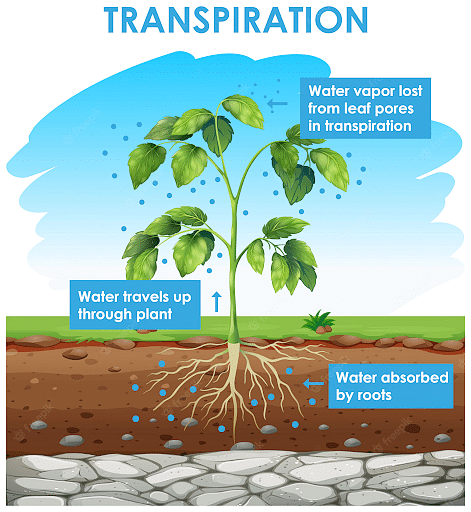
Transpiration
Rate of Transpiration and Its Importance
The rate of transpiration is the rate at which water evaporates from the leaves of plants. In monocots, like bamboo, the stomata are distributed equally across both surfaces of the leaf so the rate of transpiration is equal. In dicots, like a rose bush, there are fewer stomata on the upper surface and more on the lower surface so the rate of transpiration is higher on the lower surface than on the upper surface.
It is important to know the rate of transpiration because it helps the plant to maintain homeostasis. If the rate of transpiration decreases, then it would lead to loss of water and survival at that rate may be impossible. The rate at which a leaf can lose water depends on several factors like-
- Humidity and temperature of the air,
- Type of plant and its structure,
- Amount of stomata present on either side,
- Thickness of epidermis lining on both sides etc.
Material Required
[Click Here for Sample Questions]
- A potted plant
- Forceps
- Petri Dish
- Binder clips
- Glass Slide
- Filter paper strips
- Wire gauze
- 3% cobalt chloride solution
Procedure
[Click Here for Sample Questions]
- Pour the cobalt chloride solution into the Petri dish. Now, dip a few strips of filter paper into the solution.
- Allow the strips to stay in the solution for a few minutes, and watch them turn pink in colour.
- With help of forceps, separate the strips (or place them on the wire gauze).
- Allow them to dry by placing them on wire gauze.
- Place them one on the upper surface and one on the lower surface when they are already dried up.
- Now place two glass slides on each surface of the leaf and secure both sides with binder clips!
- After some time, observe carefully both surfaces through an optical microscope (Olympus SZX16) and note down the time that it takes for the paper strip to switch its colour from blue to pink.
- Now, place 2 glass slides on each surface of the leaf, i.e., the upper surface and lower surface.
- After then, place a few strips of filter paper on top of each glass slide and allow them to absorb the droplets from plant tissues.
- Place a solution containing cobalt chloride in between the glass slide and the strip of filter paper.
- These strips are then observed for 5 minutes to see whether they turn pink or blue in colour due to some compounds present in them (turning pink indicates the presence of sugars and is not harmful).
- The switch from blue to pink indicates that as much water has passed through it as was lost by evaporation; hence this shows a high rate of transpiration by leaves.
Read More: Difference between Evaporation and Transpiration
Observation
[Click Here for Sample Questions]
Healthy leaves have a high rate of transpiration. Through experiment, the time taken for cobalt chloride paper to turn from blue to pink on the lower surface of the leaf was calculated to be less than that on the upper leaf surface.
Conclusion
[Click Here for Sample Questions]
The fast switch of the shade of the cobalt chloride paper on the lower surfaces portrays that pace of loss of water fume is higher on the lower surface than on the upper surface.
Precautions
[Click Here for Sample Questions]
- The plant that will be used in the experiment should be a healthy and well-watered plant.
- The paper should always be handled with forceps or well-dried hands
- The leaf should completely be wiped off excess water before placing the strips.
Read More: Transpiration Pull
Things to Remember
- Transpiration is a process by which plants lose water through their leaves. The rate of transpiration is the rate at which water evaporates from the leaves of plants.
- In monocots, like bamboo, the stomata are distributed equally across both surfaces of the leaf so the rate of transpiration is equal. In dicots, like a rose bush, there are fewer stomata on the upper surface and more on the lower surface so the rate of transpiration is higher on the lower surface than on the upper surface.
- The pace of transpiration is lower on the upper surface of the leaf due to less measure of stomata and more on the lower side of the leaf because of more number of stomata.
- In any case, in monocots, as the two sides of the leaf have an equivalent measure of stomata, the pace of transpiration is equivalent on both the upper as well as lower surfaces of the leaf.
- Stomata are open in light so plants transpire more rapidly in the presence of light than in the dark.
- The higher the temperature, the faster water evaporates and so plants transpire more rapidly at higher temperatures.
Sample Questions
Ques. List the importance of the process of transpiration. List any three points. (3 Marks)
Ans. The importance of the process of transpiration is:
- Transpiration pull is responsible for the movement of water from roots to leaves. The process also facilitates the cooling of plant surfaces as evaporation occurs.
- This helps in photosynthesis by absorbing carbon dioxide from the atmosphere. Transpiration has multiple roles in the plant.
- One of its main functions is to transport water from the roots to the leaves. In addition, transpiration helps in cooling down the leaf surface by evaporation due to its effect on stomatal movements.
Ques. Why is water loss greater on the lower surface of the plant in comparison with the upper surface? (2 Marks)
Ans. It is on the grounds that typically the conveyance and number of stomata change in the lower and upper surface of leaves. The lower surface of leaves has a more noteworthy number of stomata to complete the course of happening.
Ques. Why is cobalt chloride paper used in this experiment? (2 Marks)
Ans. It is on the grounds that this paper transforms into a pink tone when it responds with water. Thus, this property of the paper can be utilized to exhibit the course of happening.
Ques. How is the rate of transpiration estimated in this experiment? (1 Mark)
Ans. It can be assessed by requiring into account the investment the paper takes to change its tone from blue to pink.
Ques. What is the significance of transpiration? (3 Marks)
Ans. Transpiration helps in creating a transpiration pull. This pull helps during the time spent assimilation and transport in plants. It additionally helps in providing the water that is required for photosynthesis. It helps in chilling the leaf surface and cutting down the temperature of the plant body. It likewise helps in keeping up with the shape and design of the leaf by keeping the cells in a bloated condition.
Ques. What are the plant factors that affect transpiration? (3 Marks)
Ans. The Factors that affect the rate of transpiration are
- Root-Shoot Ratio: Roots help in engrossing the water. Thus, a low root-shoot proportion diminishes the pace of transpiration.
- The number and dissemination of stomata and the number of open stomata help in influencing the pace of happening.
- Design of Leaf: Thick fingernail skin and waxy covering help in decreasing how much happening.
Ques. What is the rate of transpiration in a dorsiventral leaf? (3 Marks)
Ans. The pace of transpiration in a dorsiventral leaf is more prominent at the lower surface.
A dorsiventral organ is one that has two surfaces varying from one another for all intents and purposes and construction, as a common leaf.
More happening happens on the lower surface of a dorsiventral leaf on the grounds that the quantity of stomata present on the ventral side of the leaf is more than the number of stomata present on the dorsal side of the leaf.
Ques. What is the most common type of transpiration? (3 Marks)
Ans. Transpiration is the course of loss of abundance of water as water fume from flying pieces of plants, particularly from leaves yet in addition from stems and blossoms. Leaf surfaces are dabbed with openings which are altogether called stomata, and in many plants, they are more variations on the undersides of the foliage to help in the transpiration. Such a kind of transpiration is called a stomatal happening. It comprises around 50-97% of the all-out happening. It happens through the stomata.
Ques. What is the function of stomata? (3 Marks)
Ans. Transpiration is the loss of water in the form of water vapour from the parts of the plant. This process of transpiration is done with the help of stomata that are mostly present on the lower surface of leaves. The opening of stomata is controlled by specialized cells called guard cells to regulate the water loss.
Ques. List some environmental factors affecting transpiration. (3 Marks)
Ans. The rate of transpiration depends on environmental conditions, especially light, temperature and humidity.
- Stomata are open in light so plants transpire more rapidly in the presence of light than in the dark. They also open more in the presence of heat than they do at cooler temperatures.
- The higher the temperature, the faster water evaporates and so plants transpire more rapidly at higher temperatures.
- Humidity can be described as the percentage of water vapour present. At any given point on a leaf surface, air molecules tend to be replaced by dry air from outside which leads to evaporation from this point. If conditions are dry and there's no wind, the air surrounding the leaf surface becomes increasingly humid, decreasing transpiration rates.
Also Read:
Also Read:



Comments