



Content Curator
Autotrophs are defined as organisms that are capable of preparing their own food. They are the primary producers in any food chain. Autotrophs usually prepare food through photosynthesis. Autotrophs are of two types which are photoautotrophs and chemoautotrophs.
Read More: Concepts in Biology
| Table of Content |
Key Takeaways: Producers, Chemicals, Sunlight, Photosynthesis, Ecosystem, Bacteria, Photoautotrophs
Autotrophs
[Click Here for Sample Questions]
Autotrophs are defined as organisms that are capable of preparing their own food. They are the primary producers in any food chain. The word autotroph is derived from two words 'auto' meaning 'self' and 'troph' meaning 'food'. They use components from the environment for food production. Components such as sunlight, carbon dioxide, minerals, chemicals, water, etc can be used. Their ability to produce their own food has given autotrophs the title of 'producers'. They do not depend on any other organisms for food.
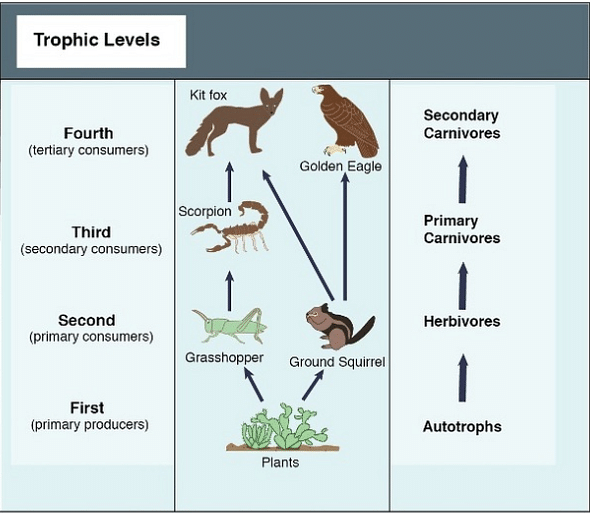
Autotrophs
Autotrophs usually prepare food through photosynthesis. Photosynthesis is defined as the process in which green organisms such as plants and green algae produce their food with the help of sunlight.
Autotrophs are of two types:
- Photoautotrophs
- Chemoautotrophs.
Read More:
Importance of Autotrophs
[Click Here for Sample Questions]
Autotrophs are the primary producers in the ecosystem. They are the only organisms capable of producing food and not depending on others for survival. Without autotrophs, other organisms will not be able to get food. Heterotrophs completely depend on autotrophs and other heterotrophs for food.
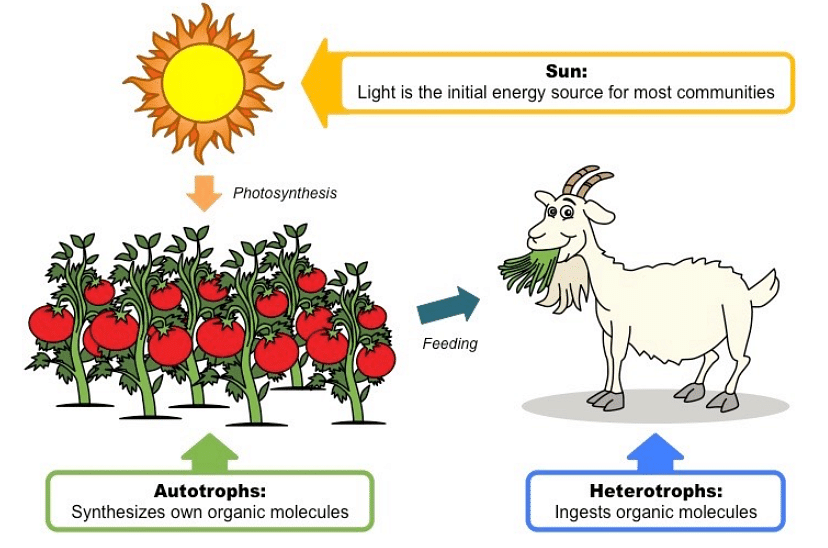
Autotrophs and Heterotrophs
Read More:
Types of Autotrophs
[Click Here for Sample Questions]
Autotrophs are classified into two types:
- Photoautotrophs
- Chemoautotrophs
Photoautotrophs
Photoautotrophs are autotrophs that can produce their own food through the process of photosynthesis. They prepare glucose by taking carbon dioxide from the air, water from the soil, and sunlight. Glucose provides them necessary energy. All plants are photoautotrophs. Green algae and some bacteria are also examples of photoautotrophs. Photoautotrophs are the largest generators of energy in the ecosystem. They also release oxygen in the atmosphere during food production.
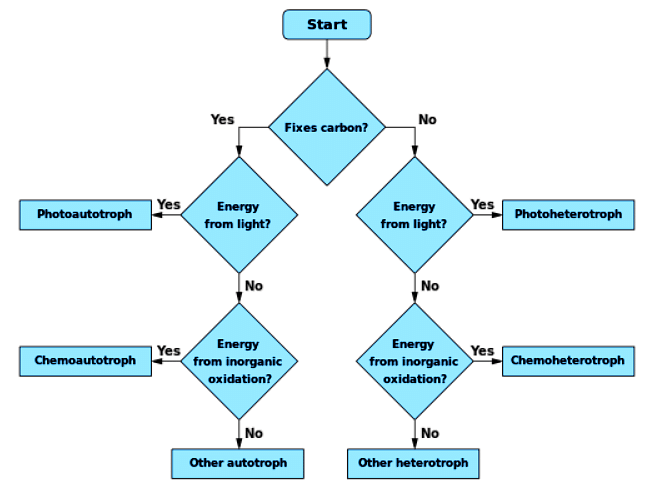
Autotrophs and Heterotrophs Classification
Chemoautotrophs
Chemoautotrophs are autotrophs that can produce their own food through chemosynthesis. They use hydrogen sulphide, molecular hydrogen, ammonia, ferrous iron, sulphur, or methane in conjunction with oxygen to prepare food. These organisms are only found in extremely toxic environments where these gases are present. They convert organic matter into an inorganic form. Chemoautotrophs can be found in volcanoes and deep oceans.
Read More:
Examples Of Autotrophs
[Click Here for Sample Questions]
Examples of autotrophs are:
- All plants
- Green algae
- Red algae
- Bacteria such as cyanobacteria
- Lichens
Read More:
Difference Between Autotrophs And Heterotrophs
[Click Here for Sample Questions]
Key differences between Autotrophs and Heterotrophs are tabulated below.
| Factors | Autotrophs | Heterotrophs |
|---|---|---|
| Members | Members of autotrophs are organisms of kingdom Plantae and few unicellular organisms | Members of Heterotrophs are all organisms of kingdom Animalia |
| Production of food | Autotrophs prepare their own food | Heterotrophs depend on autotrophs and other heterotrophs for food |
| Classification | Autotrophs are classified as photoautotrophs and chemoautotrophs | Heterotrophs are classified as photoheterotrophs and chemoheterotrophs |
| Chloroplast | Chloroplast is present in all autotrophs | Chloroplast is absent in all heterotrophs |
| Storage of energy | Autotrophs can store energy | Heterotrophs cannot store energy |
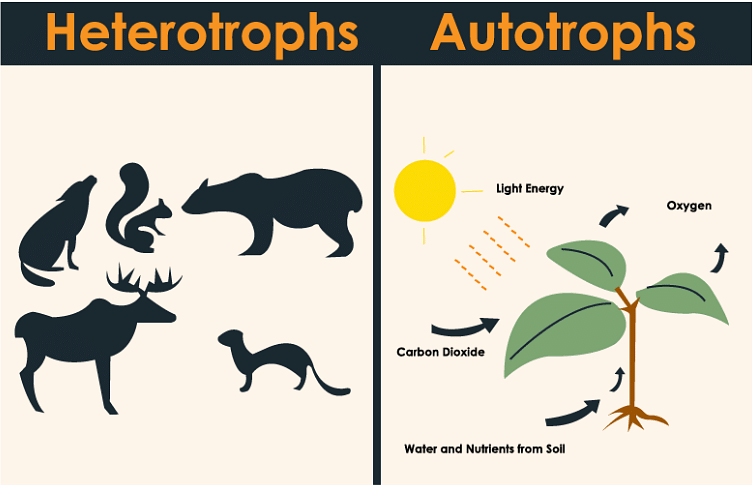
Difference between Autotrophs and Heterotrophs
Read More:
Terms Related To Autotrophs
[Click Here for Sample Questions]
Following are some of the terms related to autotrophs.
Energy Pyramid
Energy pyramid is the triangular structure that explains how energy production and flow happen in an ecosystem.

Energy Pyramid
Heterotrophs
Heterotrophs are organisms that are dependent on other organisms for food.
Photosynthesis
Photosynthesis is the process through which photoautotrophs can produce food and energy, with the help of sunlight, by taking water from the soil and carbon dioxide from the air.
Read More:
Things to Remember
[Click Here for Sample Questions]
- Autotrophs are defined as organisms that are capable of preparing their own food.
- Without autotrophs, other organisms will not be able to get food.
- Autotrophs are of two types: photoautotrophs and chemoautotrophs.
- Photoautotrophs are autotrophs that can produce their own food through the process of photosynthesis.
- Chemoautotrophs are autotrophs that can produce their own food through chemosynthesis.
Read More:
Sample Questions
Ques. Which of the following organisms is not an example of photoautotroph? (2 Marks)
(a)Cyanobacteria
(b)Iron bacteria
(c)Daisies
(d)None of the above
Ans. b. Iron bacteria
Explanation: Iron bacteria is not a photoautotroph whereas cyanobacteria and daisies are both photoautotrophs.
Ques. Choose the correct statement about chemoautotrophs. (2 Marks)
(a)Chemoautotrophs use sunlight to make food.
(b)Chemoautotrophs use chemicals such as methane and ammonia to make food.
(c)Chemoautotrophs depend on other organisms for food.
(d)None of the above
Ans. b. Chemoautotrophs use chemicals such as methane and ammonia to make food.
Explanation: Chemoautotrophs are autotrophs that use inorganic materials to produce energy and food.
Ques. Can an organism be both autotroph and heterotroph? Explain with examples. (3 Marks)
Ans. Yes, an organism can be both autotroph and heterotroph. It can create its own food in suitable environmental conditions. In this case, it acts as an autotroph. Whereas when environmental conditions are not favourable, it can take energy from other organisms to prepare. In this case, it acts as a heterotroph. Examples of organisms that can act as both autotrophs and heterotrophs are cyanobacteria and archaea.
Ques. What are photoheterotrophs and chemoheterotrophs? (3 Marks)
Ans. Photoheterotrophs are heterotrophs that obtain energy from sunlight and carbon from organic matter to produce energy.
Chemoheterotrophs are heterotrophs that obtain energy from the oxidation of inorganic compounds and carbon from organic matter to produce energy.
Ques. Are plants chemoautotrophs? (3 Marks)
Ans. Chemoautotrophs are autotrophs that are capable of making their own food with the help of inorganic materials. Plants prepare their food with the help of sunlight. Which means they require photons for the production of food. As photons are not inorganic materials, plants cannot be chemoautotrophs. Also, plants are photoautotrophs. Photoautotrophs are autotrophs that make their own food with the help of sunlight.
Ques. Explain the purpose of photosynthesis. (3 Marks)
Ans. Photosynthesis is the process through which organisms prepare their own food with the help of sunlight. It is the primary process of food production in several autotrophs. Without photosynthesis, the methods of production of food for autotrophs are limited. In the process of photosynthesis, only oxygen is released into the atmosphere which is useful for breathing in humans.
Ques. What are the different types of autotrophs? Explain in detail. (3 Marks)
Ans. There are two types of autotrophs viz. photoautotrophs and chemoautotrophs.
Photoautotrophs are autotrophs that use sunlight to prepare their food. Mainly plants are photoautotrophs. Photoautotrophs are found where sunlight is ample.
Chemoautotrophs are autotrophs that use inorganic materials to prepare their food. Several bacteria are chemoautotrophs. Chemoautotrophs are found where sunlight cannot reach.
Ques. How were banded iron formations formed? (3 Marks)
Ans. Many scientists believe that the earth's atmosphere was oxygen free until the formation of autotrophs. Once autotrophs were present in ample amounts in the sea, they released large amounts of oxygen. Sea already contained large amounts of the metal iron. The oxygen released reacted with the iron to form banded iron formations.
Read More:



Comments