



Education Journalist | Study Abroad Lead
Benthic zones are ecosystems in a water body with high-biological-activity areas where phenomena including primary production, consumption, nutrient cycling, and breakdown predominate. In this zone, as in other environments, primary producers and their consumers interact.
| Table of Content |
Key Terms: Benthic zone, pelagic zone, abyssal zone, benthos, disphotic zone, phytobenthos, zoobenthos, ecosystem, consumption, nutrient cycling, ecological zone
Read More: Difference between archaea and bacteria
Benthic Zone Definition
[Click Here for Sample Questions]
Benthic zone is an ecological zone in any water body. It mainly consists of the ocean floor or the bottom-most surface. The zone above the benthos is called the pelagic zone, and it includes the water column up to the top. Some examples of benthic zones are kelp forests, eelgrass and coral reefs beds. They help to cushion wave energy along coasts and provide hurricane protection.
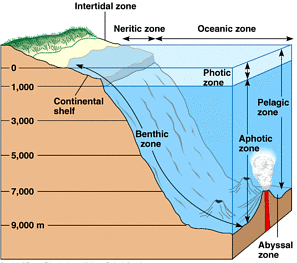
Benthic Zone
Read More: Difference between adolescence and puberty.
Types of Benthic Zone
[Click Here for Sample Questions]
Benthic zones are found in brackish, freshwater and saltwater. Benthic ecosystems in the sea are separated into four groups based on their depth:
- The nearshore and estuarine zones (less than 200 m)
- Bathyal zone (200 to 2,000 m)
- Abyssal zone (2,000 to 6,000 m)
- Hadal zone (over 6,000 m)
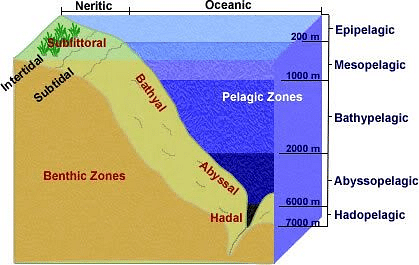
Types of Benthic Zone
Coral reefs, mangrove forests, oyster beds, shallowly buried mudflats, challenging rocky habitats, and rippling sandflats are examples of estuarine and nearshore benthic habitats.
Also Read:
Benthic Zone Characteristics
[Click Here for Sample Questions]
Benthic zone has a few significant characteristics. They are as follows:
Light
As the depth increases, the light intensity drops. It gets limited below 250 metres, and the light intensity diminishes rapidly between 250 and 1000 metres. This zone is called the disphotic zone, and photosynthesis is extremely difficult here. Beyond 1000 metres, light availability is nearly non-existent, and photosynthesis is no longer possible.
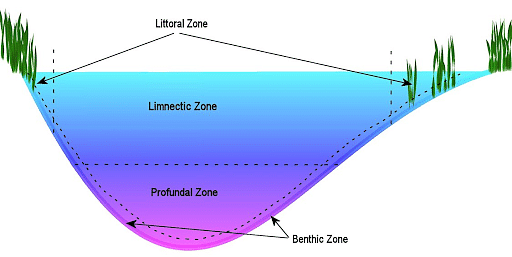
Light in Benthic Zone
Pressure
Pressure changes in the benthic zone. The pressure on the shallow benthic zone is low, but deep benthic zones are quite high. The pressure on the surface, almost 10,000 meters deep, is nearly 1000 times that of sea level.
Temperature
The temperature is warmer in benthic zones close to the shore or with a relatively shallow depth, but temperatures can drop to 2°C to 3°C in those hundreds of metres deep (near the abyssal zone). Sea organisms living in such frigid temperatures are rare, and those that do exist tend to move slowly to conserve energy.
Read More: Heterotrophic Bacteria
Benthos
The organisms that survive in the benthic zone are referred to as benthos. This is because many species have evolved to withstand deep-water pressure and can no longer thrive in surface water. The difference in the pressure can be considerably high (approximately one atm for every ten metres of water depth).
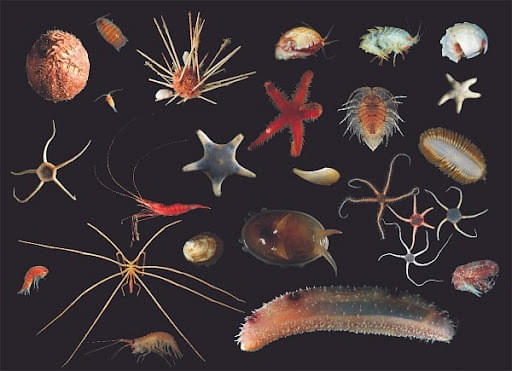
Benthos
The benthos can be classified in many ways. For example, primary producers (aquatic plants, algae) are classified as "phytobenthos," while all the consumers (benthic animals and protozoa) are classified as "zoobenthos." In addition, the title epibenthic refers to species living on top of the sediment, while hyperbenthos refers to organisms that live above the sediment.
Nutrient Flow
The benthic zone includes the sediment surface. Because of the depths it can reach, the benthic zone is characterised by cold temperatures, high pressure, and limited sunlight. Although such circumstances are not ideal for the survival of a diverse range of fauna and flora, sediment layers in the benthic zone aid nutrient recycling, allowing for the survival of diverse sea species in the upper surrounding water. The benthic zone is home to various crabs, sponges, snails, sea stars, and other organisms.
Also Read:
Benthic Zones Examples
[Click Here for Sample Questions]
| Benthic zones | Kelp forests, eelgrass and coral reefs beds |
| Nearshore benthic zones | Mangrove forests, oyster beds, shallowly buried mudflats |
| Phytobenthos | Aquatic plants, algae |
| Zoobenthos | Benthic animals and protozoa |
Things to Remember
- Benthic zone is the deepest part of a water body.
- No light reaches the benthic zone.
- The temperature ranges from 2°C to 3°C.
- The pressure in the benthic zone is almost 1000 times the sea level pressure.
- The Mariana Trench is the world's deepest trench (about 10,000 metres below sea level), and is an example of a high-pressure benthic zone.
- Pelagic zone is the zone found above the benthic zone.
- There are four types of benthic zones - estuarine zones, bathyal zone, abyssal zone and hadal zone.
Also Read:
Sample Questions
Ques: Why are there more live species in the littoral zone than the benthic zone? [5 marks]
Ans: The sun is the source of all living things. There is life wherever the sun shines. The sun reaches the littoral zone in its entirety. Phytoplanktons and hydrophytes can photosynthesise with the help of the sun. Zooplanktons can eat phytoplanktons, while larger species can eat phytoplanktons, hydrophytes, zooplanktons, and each other.
However, species in the benthic zone must adapt to the high pressure, scant food, and low oxygen conditions. Because the benthic zone's pressure can crush some species, they need hard shells or skins to live (for example, Crabs). Movement of water on the surface (which mixes with air), raindrops dropping from oxygen-rich clouds, photosynthesis of hydrophytes and phytoplanktons, and so on are all sources of oxygen in water bodies. The littoral zone will have more oxygen than the benthic zone. To thrive in the benthic zone, organisms must develop metabolism slowly and consume less energy (for example, sponges).
Ques: How do Benthos Manage to Survive at the Bottom of the Ocean? [2 marks]
Ans: Benthos are separated into deposit feeders and filter feeders and rely on one another. Sponges, crabs, water worms, and other microscopic organisms are among the foods they eat.
Ques: What is the Process of Nutrient Flow in the Benthic Zone? [5 marks]
Ans: The creatures surviving in the benthic zone control the nutrients flow between the sediment layer and the water body. Detritivores that feed on dead and decaying stuff store nutrients in their bodies for longer periods, which helps to reduce the flow of nutrients. Because sunlight is abundant in the shallow benthic zones, microalgae in this area perform photosynthesis using micronutrients and carbon dioxide.
The carbon that has been eaten is then released as slime, a polymeric material. This slimy substance binds silt particles together and keeps dissolved oxygen levels stable. Because it is a source of nutrition for microorganisms, the slime is then digested by bacteria on the ocean floor. As a result, the extra polymeric component is critical for preserving the marine ecosystem's local food web and sediment structure.
Ques: What are the differences between pelagic and benthic zone fish? [3 marks]
Ans – There are two types of fish in pelagic zones: oceanic pelagic fish and coastal pelagic fish. Oceanic pelagic fish are found in deep waters beyond the continental shelf. Coastal pelagic fish can be found in the brighter, shallower areas above the continental shelf.
Benthic fish reside on the seafloor worldwide. They are rarely seen in the abyssal zone. Demersal fish feed at or near the ocean's bottom, whereas pelagic fish feed in open waters. The presence of prey and the ease of catching prey is the driving factor behind the distinction between pelagic and demersal fishes.
Ques: What are some examples of lifeforms found in Benthic Zones? [3 marks]
Ans: The benthic zone is a region close to the bottom of an aquatic environment, such as a river, sea, or stream, and it includes some sub-surface and surface layers of sediment. The sediment is made up of sand, stones, dirt, coral and other elements. Life forms found in the benthic zone, also known as benthos, include sea urchins, seagrasses, macroalgae, mussels, sea stars, sponges, crabs, polychaete worms, lobsters and echinoderms.
Ques: What role do benthos play? Also, write a few usages of the benthic zone. [3 marks]
Ans: The creatures living in the benthic zone, known as the benthos, perform a crucial part in breaking down organic matter and food chains. Benthic zone is used for breeding, feeding, and refuge by several marine species. The habitats of the benthic zones aid in biogeochemical cycles and contaminants from the water, such as the removal of contaminants, organic matter, and sediments by filter feeders (scallops, mussels, and so on).
Ques: What are the effects of high pressure on the habitats of the benthic zones? [3 marks]
Ans: Benthic zones with high pressure provide a relatively homogeneous environment, resulting in distinct species. The unusual size of certain marine organisms is one example. Furthermore, the amount of oxygen dissolved in the water is higher at deep marine depths, causing species to grow bigger than their equivalents in other temperate zones.
Ques: State the differences between the littoral zone and benthic zone. [2 marks]
Ans: The littoral zone is a region of a stream or lake closest to the coast, whereas the benthic zone is the lowest part of a body of water, which includes some silt. Many species exist in the littoral zone, including crabs, sea urchins, and various plants. The benthic zone is home to many echinoderms (sea stars), jellyfish, and a few fish.
Ques: Write three characteristics of the abyssal zone. [3 marks]
Ans: Three characteristics of the abyssal zone are:
- The abyssal zone is always dark and never sees sunlight.
- The abyssal zone has temperatures ranging from 0 to 3°C, although the Mediterranean Sea reaches temperatures of 13-15°C.
- The pressure in this zone can reach up to 76 megapascals.
For Latest Updates on Upcoming Board Exams, Click Here: https://t.me/class_10_12_board_updates
Check-Out:



Comments