



Education Content Expert
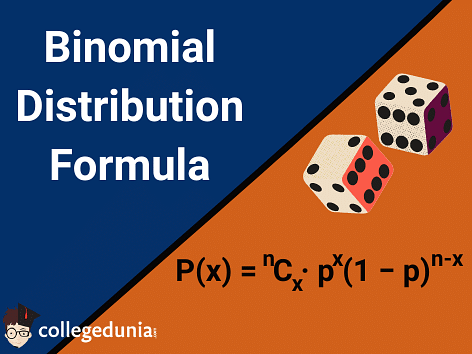
Binomial Distribution Formula is used to check the probability of getting “x” successes in “n” independent trials of a binomial experiment. Binomial Distribution is a crucial part of the probability distribution.
- Probability Distribution refers to the process of obtaining the possible outcomes in random events.
- Binomial Distribution involves the two types of two possible outcomes of any event.
- It is a discrete type of distribution between the elements.
- Binomial Distribution forms the base for the famous binomial test that is integral in Statistics.
- It was discovered by the Mathematician Jakob Bernoulli.
Binomial Distribution Formula is given as follows:
| P(x) = nCx · px (1 − p)n-x |
Read More: NCERT Solutions For Class 11 Maths Binomial Theorem
Key Terms: Binomial Distribution, Binomial Distribution Formula, Probability Distribution, Events, Trial, Probability, Bernoulli Trials
What is Binomial Distribution?
[Click Here for Sample Questions]
Binomial Distribution is a discrete probability distribution that gives only two possible results in an experiment, either Success or Failure. Binomial Distribution was discovered by the Mathematician Jakob Bernoulli. Under certain events, the probability of the two outcomes can be easily obtained through the binomial distribution in Statistics.
A probability distribution becomes a Binomial Distribution when it meets the following conditions:
- Each trial should have only two outcomes or outcomes that can be reduced to two outcomes, either a success or a failure.
- The number of observations or trials must be fixed.
- The outcome of each trial should be independent of the other.
- The success of probability (tails, heads, fail or pass) is exactly the same from one trial to another.
Binomial Theorem and Pascal Triangle Detailed Video Explanation
Also Read:
Binomial Distribution Formula
[Click Here for Previous Years’ Questions]
Binomial Distribution Formula is used to find the probability of the ‘x’ success in the n independent events. Binomial Distribution Formula is given as:
| P(x) = nCx · px (1 − p)n-x |
It can also be written as
| P(x) = nCx · px (q)n-x |
Where
- n refers to the Total Number of Events or trials.
- x refers to the Total Number of Successful Events.
- p refers to the Probability of Successful Events in One Trial.
- nCx refers to the Selection of n Events among the total events.
- 1 – p refers to the Probability of Failure in One Trial.
- q refers to the Probability of Failure in One Trial (1-p).
Binomial Distribution Formula can also be written in the form of n-Bernoulli trials,
| P(x) = \(\left(\! \begin{array}{c} n \\ x \end{array} \!\right)\)Pxqn-x = \(\frac{n!}{(n-x)!x!}\)Pxqn-x |
Binomial Distribution Formula
Read More: Binomial Expansion Formula
Binomial Distribution Formula Solved Examples
[Click Here for Sample Questions]
Here are a few solved examples on Binomial Distribution Formula for a better understanding of the formula:
Example 1: Consider that a coin is tossed 12 times. Calculate the probability of getting exactly 7 heads.
Solution: It is given that a coin is tossed 12 times. So,
- n = 12
- Probability of getting head in single toss (p) = ½
So,
1-p = 1-½ = ½
Using Binomial Distribution Formula,
P(r) = nCr · pr (1 − p)n-r
We need to find the probability of getting exactly 7 heads, which means
r = 7
Substituting the values in the Binomial Distribution Formula,
P(7) = 12C7 · (½)7 (½)12-7
P(7) = 792· (½)7 (½)5
P(7) = 792.(½)12
P(7) = 792 (1/4096)
P(7) = 0.193
Thus, the probability of getting exactly 7 heads if a coin is tossed 12 times is 0.193.
Read More: Important Questions for Class 11 Maths Binomial Theorem
Example 2: The probability of a person achieving a target is 3/4. The number of tries is given as 5. Find out the probability that he will attain the target at least thrice.
Solution: According to the question,
- p = 3/4
- q = 1/4
- n = 5
Using binomial distribution formula,
P(x) = nCx · px (1 − p)n-x
P(X = 3) + P(X=4) + P(X=5)
= 5C3 · (3/4)3 (1/4)2 + 5C4 · (3/4)4 (1/4)1 + 5C5 · (3/4)5
= 459/512
Thus, the probability that the person will attain the target at least thrice is 459/512.
Read More: Probability Distribution Formula
Properties of Binomial Distribution
[Click Here for Previous Years’ Questions]
The properties of the binomial distribution are listed below:
- There are only two possible outcomes in binomial distribution: true or false, success or failure, yes or no, etc.
- There is a fixed number of ‘n’ independent trials.
- Each trial is an independent trial, i.e. the outcome of one trial does not affect the outcome of another trial.
- The probability of success or failure is the same for each trial.
- Only the number of successes is calculated from the n independent trials.
Binomial Distribution Examples
[Click Here for Sample Questions]
Binomial Distribution is used to provide the probability of a different set of outcomes. It is used in numerous aspects of real life such as:
- The most common example is a YES/ NO survey for opinions on certain topics or events.
- It is used to find the quantity of raw and used materials while making a product.
- It is also used for taking a survey of positive and negative reviews about a product or a place.
- It can be used to find the number of male and female employees in an organization.
- The number of votes received by a candidate in an election is counted based on 0 or 1 probability.
The video below explains this:
Binomial Distribution Detailed Video Explanation:
Also Read:
Things to Remember
- Binomial Distribution is a type of probability distribution that has two possible outcomes.
- It is a discrete type of distribution that has two possible results, either Success or Failure.
- The graph of a Binomial Distribution is bell-shaped.
- Mathematician Jakob Bernauli discovered the concept of Binomial Distribution.
- The probability of the success of the events in the binomial distribution remains the same for the different types of trials.
- Binomial Distribution Formula is P(x) = nCx · px (1 − p)n-x.
- It can also be expressed as P(x) = nCx · px (q)n-x.
Previous Years’ Questions
- A die is thrown 10 times, and the probability that an odd number will come to… (VITEEE 2020)
- The probability of solving a problem by three persons… (KCET 2020)
- The digit in the unit's place of… (KCET 2011)
- If mean and variance of a binomial variate X are 2 and 1 respectively… (JKCET 2012)
- The coefficients of three consecutive terms in the expansion of…
- A flashlight has 10 batteries out of which 4 are dead. If 3 batteries… (KCET 2018)
- If X has a binomial distribution with parameters n = 6… (KCET 2019)
- The probability of happening of an event A is 0.5 and the of B… (KCET 2018)
- An unbiased coin is tossed 5 times. Suppose that a variable X… (JEE Main 2020)
- The probability that an event A happens in one trial of an experiment… (JEE Advanced 1980)
Sample Questions
Ques. A coin has been tossed 15 times by Ram. What is the probability of getting the 7 heads? (3 Marks)
Ans. Given that, a coin has been tossed 15 times.
Therefore,
- n = 15
- r = 7
- Probability of getting the heads on the single toss P = 1/2
Binomial distribution of the events will be
P(x) = nCx · px (1 − p)n-x
P(7)= 15C7. (1/2)7. (1/2)15-7
P(7)= 6435. (1/2)15
P(7)= 0.196
Therefore, the probability of attaining exactly 7 heads on tossing the coin is 0.196.
Ques. A coin has been tossed 12 times by Shreya. What is the probability of getting the 3 heads? (3 Marks)
Ans. It is given that a coin has been tossed 12 times.
Therefore,
- n = 12
- r = 3
- Probability of getting the heads on the single toss P = 1/2
Binomial distribution of the events will be
P(x) = nCx · px (1 − p)n-x
P(3)= 12C3. (1/2)3. (1/2)12-3
P(3)= 220.(1/2)12
P(3)= 0.053
Therefore, the probability of attaining exactly 3 heads on tossing the coin is 0.053.
Ques. A coin has been tossed by the ram, n number of times. The probability of attaining the head four times is the same as the probability of attaining the head six times. Find the value of n. (3 Marks)
Ans. Using the Binomial Distribution Formula, we get
P(6)= nC6. (1/2)6. (1/2)n-6
P(4)= nC4. (1/2)4. (1/2)n-4
According to the question,
- P(6)=P(4)
- nC6=nC4
- 6 = n-4
n = 10
Thus, the value of n is 10.
Ques. A coin has been tossed by the ram, n number of times. The probability of attaining the head six times is the same as the probability of attaining the head nine times. Find the value of n. (3 Marks)
Ans. Using the Binomial Distribution Formula:
P(6)= nC6. (1/2)6. (1/2)n-6
P(9)= nC9. (1/2)4. (1/2)n-9
According to the question,
- P(6)=P(9)
- nC6=nC9
- 6 = n-9
n = 15
Hence, the value of n is 15.
Ques. The probability that the individual can attain the target is 4/5. The number of counts for the trials is 6. What is the probability of the attainment of the target three times? (3 Marks)
Ans. Given,
- P=⅘
- q=⅕
- n=6
By using the binomial distribution formula,
P(x) = nCx · px (1 − p)n-x
P(X=4)+ P(X=5) + P(X=6)
- 6C4. (4/5)4(1/5)2+ 6C5. (4/5)5(1/5)1+6C6. (4/5)6(1/5)0
- 540 x 0.4096 x 0.04 + 6 x 0.32768 x 0.2 + 1 x 0.262144
- 8.84 + 0.384 + 0.26
- 9.484
Thus, the probability of the attainment of the target three times is 9.484.
Ques. The probability that the individual can attain the target is 5/6. The number of counts for the trials is 7. What is the probability of the attainment of the target three times? (3 Marks)
Ans. Given,
- P=⅚
- q=⅙
- n=7
Using the Binomial Distribution Formula,
P(x) = nCx · px (1 − p)n-x
P(X=5)+ P(X=6) + P(X=7)
- 7C5. (5/6)5(1/6)2+ 7C6. (5/6)6(1/6)1+7C7. (5/6)7(1/6)0
- 21*0.401*0.027+7*0.027*0.33+0.279
- 1.74+0.34
- 2.08
Thus, the probability is 9.484.
Ques. A coin has been tossed by the ram, n number of times. The probability of attaining the head nine times is the same as the probability of attaining the head ten times. Find the value of n. (3 Marks)
Ans. Using the Binomial Distribution Formula,
P(10)= nC10. (1/2)10.(1/2)n-10
P(9)= nC9. (1/2)4. (1/2)n-9
According to the question,
- P(10)=P(9)
- nC10=nC9
- 10 = n-9
n = 19
Thus the value of n is 19.
Ques. A coin has been tossed 10 times by Abdul. What is the probability of getting the 3 heads? (3 Marks)
Ans. It is given that a coin has been tossed 10 times.
Therefore,
- n = 10
- r = 3
- Probability of getting the heads on the single toss P = ½
The Binomial distribution of the events will be
P(x) = nCx · px (1 − p)n-x
P(3)= 10C3. (1/2)3. (1/2)10-3
P(3)= 120.(1/2)10
P(3)= 0.117
Ques. A coin has been tossed 15 times by David. What is the probability of getting the 5 heads? (3 Marks)
Ans. Given that a coin has been tossed 15 times.
Therefore,
- n= 15
- r=5
- Probability of getting the heads on the single toss P = ½
Binomial distribution of the events will be
P(x) = nCx · px (1 − p)n-x
P(5)= 15C5. (1/2)5. (1/2)15-5
P(5)= 3003.(1/2)15
P(5)= 0.0916
Ques. A coin has been tossed n number of times by Hania. The probability of attaining the head eight times is the same as the probability of attaining the head ten times. Find the value of n? (3 Marks)
Ans. Using the Binomial Distribution Formula,
P(10)= nC10. (1/2)10.(1/2)n-10
P(8)= nC8. (1/2)8. (1/2)n-8
According to the question,
- P(10)=P(8)
- nC10=nC8
- 10= n-8
n = 18
Thus, the value of n is 18.
Ques. What are the types of distribution in probability? (3 Marks)
Ans. Probability Distribution can be defined as the function which describes the possible outcomes associated with the random variable in the given range of outcomes. It can be divided into two major types:
- Discrete Probability Distribution
- Continuous Probability Distribution
Discrete Probability Distribution refers to the countable occurrences that have finite or countable outcomes within the associated range of outcomes. Continuous Probability Distribution refers to the probability distribution, which involves the infinite or wide range of uncountable values.
Check Out:



Comments