



Content Curator
Binomial distribution is a probability distribution defining the number of successful outcomes in a fixed number of independent trials, given a specific probability of success for each trial.
- The discrete probability distribution known as the binomial distribution, which is used in probability theory and statistics, only permits Success or Failure as the possible results of an experiment.
- For instance, there are only two possible outcomes when we flip a coin: heads or tails, and there are only two outcomes when we take a test: pass or fail.
- This distribution is also known as a binomial probability distribution.
- The key features of a binomial distribution are the number of trials, the probability of success, and the number of successes.
Read More: NCERT Solutions For Class 11 Maths Binomial Theorem
Key Terms: Probability, Boolean Algebra, Bernoulli Theorem, Binomial Distribution, Mean, Variance, Negative Binomial Distribution
Binomial Probability Distribution
[Click Here for Sample Questions]
Binomial Probability Distribution can be defined as:
| “A probability model used to calculate the probability of a certain number of successes in a fixed number of independent trials, given the probability of success on each trial.” |
- Depending on the Boolean value of the outcome, the number of "Successes" in a sequence of n experiments is represented in a binomial confidence interval as either failure/no/false/zero (probability q = 1 – p) or success/yes/true/one (probability p).
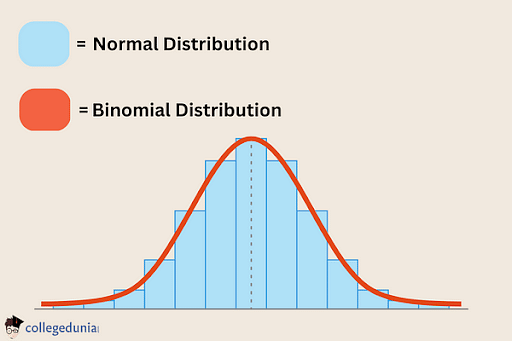
Binomial Distribution and Normal Distribution
- A single success or failure test is known as a Bernoulli trial or experiment, and a series of results is known as a Bernoulli process.
- For n = 1, or one experiment, the binomial distribution is a Bernoulli distribution.
- The binomial distribution serves as the foundation for the well-known binomial test of statistical significance.
The video below explains this:
Binomial Distribution Detailed Video Explanation:
Check Also:
Negative Binomial Distribution
[Click Here for Previous Year Questions]
The negative binomial distribution can be defined as a discrete probability distribution that models the probability of the number of failures occurring before a certain number of successes in a series of independent and identically distributed Bernoulli trials.
- Here, "r" stands for the number of failures.
- For instance, suppose we roll the dice and label any 1s as failures and any non-1s as successes.
- The probability distribution of the number of non-1s that arrived would be the negative binomial distribution if we threw the dice repeatedly until 1 appeared the third time, i.e., r = three failures.
Read Also: Exponents Powers: Formulas, Laws & Solved Examples
Binomial Distribution Formula
[Click Here for Sample Questions]
For each of the random variable X, the formula of binomial distribution is given as:
→ P (x: n, p) = nCx px (1-p) n-x
Or
→ P (x: n, p) = nCx px (q) n-x
Where,
- n = number of tests conducted.
- x = 0, 1, 2, 3, 4, …
- p = probability that an experiment will succeed
- q = Probability of Failure in a Single Experiment (p - 1)
The formula for the binomial distribution can also be expressed as n-Bernoulli trials, where nCx = \(\frac{n!}{x! (n - x)!}\)
Hence, P (x: n, p) = \(\frac{n!}{x! (n - x)!}\). px. (q) n-x.
Also Read:
| Related Concepts | ||
|---|---|---|
| Venn Diagrams | Real-Valued Function | Relations and Functions |
Characteristics of Binomial Distribution
[Click Here for Previous Year Questions]
The binomial distribution's characteristics are as follows:
- The results can be true or false, successful or unsuccessful, yes or no.
- A specified number of n times repeated trials or 'n' separate trials are conducted.
- For each trial, the probability of success or failure is the same.
- Only the success rate is determined from n separate experiments.
- Every trial is independent of one another, therefore the result of one does not influence the result of another.
Binomial Distribution Criteria
[Click Here for Sample Questions]
When particular conditions are met, the likelihood of an event occurring is modelled by a binomial distribution. To utilise the binomial probability formula, the following principles involving binomial distribution must be followed:
1. Fixed trials
The number of trials in the procedure under investigation must be fixed and cannot be changed during the analysis. Each experiment must be carried out consistently throughout the analysis, even though each trial's results could vary.
2. Independent trials
These trials must be independent of one another for the binomial probability to exist. Simply said, the results of one study should not influence those of others. The probability of having trials that are not entirely independent of one another when employing certain sampling techniques exists, therefore binomial distribution should only be utilised when the population size is big relative to the sample size.
3. Fixed probability of success
For these trials, the probability of receiving success in such a binomial distribution must stay constant. As there are only two possible outcomes when tossing a coin, for instance, the probability of flipping the coin is 12 or 0.5 for each experiment we conduct.
4. Two mutually exclusive outcomes
Only two outcomes—success or failure—are mutually exclusive in binomial probability. Even though the word "success" is typically used to refer to anything positive, it can also signify that the trial's results concur with your definition of success, whether that result is favourable or bad.
Check Also: Independent Events in Probability
Binomial Distribution Examples
[Click Here for Previous Year Questions]
Here are a few situations from everyday life where a binomial distribution would be used.
- Determining a television channel's TRP by asking households if they watch the channel (YES) or not (NO).
- Measuring the difference between the used and unused materials used in the production of a commodity (raw).
- Finding the total number of votes cast for an electoral candidate is based on a probability of 1 or 0.
- Calculating the total number of male and female workers in a workplace.
Check More:
Mean and Variance
[Click Here for Sample Questions]
The formulas below are used to indicate the mean, variance, and standard deviation for a binomial distribution for a certain number of successes.
- Mean, μ = np
- Variance, σ2 = n × p × q
- Standard Deviation, σ = √ (n × p × q)
Where,
- p is known as the probability of achieving success
- ‘q’ is the probability of failure, q = 1 - p
Also read: Geometric Distribution: Formula, Properties & Solved Questions
Difference between Normal Distribution and Binomial Distribution
[Click Here for Previous Year Questions]
The primary difference between the normal distribution and the binomial distribution is that the latter is continuous, while the former is discrete.
- In contrast to the normal distribution, which has an unlimited number of events, the binomial distribution has a finite number of events.
- The distribution curve for the binomial distribution resembles the normal distribution curve if the sample size for the binomial distribution is quite large.
Thus, some of the major differences between Normal distribution and Binomial Distribution include:
| Parameters | Binomial Distribution | Normal Distribution |
|---|---|---|
| Variables Representation | r (It counts the total number of successes) | x (It is a measurement variable) |
| Variables Types | Discrete | Continuous |
| Graph | Histogram | Bell–Shaped Curve |
Read Also: Cumulative Frequency Curve: Graph and Calculations
Things to Remember
- Binomial distribution is a probability distribution showing the number of successful outcomes in a fixed number of independent trials, provided that there is a specific probability of success for each trial.
- Statisticians frequently utilise the binomial distribution as a discrete distribution rather than a continuous distribution like the normal distribution.
- The normal distribution is a probability distribution that is widely used in statistics to describe continuous data that have a symmetric, bell-shaped distribution.
- Normal Distribution is also known as the Gaussian distribution or the bell curve.
- The main distinction between the normal distribution and the binomial distribution is that the latter is continuous, while the former is discrete.
Previous Year Questions
- Sum of last 30 coefficients in the binomial expansion of… (KEAM 2018)
- Let tn denote the nth term in a binomial expansion. If… (KEAM)
- The number of irrational terms in the expansion of… (WBJEE 2019)
- The coefficient of x50 in the binomial expansion of… (JEE Main 2014)
- A die is thrown 10 times, and the probability that an odd number will come to… (VITEEE 2020)
- The probability of solving a problem by three persons… (KCET 2020)
- A flashlight has 10 batteries out of which 4 are dead. If 3 batteries… (KCET 2018)
- If X has a binomial distribution with parameters n = 6… (KCET 2019)
- The probability of happening of an event A is 0.5 and the of B… (KCET 2018)
- An unbiased coin is tossed 5 times. Suppose that a variable X… (JEE Main 2020)
Sample Questions
Ques. What is the binomial distribution's mean and variance formula? (1 mark)
Ans. The binomial distribution mean and variance are:
Mean = np
Variance = n × p × q
Ques. Assume that 0.25 per cent of women and 5% of males have gray hair. Randomly, a person with grey hair is chosen. What is the probability that this individual is male? Assume there is the same number of men and women. (2 marks)
Ans. Given that, 0.25 percent of women and 5% of males have grey hair.
Total percentage of grey hair owners: 5 + 0.25
= 5.25 %
Consequently, the probability that a selected male has grey hair is P = 5 / 25 = 20 / 21.
Ques. What criteria apply to the binomial distribution? (2 marks)
Ans. The criteria of binomial distribution are:
- There should be a set number of trials.
- Every trial ought to be separate.
- From one trial to the next, the chance of success is exactly the same.
Ques. Assuming that A and B are two independent events with P(A) = ⅗ and P(B) = 4/9, then what does P(A’ ∩ B’). (3 marks)
Ans. In the question, it is stated that P(A) = 3/5 and P(B) = 1/5.
P(A’ ∩ B’) = 1 - P(A ∪ B)
= 1 - [P (A) + P(B) - P(A ∩ B)]
= 1 - [3/5 + 4/9 - 3/5 x 4/9] … [P(A∩B)=P(A)⋅P(B)]
Thus,
= 1 - \(\frac{27+20-12}{45}\)
= 1 - 35/45
= 10/45
= 2/9
Ques. What is the probability that a leap year chosen at random will have 53 Tuesdays? (3 marks)
Ans. We are aware that there are 366 days, 52 weeks, and 2 days in a leap year. There are 52 Tuesdays in a year, or 52 weeks.
The probability that there will be 53 Tuesdays in a leap year is equal to the probability that the final two days will fall on a Tuesday.
Monday and Tuesday; Tuesday and Wednesday; Thursday and Friday; Friday and Saturday; and Saturday and Sunday (Sunday and Monday). There are a total of 7 cases.
Cases where Tuesday might arrive = 2
Therefore, the probability that a leap year will include 53 Tuesdays is 2 / 7.
Ques. From a deck of 52 playing cards, two are picked at random and without replacement. Calculate the probability that both cards are black. (4 marks)
Ans. Given a 52-card deck. As far as we are aware, there are a total of 26 black cards. Let A and B stand in for the instances where the first and second drawn cards are both black.
At this point, P (A) = P (black card in first draw) = 26 / 52 = 12.
Given that A has already occurred, the conditional probability of B is that B will also occur since the second card is drawn without replacement, bringing the total number of black cards to 25, and the total number of cards to
5. P (B / A) equals P (black card in second draw) = 25 / 51.
Consequently, the probability that both cards are black
⇒ P (A ∩ B) = ½ × 25 / 51 = 25 / 102
Thus, the probability that both cards being black is equal to 25 / 102.
Ques. What is the probability that a leap year chosen at random will have 53 Tuesdays? (3 marks)
Ans. We are aware that there are 366 days, 52 weeks, and 2 days in a leap year. There are 52 Tuesdays in a year or 52 weeks. The likelihood that there will be 53 Tuesdays in a leap year is equal to the likelihood that the final two days will fall on a Tuesday.
Consequently, the latter two days can be Monday and Tuesday; Tuesday and Wednesday; Thursday and Friday; Friday and Saturday; and Saturday and Sunday (Sunday and Monday) 7 total instances were reported.
Cases where Tuesday might arrive = 2
Thus, the probability that a leap year will have 53 Tuesdays is 2/7.
Ques. Five red and five black balls are housed in an urn. At random, a ball is selected, its colour documented, and it is then put back in the urn. A ball is then picked at random after 2 extra balls of the colour drawn are placed in the urn. How likely is it that the second ball will be red? (5 marks)
Ans. The answer states that two balls of the same colour are added after a ball is randomly selected and its colour noted, hence there are two occurrences in this situation. Think about the first instance
If Red were to be the first ball drawn, its likelihood is 5/10.
Adding two more red balls now. P (drawing the red ball on the second try = 7/12)
Given that these two events are unrelated, the necessary probability in this situation is 5/10 * 7/12.
Think of the second scenario. If the black ball is pulled on the first try, the likelihood is 5/10.
Two additional black balls will now be added. P (drawing the red ball on the second try) = 5/12
Given that these two events are separate, the necessary probability in this instance is 5/10 * 5/12.
The formula for total probability is 5/10 * 7/12 + 5/10 * 5/12 = 5/10.
Consequently, the likelihood of sketching the colour red is ½.
Ques. Three oranges are picked at random and examined without replacement to inspect an orange box. The box is accepted for sale if all three oranges are in acceptable condition; otherwise, it is refused. Calculate the probability that a package containing 15 oranges, 12 of which are good, and 3 of which are bad, will be accepted for sale. (4 marks)
Ans.
A box of oranges was given. Assume that A, B, and C represent the first, second, and third drawn oranges, respectively, as good events. P (A) = P (good orange in first draw) = 12 / 15 at this point.
The overall number of nice oranges will now be 11, and there will be a total of 14 oranges, which is the conditional probability of B given that A has already happened. This is because the second orange is drawn without replacement.
P (B / A) = P (good orange in second draw) = 11 / 14 at this point.
The overall number of nice oranges will now be 10, and there will be a total of 13 oranges, which is the conditional probability of C given that A and B have already happened. This is because the third orange is pulled without replacement.
P (C / AB) =P (good orange in third draw) = 10 / 13 now.
Consequently, there is a chance that every orange will be good.
⇒ P (A ∩ B ∩ C) = 12 / 15 × 11 / 14 × 10 / 13 = 44 / 91
Consequently, 44 / 91 represents the probability that a box will be approved for sale.
Ques. From a box of 10 black and 8 red balls, two balls are picked at random and replaced. Calculate the probability that
(i) both balls are red.
(ii) The first ball is red and the second is black.
(iii) One is crimson, the other is black. (5 marks)
Ans. Given 10 black and 8 red balls in a box. There are 18 balls in the box overall.
(i) The two balls are red
8 / 18 = 4 / 9 is the probability of getting a red ball in the first draw. Once the initial throw has been made, the ball is replaced.
Consequently, the probability of receiving a red ball in the second draw is 8 / 18, or 4 / 9. The probability of receiving both red balls is now 4 / 9 x 4 / 9, or 16 / 81.
(ii) The first ball is black, whereas the second is red.
10 / 18 = 5 / 9 is the probability of getting a black ball in the first draw. After the initial toss, the ball is changed, Consequently, the probability of receiving a red ball in the second draw is 8 / 18, or 4 / 9.
The probability of receiving the first ball to be black and the second to be red is now 5 / 9 x 5 / 9, or 20 / 81.
(iii) One is red and the other is black. 10 / 18 = 5 / 9 is the probability of getting a black ball in the first draw. Once the initial throw has been made, the ball is replaced.
Consequently, the probability of receiving a red ball in the second draw is 8 / 18, or 4 / 9. The probability of getting the first black ball and the second red ball is now 5 / 9 x 4 / 9 x 20 / 81.
8 / 18 = 4 / 9 is the probability of getting a red ball in the first draw. Once the initial throw has been made, the ball is replaced. The odds of getting a black ball in the second draw are therefore 10 / 18 = 5 / 9.
The probability of landing the first ball red and the second black is now equal to 5 / 9 x 4 / 9, or 20 / 81. Consequently, the probability of receiving one of them in black and the other in red is:
= Chance of getting the first ball to be black and the second to be red plus the Chance of getting the first to be red and the second to be black.
= 20 / 81 + 20 / 81 = 40 / 81
Join Our Telegram Channel for Live Updates on Board Exams: https://t.me/class_10_12_board_updates
Check-Out:



Comments