



Content Curator
When a dice is rolled, the possibility of coming 6 is the probability and the formula to derive this possibility is known as the Probability Distribution Formula. The probability formula refers to the most favorable outcome which may take place in an event.
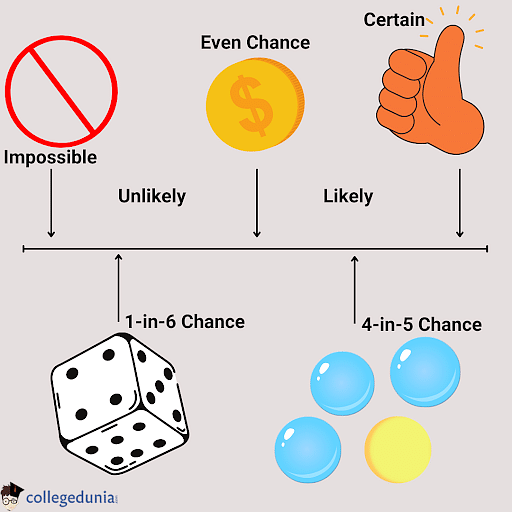
Probability is the ratio of possible outcomes of an event to the total number of outcomes. The probability of a particular event can be any number from 0 to 1. 0 refers to no possible outcomes.
An example of the same is the possibility of 7 while rolling a die with only 6 numbers is impossible and its probability is 0. 1 refers to the event that will take place for sure.
Read Also: Probability Important Questions
| Table of Content |
Key Terms: Probability, Probability Distribution, Normal Probability Distribution, Binomial Probability Distribution
What is Probability Distribution?
[Click Here for Sample Questions]
The probability formula can be defined as the most favourable outcome which may take place in an event.
- When a dice is rolled, the possibility of coming 6 is the probability and the formula to derive this possibility is known as the Probability Distribution Formula.
- Probability distribution,simply, helps determine the possible outcomes for any random event.
- It is also expressed on the underlying sample space due to a set of possible outcomes of any random experiment.
- The settings here can be a set of real numbers, a set of vectors or a set of any entities, thus being a part of probability and statistics.
Probability
Read Also: Probability MCQs
Probability Distribution Formula
[Click Here for Previous Year Questions]
Probability Distribution Formula is the formula to derive the possible outcomes of a particular event. Probability distribution has a wide range of categories such as
- Binomial Probability Distribution
- Normal Probability Distribution (or, Gaussian Distribution)
- Poisson distribution
- Chi-square distribution.
But Normal and Binomial Distribution Formulas are the most common. However, Normal Distribution can be simple to derive. Here, we will discuss both of them.
Examples of Probability Distribution Formula
Probability distribution formula can be applied in various day-to-day activities. Some common examples include
- Rolling a Die
- Tossing a Coin
- Number of Males and Females living in a Society
- Average Marksheet of all Students of a Class

Probability Formula
Normal Probability Distribution Formula
[Click Here for Sample Questions]
The Normal Probability Distribution is also called Gaussian Distribution. While presenting it on a graph, this distribution will form a ‘bell-shaped’ curve and it will always show normal distribution between values.
Here is the formula of normal distribution : P(x) = \(\frac{1}{\sqrt{2 \pi \delta^2}} e ^{-(x-\mu)^2/2\delta^2}\)
Here,
- μ = Mean
- σ = Standard Distribution
- x = Normal random variable
Binomial Probability Distribution Formula
[Click Here for Previous Year Questions]
The Binomial Probability Distribution is a formula to find out the probability of a particular event in which repeated trials are taking place.
- Suppose the independent trials of a particular event in a binomial experiment is ‘n’ and ‘x’ is the probability of this outcome.
- The value of ‘n’ is to be derived in this experiment. The trial in this probability is fixed in number. The trials are not dependent on each other.
- For every outcome, the probability of success will be the same for every trial.
- Thus, it can also be represented as,
| Resulting Number | Probability |
|---|---|
| 1 | On dot on 3 out of the given 6 sides, thus the probability is 3/6 (50%) |
| 4 | Four dots on 2 out of the given 6 sides, thus the probability is 2/6 (33%) |
| 6 | Four dots on 1 out of the given 6 sides, thus the probability is 1/6 (17%) |
Binomial Probability Distribution is helpful in various ways:
- To find out the total good and bad products while manufacturing
- Total number of votes a person has got in an election.
- Number of female and male employees of a particular company
The formula of Binomial Probability Distribution is:
P (r out of n) = \( \frac{n!}{r!(n-r)!} . p^r ( 1 - p)^{n-r} = ^nC_r.p^r(1-p)^{n-r}\)
Here,
- ‘n’ refers to the total number of trials
- ‘x’ refers to the total success desire
- ‘P’ refers to probability to get success only in one trial
- ‘Q’ refers to the probability to have an unsuccessful in a trial
Things to Remember
- Any event which has the surety to take place is known as a Possible Event and its probability is always 1.
- Any event which is not possible to take place is known as an Impossible Event and its probability is always 0 (zero).
- The probability formula can be defined as the most favorable outcome which may take place in an event.
- When a dice is rolled, the possibility of getting a 6 is the probability and its formula to derive the possibility is called the Probability Distribution Formula.
Previous Year Questions
- Two cards are drawn at random from a pack of 52 cards ….[KCET 2016]
- If two dice are thrown simultaneously, then the probability that the sum of the numbers ….[KCET 2015]
- A bag contains (2n+1) coins. It is known that n of these coins have a head on ….[KCET 2015]
- A and B each select one number at random from the distinct numbers 1,2,3 ...[WBJEE 2019]
- Two dice are thrown simultaneously, the probability of ….[KCET 2016]
- Probability of four sons to a couple is…..[NEET 2001]
- A die is thrown twice. If getting a number greater than four on the die is..[MHT CET 2019]
- A bag contains 2n coins out of which n−1n−1 are unfair with ….[BITSAT 2019]
- A bag contains 3 red and 3 white balls. Two balls are drawn….[BITSAT 2015]
- A four digit number is formed by the digits 1,2,3,41,2,3,4 with no repetition ….[JIPMER 2014]
Sample Questions
Ques. What is the probability? (1 mark)
Ans. Probability refers to the most favourable outcome which may take place in an event.
Ques. What should mutually exclusive events contain? (1 mark)
Ans. Some Events are mutually exclusive only in the case they do not have any common sample point.
Ques. Show probability of an event ‘G’ considering that H represents its complement, as per the axioms of probability? (1 mark)
Ans. The probability of an event ‘G’, assuming that H represents its complement is:
P(G) + P(H) = 1.
Ques. Represent the expected value of a discrete random variable ‘x’. (1 mark)
Ans. The expected value, herein, has been referred to mean that is given by ∑ x P(x) in case of discrete probability distribution.
Ques. Suppose a coin is tossed for 5 times. Find out the probability to get : (5 marks)
a) Exactly 3 heads
b) Minimum 3 heads
Ans: The phenomenon of tossing a coin multiple times comes under Bernoulli trial.
(a) According to this question :
Total number of trial or n = 5 (as coin is said to be tossed for 6 times
(p) or probability to get a head is always ½ (as there is one head and one tail in one one coin)
x=3 (for exactly 3 heads)
Now putting all the values
P(x=3) = \((\frac{5}{3})*(\frac{1}{2})^3*(\frac{1}{2})^{6-3}\)
= (10)*\((\frac{1}{8})*(\frac{1}{4})\)
=\((\frac{10}{32})\)
So here, the probability of exactly 3 heads in this equation is 10/32 or 0.312
(b) Putting the above values in the formula :
P(x=4) = \((\frac{5}{4})* (\frac{1}{2})^4* (\frac{1}{2})^{5-4}\)
= 5* \((\frac{1}{16})*(\frac{1}{2}) = \frac{5}{32}\)
P(x=5) = \((\frac{5}{5})* (\frac{1}{2})^5* (\frac{1}{2})^{5-8}\)
= 1* \((\frac{1}{32})\)* (1) = \(\frac{1}{32}\)
Now adding the values,
\(\frac{10}{32} + \frac{5}{32} + \frac{1}{32} = \frac{16}{32} = \frac{1}{2}\)
So, the answer is \(\frac{1}{2}\)
Ques. In a Binomial distribution, the mean the 20 and standard deviation is 4. Find out Number of trials (n), Probability (p) and failure probability (q). (5 marks)
Ans: Putting all the values according to the question.
Mean, np = 20 (equation 1)
S.D., sqrt npq = 4 (equation 2)
Squaring the equation 2
npq = 16 (equation 3)
Dividing equation 3 by equation
npq \(\frac{16}{20}\)
np
q = \(\frac{4}{5}\)
We know that,
p+q = 1
p = 1-q = 1 - \(\frac{4}{5}\)= \(\frac{1}{5}\)
Put P = \(\frac{1}{5}\)in equation 1 n × \(\frac{1}{5}\)= 20
N= 100
So, value of 'n' is 100, p is ⅕ and q is ⅘.
Ques. Two unbiased coins are tossed at a moment. Find the probability of Exactly two heads (b) at least one head (c) no heads (3 marks)
Ans: One coin has a head and a tail. So, accordingly,
(i) A = events of exactly two heads
A = (HH)
n (A) = 1
P(A) = number of favorable cases/Total number of cases
= \(\frac{1}{4}\)
(ii) B = event of at least one head (1H or 2H)
B = (HT, TH, HH)
n (B) = 3
P (B) = n(B) / n(S) = ¾
(iii) D = event of no head
D = (TT)
n(D) = 1
P(D) = No. Of favourable cases/ Total number of cases
P(D) = ¼
Check-More:



Comments