



Content Writer
Bromothymol blue, also known as red synthetic dye, is used as an indicator in determining the pH of a substance. It is a weak acid with the chemical formula C27H28Br2O5S.
- Bromothymol blue is also known as BTB, Dibromothymolsulfophthalein and 3,3′-Dibromothymolsulfonphthalein.
- It is used in applications requiring measuring substances with a relatively neutral pH.
- We can use it to measure the presence of carbonic acid in a liquid.
- The IUPAC name of bromothymol blue is 3,3-Bis[3-bromo-4-hydroxy-2-methyl-5-(propan-2-yl)phenyl]-2,1λ6-benzoxathiole-1,1(3H)-dione.
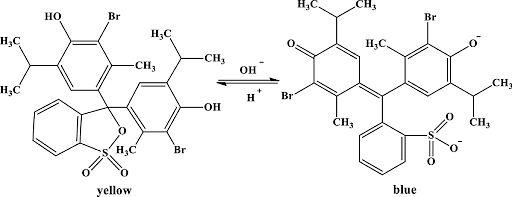
- BTB can be protonated or deprotonated, thus changing the colour to yellow or blue.
- The pH range for bromothymol blue is 6 to 7.6.
- It is typically sold in solid form as the sodium salt of the acid indicator.
Key Terms: Bromothymol Blue, Bromothymol Sulfonephthalein, pH Indicator, Organic chemistry, Carbonic Acid, pH, Sodium, Dye, Bromothymol blue Structure
What is Bromothymol Blue?
[Click Here for Sample Questions]
Bromothymol blue or bromothymol sulfonephthalein is used as a pH indicator, which gives a yellow colour in case of acid; in basic solutions, it turns blue, and in neutral solutions, it turns a bluish-green colour.
- It contains cycloheximide, chlortetracycline, and chloramphenicol.
- BTB is a weak acid that can act as an acid or in base form, depending on the pH level of the solution.
- The dry powder of bromothymol sulfonephthalein is converted into a solution form by mixing sodium hydroxide, ethanol, and water.
- However, the compound is quite toxic and can cause skin and eye irritation if swallowed.
- Bromothymol blue is used by obstetrics to detect premature rupture of membranes.

Bromothymol Blue
Also Read:
| Chapter Related Articles | ||
|---|---|---|
| Activity Selectivity of Catalyst | Brownian Motion Zig Zag Motion | Coagulation of Colloidal Solutions |
| Fischer Esterification Mechanism | Flocculation | Latex Chemical Compound |
Bromothymol Blue Structure
[Click Here for Sample Questions]
Bromothymol blue is a heavy-weight molecule of 625 g/mol, which has a unique structure of three aromatic benzene rings. The first ring is connected with the sulfur atom and has a thym group that has two oxygen atoms bonded by a double bond.
- Another oxygen atom is attached to the sulfur atom via a single bond.
- Both the second and third benzene rings have a bromine atom, a methyl group, a tert-butyl group, and an alcohol group attached.
- The last five carbon atoms on two of the benzene have alcohol, propyl, bromine, methyl and hydrogen atoms attached to them.
In another way, bromothymol blue is a member of 2,1-benzoxazoles, which is 2,1-benzoxathiole 1,1-dioxide in which both of the hydrogens at position three have been substituted by 3-bromo-4-hydroxy-5-isopropyl-2-methylphenyl groups.

Bromothymol Blue Structure
Properties of Bromothymol Blue
[Click Here for Sample Questions]
The physical and chemical properties of Bromothymol Blue are as follows:
Physical Properties of Bromothymol Blue
The physical properties of Bromothymol Blue are as follows:
- Bromothymol Blue is an odourless indicator that is sparingly soluble in water.
- It is a white crystalline solid that has a molecular density of 624.38 g/mol.
- The melting and boiling point of BTB is 202 °C (396 °F; 475 K) and 614.26 °C at 760 mmHg, respectively.
- The pH indicator has a density of 1.25g/cm3.
The physical properties are tabulated below:
| Category | Data |
|---|---|
| Compound Name | Bromothymol Blue |
| Appearance | Yellow in acid solution, Blue in basic solutions, and green in neutral solution. |
| Covalently-Bonded Unit | 1 |
| Complexity | 818 |
| Density | 1.25 g/cm3 |
| Molecular Weight/ Molar Mass | 624.384 g/mol |
| Boiling Point | 614.26° C at 760 mmHg |
| Melting Point | 202 °C |
| Chemical Formula | C27H28Br2O5S |
Chemical Properties of Bromothymol Blue
The chemical properties of Bromothymol Blue are as follows:
Bromothymol Blue pH Range
Bromothymol Blue has a pH range of 6 to 7.6. It is a member of the class of 2,1-benzoxazoles, which is 2,1-benzoxathiole 1,1-dioxide, in which both of the hydrogens at position three have been substituted by 3-bromo-4-hydroxy-5-isopropyl-2-methyl phenyl groups.
- Bromothymol Blue is a protonated form with an absorption at 927 nm that makes it turn yellow.
- Its deprotonated form has an absorption point of 602 nm, turning it into blue light when in basic solution.
- BTB turns blue when neutral solutions are used.
Synthesis and Preparation of Bromothymol Blue
[Click Here for Sample Questions]
Bromothymol blue is a large molecule that is converted into an aqueous solution as follows:
Reagents required for this process:
The reagents required are as follows:
- 0.1 grams of bromothymol blue powder
- 16mL of 0.01 N sodium hydroxide
- Distilled Water
Steps followed in the process:
The steps required for the preparation of Bromothymol Blue are as follows:
- Dissolve the given bromothymol blue powder in sodium hydroxide solution
- After the above process, dilute the solution with water that is not more than 250 mL.
Bromothymol Blue Uses
[Click Here for Sample Questions]
Bromothymol Blue is used for various purposes, including :
- It can be used as an indicator of CO2 level and to observe photosynthetic activities.
- Bromothymol blue is a common demonstration of the pH indicator properties and measures the pH level of any solution.
- This indicator is used in conjunction with phenol red to examine the fungal asparaginase enzyme activity when it turns pink.
- BTB turns blue indicating an increase in pH, which determines the enzyme activity.
- According to a recent study, the red part is useful for determining activity because the bright yellow ring forms in the enzyme activity zone.
- Bromothymol blue is also used to detect premature membrane rupture.
- So, bromothymol turns blue after being in contact with leaking fluid amnion.
- It is also used in the laboratory as a stain on a biological slide.
Things to Remember
- Bromothymol blue is mainly used to measure the pH level of any liquid.
- It turns yellow in acid solution, blue in basic solutions, and green in neutral solution.
- The chemical formula of bromothymol blue is C27H28Br2O5S.
- Its pH level ranges from 6.0 to 7.6.
- Bromothymol blue has various usages in finding results about various solutions.
Also Read:
Sample Questions
Ques. What bromothymol blue indicates the presence of any substances? (2 marks)
Ans. Bromothymol blue (BMB) is an indicator dye that turns yellow when in contact with acid. When CO2 is added to the solution, carbonic acid is produced which lowers the solution’s pH.
Ques. How toxic is bromothymol blue? (2 marks)
Ans. It causes Chronic effects on humans. It can cause damage to human organs lungs and mucous membranes. It may have adverse effects on humans and is very dangerous for ingestion. skin touch (irritant), and inhalation.
Ques. What is the color of bromothymol blue in a base? Explain. (3 marks)
Ans. Bromothymol blue is an acid indicator and based on the pH level of the solution, it indicates whether it is an acid or base form. It changes to purple or blue color in acid solution and green in neutral solution. However, bromothymol blue is a weak acid but it can stay in both acid and base form. To conclude, bromothymol blue turns yellow in acidic solution, blue in basic solution, and green in neutral solution.
Ques. How harmful is the consumption of Bromothymol blue? (3 marks)
Ans. The consumption of bromothymol blue can cause irritation to the eyes and skin and can cause toxicity if swallowed. However tiny consumption can cause digestion malfunction and causes nausea and vomiting, and even death if it continues for long. Drinking water will treat incidental swallowing.
Ques. What is the color of bromothymol blue in neutral solution? Why? (3 marks)
Ans. Bromothymol blue is green in color when put in a neutral solution. It is a heavy acid and in neutral water, it is bluish-green. The deprotonation of the results in neutral form is a type of structure that is highly conjugated and because of this, the difference in colors occurs. The greenish color of the neutral solution is responsible for an intermediate of the deprotonation process.
Ques. What is the chemical formula of bromothymol blue? Explain. (3 marks)
Ans. The chemical formula of bromothymol blue is C27H28Br2O5S. Bromothymol blue is a member of the class of 2,1-benzoxathioles that is 2,1-benzoxathiole 1,1-dioxide in which both of the hydrogens at position 3 have been substituted by 3-Bromo-4-hydroxy-5-isopropyl-2-methyl phenyl groups. It has a role as an acid-base indicator, a dye, and a two-color indicator.
Ques. Bromothymol blue added to a solution imparts blue color, what is the pH of this solution? (1 mark)
Ans. If the solution’s pH level is 5 then it is acidic in nature and if the solution’s pH level is 9 then it has a base form.
Ques. Is there a benefit to using different pH indicators for carbon utilization tests? (3 marks)
Ans. Choice of pH indicator depends upon the factor, that different indicators provide changes as per to their limits. For example, if you are using Bromocresol Purple, you will see it purple at neutral pH and turns yellow near pH 5. Now the question is if your bacterial stain does not produce enough acid to go near that pH, this indicator will not work, and even though your bacterium is creating acid from carbon and the result can be seen. To see the result, you have to use phenol red (6.8 to 8.4; where minor change is examined).
Ques. What color change occurs when bromothymol blue is put into acidic condition? (2 marks)
Ans. The correct option is yellow. Bromthymol Blue is a type of dye used as an indicator to determine pH. Bromthymol blue is a weak acid. It can be either acid or base form, depending on the pH of the solution. This reagent is yellow in acidic solutions, blue in basic solutions, and green in neutral solutions.
Ques. Why is alcohol added in the preparation of bromothymol blue solutions? (2 marks)
Ans. The alcohol can be used to make it easier to dissolve the bromothymol in water since bromothymol is highly soluble in alcohol but dissolves with difficulty in the water.
Ques. Why is the colour of bromothymol blue red? (2 marks)
Ans. Bromothymol blue is a weak acid with a nearly red appearance. On the other hand, it becomes blue and yellow when it reacts with an alkaline solution and an acidic solution. It displays bluish green color at neutral pH (7.0).
For Latest Updates on Upcoming Board Exams, Click Here: https://t.me/class_10_12_board_updates
Check-Out:



Comments