



Education Journalist | Study Abroad Lead
Dialysis of sol means removing impurities/ ions/ electrolytes from it. This is done on the basis of unequal rates of diffusion of ions by a semi-permeable membrane (parchment or cellophane paper). The membrane has pores on it that allow the flow of electrolytes, not colloidal particles. Sol can be lyophilic (solvent attracting) or lyophobic (solvent repelling) on the basis of interaction between the dispersed phase and the dispersion medium. If there is strong interaction this means sol is lyophilic and if there is no interaction, it means sol is lyophobic. Dialysis of egg albumin sol can be done by keeping it in a soaked parchment paper cone. This cone is held above the trough (containing distilled water). The impurities will flow from egg albumin to distilled water through the membrane pore. The egg albumin has Na+ and Cl– ions as impurities. The trough water can be tested for the presence of these ions.
| Table of Content |
Key Takeaways: Sol, Lyophilic, Lyophobic, Dialysis, Colloids, Uranyl Zinc Acetate, Silver Nitrate, Parchment, Cellophane, Impurities, Electrolyte
What is Dialysis of Sol?
[Click Here for Sample Questions]
Dialysis of sol means the separation of suspended colloidal particles from dissolved ions or molecules through the semi-permeable membrane (parchment or cellophane paper) on the basis of their unequal rates of diffusion. The pores of the membrane allow the passage of electrolyte ions only not colloidal particles. This is how impurities get separated. Thomas Graham, a British Chemist was the first who employed this process.
Also Read:
| Chapter Related Articles | ||
|---|---|---|
| Relation Between Viscosity and Density | Saturated and Colloidal, Electrolytes, Solute & Solvent | Tyndall Effect |
| Mixtures | Coefficient Of Viscosity | Dispersion Forces |
Why is Dialysis of Sol Required?
Lyophilic and lyophobic sols are purified by dialysis. This is done to remove the electrolytes as impurities. These electrolytes if present in small amounts can stabilize a sol but if present in large concentrations, they can destabilize the colloidal solution. Therefore, it is necessary to purify colloidal solutions by dialysis.

Dialysis of Sol
What is Lyophilic Sol?
[Click Here for Sample Questions]
Lyophilic means ‘solvent attracting’. In these sols, the dispersed phase and dispersion medium have a high attraction towards each other. For example- colloidal solution of starch in water. In this, the dispersed medium is starch and dispersing medium is water. Both starch and water have strong interaction and thus form a stable sol. This means they cannot be separated. Other examples include egg albumin and gum etc.
What is Lyophobic Sol?
[Click Here for Sample Questions]
Lyophobic means ‘solvent repelling’. In these sols, the dispersed phase and dispersion medium have no attraction towards each other. They are unstable and thus can be easily separated. However, they can be made stable by adding stabilizers. For example- freshly prepared ferric hydroxide, aluminium hydroxide and arsenic sulphide sols etc.
Experiment on Dialysis of Lyophilic and Lyophobic Sol
[Click Here for Sample Questions]
Aim
To purify lyophilic and lyophobic sols by dialysis
Materials Required
- Parchment/cellophane paper (one sheet, 30cm x 30cm)
- Trough (one)
- Threads
- Test tubes (two)
- The colloidal suspension of egg albumin
- Distilled water
- Uranyl zinc acetate
- Silver nitrate
Procedure
- Take the parchment/ cellophane paper (square sheet, 30 cm × 30 cm) and soak in water.
- After soaking, gives it a conical shape.
- Pour the colloidal suspension of egg albumin in the conical cone.
- Tie the cone with a thread on an iron stand. Suspend cone in a trough containing distilled water.
- Wait for half an hour then test for the presence of ions (Na+ and Cl– in case of egg albumin)/impurities/ electrolytes in the trough water.
- To check the presence of ions takes water from the trough in two test tubes.
- In one test-tube add uranyl zinc acetate. If yellow precipitate appears this indicates the presence of Na+ ions.
- In the second test tube add silver nitrate solution. If white precipitate appears this indicates the presence of Cl– ions.
- Change the water of the trough after every half an hour till it is free of Na+ and Cl– ions.
- Note the time required for the purification of colloidal dispersion.
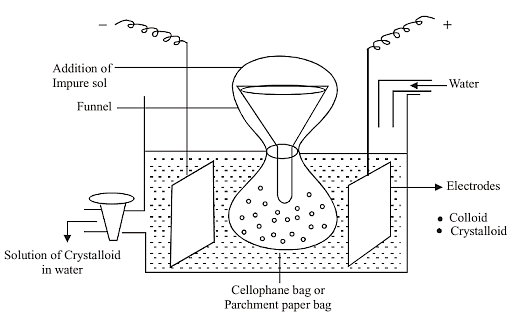
Electrodialysis
Precautions
- Keep the parchment paper airtight to prevent the entry of water into the bag.
- Keep the neck of the parchment cone above the surface of the water.
- Change the water in the trough from time to time till it gets free from impurities.
Things to Remember
- Sol is one of the types of colloids that consists of the dispersed phase (solid) and dispersion medium (liquid). For example-lyophilic or lyophobic.
- Lyophilic means ‘solvent attracting’ which means there is high interaction between the dispersed phase and dispersion medium. They are stable, reversible, highly viscous and their colloidal particles have no charge.
- Lyophobic means ‘solvent repelling’ which means there is no interaction between the dispersed phase and the dispersion medium. They are unstable, irreversible and their colloidal particles carry either positive or negative charges.
- Sol dialysis is the process of purification of sol by removing impurities (ions or electrolytes).
- It is important to remove impurities from the sol because these impurities can unstable the sol and if sol becomes unstable it can be easily separated.
- Dialysis is done through a semi-permeable membrane (parchment or cellophane paper) on the basis of unequal rates of diffusion of ions.
Also Read:
Sample Questions
Ques. What is the use of parchment paper in the experiment? (3 Marks)
Ans. The parchment membrane act as a semi-permeable membrane. It has a pore on it through which ions can move and sol gets purified. It does not allow the colloidal particles to move through it as they are of large size than paper holes. However, ions are smaller than the parchment hole and thus impurities can move from it to the water trough.
Ques. Why parchment cone is advised to keep on the surface of the water? (3 Marks)
Ans. It is advised to keep parchment cone on the surface of the water. This is advised so that water couldn’t move into the cone. If this happens then impurities will go back into a cone, and it will again fill with impurities. Also, the mixing of water can destroy the egg albumin in a cone. This can make the whole experiment invalid.
Ques. Do lyophilic sols require stabilizers? (3 Marks)
Ans. No, lyophilic sols do not require stabilizers because they are stable. However, the stabilizer is required for lyophobic sol as they are highly unstable. The stability depends upon the interaction between the dispersed phase and dispersing medium. Strong the interaction higher will be the stability of sol. Lyophilic sol has strong interaction, thus are highly stable and does not require a stabilizer.
Ques. Is it necessary to change the trough water from time to time? (3 Marks)
Ans. No, it is not always necessary to change the water from time to time. This is applicable to that sol in which the speed of dialysis is low. Therefore, in such cases, it has been advisable to change the water of the trough twice or thrice till the colloidal dispersion is free of ions.
Ques. Why lyophobic are called irreversible sols? (2 Marks)
Ans. The lyophobic is called irreversible sols because if the small electrolyte is added into them, they get precipitated and do not turn into colloids after the addition of dispersion medium.
Ques. Do lyophilic sols get coagulate? (2 Marks)
Ans. When excess electrolyte to a colloidal solution, it gets precipitated and this phenomenon is called coagulation. The factors responsible for coagulation are the charge and solvation of the colloidal particles. The removal of these two factors can coagulate lyophilic sol.
Ques. Do lyophilic and lyophibic sols carry charge? (3 Marks)
Ans. The colloidal particles of lyophilic sol do not carry any charge. Therefore, the particle does not migrate in an electric field. Whereas the lyophobic sol colloidal particles carry either positive or negative charge. Therefore, the particle migrates in either cathode or anode in an electric field.
Ques. Do lyophobic sols show the Tyndall effect? (3 Marks)
Ans. The scattering of light by colloidal particles is defined as the Tyndall effect. The scattering of light depends on the difference in the refractive indices of the dispersed phase and the dispersion medium. The larger the difference, the greater is the intensity of scattered light. In lyophobic sols, the difference in refractive indices is large. Therefore, lyophobic sol shows a tyndall effect.
Ques. How to test the presence of Na+ and Cl- ions in egg albumin lyophilic sol? (3 Marks)
Ans. Take two test tubes. In one test tube add water containing ions and add uranyl zinc acetate. The presence of yellow precipitate indicates the presence of Na+ ions. In the second test tube add silver nitrate solution. If white precipitate appears this indicates the presence of Cl– ions.
Ques. What is the need for dialysis of sol? (3 Marks)
Ans. Sol dialysis helps in the purification of sols. This is done by removing impurities (ions or electrolytes) as they can unstable the sol. Dialysis is done through a semi-permeable membrane (parchment or cellophane paper) on the basis of unequal rates of diffusion of ions.
For Latest Updates on Upcoming Board Exams, Click Here: https://t.me/class_10_12_board_updates
Check-Out:



Comments