



Education Journalist | Study Abroad Lead
Acid-base catalysis is a type of catalysis that involves the use of an acid or base to boost the rate of a chemical reaction. In many cases, acid-base catalysis is used to promote reactions that would otherwise be difficult or impossible to perform. Simply, acid-base catalysis is a process that makes it easier for to occur.
Key Takeaways: Acid-base catalysis, Hydrolysis of esters, Dehydration, Decarboxylation
What is Acid-Base Catalysis?
[Click Here for Sample Questions]
Acid-base catalysis is a type of heterogeneous catalysis in which the catalyst is an acid or base. In this type of catalysis, the reaction is accelerated by the presence of an acid or base. The mechanism of acid-base catalysis involves the formation of an intermediate complex between the acid or base and the reactant. This complex is then broken down to form the products of the reaction.
There are two main types of catalysis:
- Homogeneous catalysis: This type of catalysis involves reactions in which the catalyst is in the same phase as the reactants.
- Heterogeneous catalysis: In this type of catalysis, the catalyst is in a different phase from the reactants.
Check More:
| Related Articles | ||
|---|---|---|
| Order of Reaction | Rate of a Chemical Reaction | Chemical Kinetics |
| Classification of Colloids | Integrated rate equations | Emulsion |
Role of Acid-Base Catalysis in Nature
[Click Here for Sample Questions]
Acid-base catalysis plays a vital role in many natural biochemical processes. For example, the digestion of food in our stomachs is made possible by hydrochloric acid, which acts as a catalyst to break down complex molecules into their simpler constituents. Similarly, enzymes responsible for chemical reactions in our body often make use of acid-base catalysis to speed up the process.
Basic Acid Catalysis and General Acid Catalysis
[Click Here for Sample Questions]
Acid catalysis can be dissected into two parts: Basic Acid Catalysis and General Acid Catalysis.
Basic Acid Catalysis
Basic acid catalysis involves the use of a Lewis acid to catalyze a reaction. Basic acid catalysis is not as common as general acid catalysis.
- One example of a reaction catalyzed by a Lewis acid is the addition of bromine to alkenes in the presence of AlBr3.
- Another example is the addition of water to alkenes in the presence of SnCl4.
General Acid Catalysis
General acid catalysis is much more common than basic acid catalysis. It occurs when an acid donates a proton to the reactant. In this type of catalysis, the acid must be present for the reaction to occur.
The following are examples of general acid catalysis:
- The hydrolysis of esters in the presence of aqueous HCl.
- The dehydration of alcohols in the presence of a strong acid such as H2SO4.
- The decarboxylation of carboxylic acids in the presence of an acid such as HNO3.
When Does General Acid Catalysis Occur?
[Click Here for Sample Questions]
When acids other than the hydronium ion accelerate the reaction rate, this is known as general acid catalysis.

General Acid Catalysis
General base catalysis occurs when bases, apart from hydroxide ion, accelerate the reaction rate.
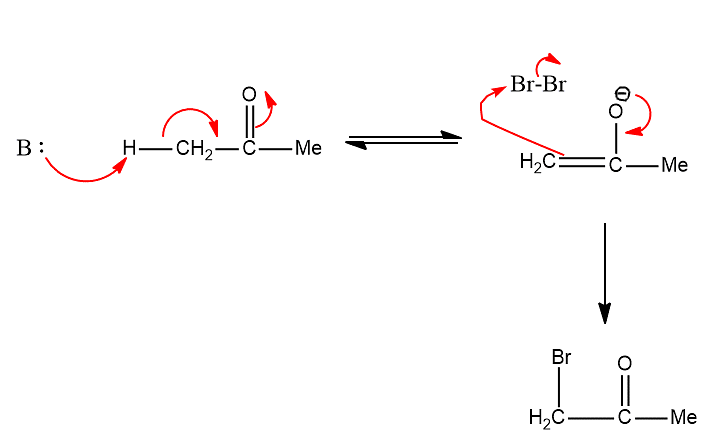
General Base catalysis
The Brønsted-Lowry theory does not restrict acids and bases to H3O+ and OH- respectively. According to this theory, any molecule that can donate a proton is an acid, and any molecule that can accept a proton is a base.
Advantages and Disadvantages of Acid-Base Catalysis
[Click Here for Sample Questions]
There are several advantages to using acid-base catalysis.
- It can be used to increase the rate of a reaction without using a large amount of energy. This is important in many industrial processes, where high temperatures and pressures would be too expensive or dangerous.
- Acid-base catalysis can be used to create new products that would not be possible without using an acid or base. For example, many pharmaceuticals are made using acid-base catalysis.
- Acid-base catalysis can be used to improve the yield of a reaction, making it more efficient.
There are also some disadvantages to acid-base catalysis.
- It can sometimes be challenging to control the reaction, leading to unwanted side reactions.
- The products of an acid-base catalyzed reaction can be corrosive, making them difficult to handle and store.
- Acid-base catalysis often results in the formation of pollutants.
Mechanism of Acid-Base Catalysis
[Click Here for Sample Questions]
The mechanism of acid-base catalysis involves the transfer of a proton (H+) from the acid to the base, which results in the formation of a new acid and base. This process is known as protonation, and it can either increase or decrease the reactivity of the molecules involved.

Acid Base Catalysis mechanism
Examples of Acid-Base Catalysis
[Click Here for Sample Questions]
One of the most famous examples of acid-base catalysis is the Haber-Bosch process, which is used to produce ammonia (NH3) from nitrogen (N2) and hydrogen (H2). This process is made feasible by using a catalyst called iron oxide (Fe2O3), which helps to transfer protons between the reactants.
Things to Remember
[Click Here for Sample Questions]
- An acid is a substance that increases the concentration of H+ ions in a solution.
- A base is a substance that decreases the concentration of H+ ions in the solution.
- Acid-base catalysis is when an acid or base speeds up a chemical reaction by reducing the activation energy.
- In general, acid-base catalysis happens when the acid or base provides a proton (H+) to the reaction.
- The most common type of acid-base catalysis is hydrolysis, which is when water breaks down a molecule into smaller molecules.
- Acid-base catalysis can also happen in reactions that don't involve water.
- In some cases, an acid or base can slow down a reaction by increasing the activation energy.
Also Read:
Sample Questions
Ques. What is the function of H+ in an acid-base reaction? (2 marks)
Ans. The function of H+ in an acid-base reaction is to act as a catalyst, increasing the reaction rate. H+ does this by providing a proton (H+ ) that can be transferred to the base, which increases the base's ability to accept electrons. This increase in electron-accepting ability decreases the activation energy of the reaction, allowing it to proceed more quickly.
Ques. What is the function of a base in an acid-base reaction? (2 marks)
Ans. The function of a base in an acid-base reaction is to accept protons from the acid. This proton transfer decreases the acid's ability to donate electrons and increases the base's ability to accept electrons. The overall effect is to decrease the activation energy of the reaction, allowing it to proceed more quickly.
Ques. Elaborate the strength of acids and bases. (2 marks)
Ans. The strength of an acid or base is a measure of its ability to donate or accept protons. Strong acids and bases are those that readily donate or accept protons, while weak acids and bases are those that do not. The strength of an acid or base can be affected by many factors, including the nature of the molecule, the environment, and the presence of other molecules.
Ques. How do we determine the strength of acids and bases? (3 marks)
Ans. There are several ways to determine the strength of acids and bases. One common method is to measure the rate at which an acid or base reacts with water. Another method is to measure the amount of H+ or OH produced when an acid or base is added to water. The strength of acids and bases can also be affected by the presence of other molecules, which can either increase or decrease the reaction rate.
Ques. What are the types of catalysis? (2 marks)
- Acid-base catalysis involves the transfer of a proton from the acid to the base. This type of catalysis is used in many reactions, including those that occur in the body.
- Enzyme catalysis involves the use of enzymes to accelerate chemical reactions. The proteins that help catalyze reactions by lowering their activation energy are usually known as enzymes. Many biological processes, such as digestion and metabolism, depend on enzyme catalysis.
Ques. What factors affect the rate of an acid-base reaction? (3 marks)
Ans. Several factors can affect the rate of an acid-base reaction. These include the strength of the acid or base, the concentration of the acid or base, the presence of other molecules, and the temperature. The stronger the acid or base, the faster the reaction will be. The higher the acid or base concentration, the quicker the reaction will be. The presence of other molecules can either increase or decrease the reaction rate. Ideally, the reaction rate depends on the temperature. To put simply, the higher the temperature becomes, the quicker the reaction rate will be.
Ques. What are the products of an acid-base reaction? (2 marks)
Ans. The products of an acid-base reaction are the conjugate acid and conjugate base of the reactants.
- The conjugate acid is the compound formed when the base reacts with the proton from the acid.
- The conjugate base is the compound formed when the acid reacts with the proton from the base.
Ques. What is the importance of an acid-base reaction? (3 marks)
Ans. Acid-base reactions are important because they can be used to control the rate of other chemical reactions. By regulating the amount of acid or base present, the reaction can be slowed down or speeded up. Acid-base reactions are also crucial because they can be used to produce new products that were not present in the reactants.
Ques. What are the applications of acid-base catalysis? (2 marks)
Ans. Acid-base catalysis is used in many different applications. It is used in the body to help with the digestion of food and the metabolism of nutrients. It is also used in industry to help speed up chemical reactions. Acid-base catalysis can be used to produce new products or improve existing products' yield.
For Latest Updates on Upcoming Board Exams, Click Here: https://t.me/class_10_12_board_updates
Check-Out:



Comments