



Education Journalist | Study Abroad Lead
The conversion of Carboxylic acid and alcohol into an ester in the presence of a strong acid catalyst is known as Fischer Esterification Mechanism. Fischer Esterification is also known as Fischer-Speier Esterification given after the name of the scientist who first discovered it - Arthur Speir and Emil Fischer. The reaction can occur only in the presence of alcohol and heat. Fischer Esterification reaction was first described by Arthur Speir and Emil Fischer in 1895. The overall Fischer Esterification reaction is reversible. Catalysts commonly used for Fisher Esterification Mechanism include sulfuric acid, p-toluene sulfonic acid, and Lewis acids such as scandium(III) triflate.
| Table of Content |
Key Terms: Ester, Carboxylic acid, Protonation, Lewis Base, De-Protonation, Alcohol, Carbonyl, Strong Acids
What is Fischer Esterification Mechanism?
[Click Here for Sample Questions]
Fischer Esterification is a coupling reaction between a carboxylic acid and an alcohol in the presence of an acid catalyst. The final product thus obtained is Ester along with water. This mechanism is a reversible reaction and is also done in presence of heat. sulfuric acid, p-toluene sulfonic acid, and Lewis acids are used as catalysts as strong acids.
The example of Fischer Esterification Mechanism is:
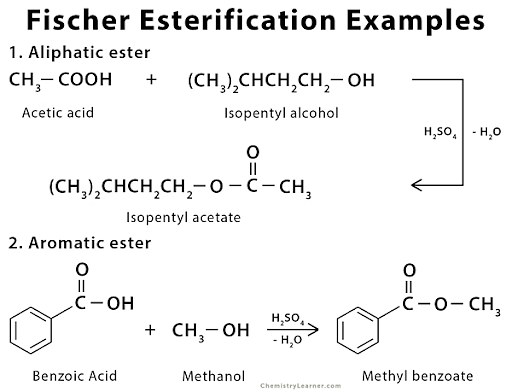
Example of Fischer Esterification Mechanism
Also Read:
Mechanism of Fischer Esterification
[Click Here for Sample Questions]
The Mechanism consists of the following steps and the final product obtained is Ester.
Step I: Protonation of the carbonyl group of carboxylic acid by the catalyst.
Step II: Nucleophilic attack on the carbonyl by the alcohol and subsequent cleavage of the pi bond results in an oxonium ion which then rearranges itself after proton transfer.
Step III: Elimination of water followed by a pi bond formation between C and O results in protonated water.
Step IV: Deprotonation of the protonated ester by Lewis base gives the desired ester.
Fischer Esterification Mechanism: Advantages
[Click Here for Sample Questions]
The advantages of Fischer Esterification Mechanisms are as follows.
- Fischer Esterification Mechanism is a relatively simple mechanism than any other esterification Mechanism.
- The Chemicals used and the by-products released during the esterification Mechanism are non-toxic.
- Esterification can increase the volatility of fatty acids.
Fischer Esterification Mechanism: Disadvantages
[Click Here for Sample Questions]
As every reaction has some good effects and some disadvantages, the disadvantages of Fischer Esterification Mechanism are as follows.
- One of the primary disadvantages of Fischer Esterification is its thermodynamic reversibility and slow rate of reaction.
- As the process is reversible the whole Esterification can take more time to yield the ester.
- Because of the usage of strong acid, it takes less time. If weak acid was used the time would have increased for the esterification.
- Tertiary alcohols rapidly dehydrate in the presence of strong acids.
Fischer Esterification Mechanism: Applications
[Click Here for Sample Questions]
Fischer Esterification Mechanism is used in the following ways:
- The process is mainly intended to produce Ester and Ester finds its application production of a number of items such as Paints, Varnishes, etc.
- Apart from its synthetic and biological applications, Esterification is used to make fragrances and flavours.
Things to Remember
- Fischer Esterification is done in the following steps: Protonation of the carbonyl, nucleophilic attack on the carbonyl, proton transfer to the OH group, deprotonation step.
- Arthur Speir and Emil Fischer in 1895 first described the Esterification process and hence is also known as Fischer Speier Esterification.
- Fischer Esterification is done in presence of Strong Acid that works as a catalyst and heat.
- Fischer Esterification is a reversible reaction.
- Fischer Esterification is a time-consuming process as the process can take from several hours to years to yield the desired product.
Also Read:
Sample Questions
Ques. What is the process of Fischer esterification? (2 marks)
Ans. An ester (together with water) is generated when a carboxylic acid is treated with alcohol and an acid catalyst. Fischer esterification is the name for this reaction. Alcohol is commonly employed as a solvent in large amounts.
Ques. What is the significance of Fischer esterification? (2 marks)
Ans. One of the most prevalent carboxylic acid reactions is Fischer esterification. Treatment of carboxylic acids with alcohol in the presence of an acid catalyst leads to the creation of esters and the removal of a water molecule.
Ques. What are some of the drawbacks of Fischer esterification? (3 marks)
Ans: In Fischer esterification, the reaction's equilibrium existence represents a significant drawback. When the reaction is carried out in a closed vessel, it becomes considerably more challenging since either the product or the water created must be removed in order to complete the reaction.
Ques. In Fischer esterification, what is the limiting reagent? (3 marks)
Ans. Sulphuric acid is used as a catalyst in Fischer esterification process. It protonates the carboxylic acid carbonyl group rather than the hydroxyl characteristic. The cation that results is a stable resonance. Because the reaction is a 1:1 reaction (carboxylic acid: alcohol), the carboxylic acid is the limiting reagent.
Ques. What is direct esterification and how does it work? (1 mark)
Ans: Esterification is the reaction of an acid with an alcohol in the presence of a catalyst (acid carboxyl group condensation) (alcohol hydroxyl group).
Ques. State the steps of Esterification. (2 marks)
Ans. Fischer Esterification Mechanism is done in four steps. Following are the four steps.
- Protonation of Carbonyl Oxygen.
- Nucleophilic Attack of alcohol
- Loss and regain of Proton
- Loss of Water.
Ques. Give the standard reaction of Fischer Esterification. (1 mark)
Ans. The standard format of Fischer Esterification Mechanism is as follows.
R1COOH + R2OH → R1COOR2 + H2O
Ques. Give the applications of Ester. (5 marks)
Ans. Fischer Esterification is done to obtain Ester which has many applications such as:
- Ester can be used as an alternative to Perfumes
- Esters can also be employed as organic solvents.
- Fats and oils that occur naturally are fatty acid esters of glycerol.
- Esters that constitute Nitrates can be used as Explosives.
- Plastics are made of Polyesters.
- Esters are also used to produce soaps, detergents, and other household products.
Ques. What is the purpose of Fischer Esterification Mechanism and how can you remove water from the mechanism? (3 marks)
Ans. The main aim of Fisher Esterification is to produce Ester as a final product by converting carboxylic acids in presence of excess alcohol and a strong acid catalyst. The ester thus formed is formed with water.
Water can be removed with the help of Sulphuric Acid as Sulphuric acid reacts strongly and rapidly with water to form a hydrated sulfuric acid this results in removal of water from Fischer esterification mechanism.
Ques. What is the Difference Between Fischer Esterification and Steglich Esterification? (2 marks)
Ans. The main difference between both Esterification mechanism is the use of catalyst. Fisher Esterification Mechanism uses Strong alcohol as a catalyst while Steglich Esterification uses dimethyl aminopyridine (DMAP) as a catalyst.
For Latest Updates on Upcoming Board Exams, Click Here: https://t.me/class_10_12_board_updates
Check-Out:



Comments