



Content Writer
Calvin cycle, also known as the C3 Cycle, is a light-independent or dark reaction. It is the second stage of photosynthesis, in which the plant takes in the carbon dioxide present in the atmosphere. The carbon dioxide is converted into different forms of sugar, lipids and protein. The final end product formed in the reaction is glucose.
- Calvin Cycle was first explained by the American Biochemist Melvin Calvin along with Andrew Benson and James Bassham.
- The carbon forms the basis of all complex molecules in higher organisms in the food chain.
- The cycle is most commonly used during the days when ATP and NADPH molecules are in abundant.
- It is present in all photosynthetic eukaryotes and bacteria.
- The carbon atoms present in the human body were once carbon dioxide in the atmosphere, which is converted in this stage of photosynthesis.
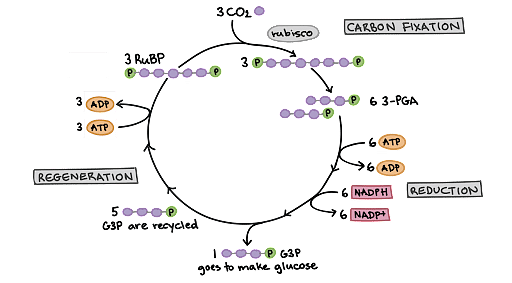
- Calvin Cycle is divided into three processes, namely Carbon Fixation, Reduction and Regeneration.
- It also produces glyceraldehyde-3-phosphate (G3P), which is used to synthesize glucose and other sugars.
Read More: Difference Between Euchromatin and Heterochromatin
| Table of Content |
Key Terms: Calvin Cycle, Photosynthesis, Carbon Dioxide, Glucose, Molecules, Food Chain, Oxygen, ATP, NADPH, Cellular Respiration
Photosynthesis
[Click Here for Sample Questions]
Photosynthesis is defined as the biological process which is used to convert light energy into chemical energy. In this process, green plants use light energy and carbon dioxide to produce nutrients, organic molecules, and oxygen as the by-products.
- The chemical energy is stored in an organic compound, which is later metabolized through the process of cellular respiration.
- It is responsible for maintaining the required quantity of oxygen on the Earth.
- Plants and animals performing the process of photosynthesis are called photoautotrophs.
- The process usually begins when energy is absorbed by proteins called reaction centres.
- Photosynthesis consists of many carbon-hydrogen bonds.
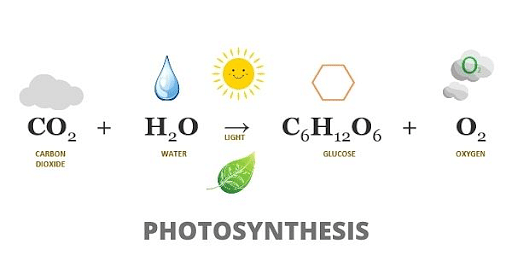
Photosynthesis
Read More:
Stages of Photosynthesis
[Click Here for Sample Questions]
Photosynthesis comprises of two stages which are as follows:
Light Dependent Reaction
Light Dependent Reaction takes place in the presence of sunlight and occurs mostly during the daytime. In this reaction, one molecule of chlorophyll absorbs a photon and loses an electron. It also creates an energy gradient across the membrane of chloroplast. The chemical equation involved in the process is as follows:
2 H2O + 2 NADP+ + 3 ADP + 3 Pi + light → 2 NADPH + 2 H+ + 3 ATP + O2
Light Independent Reaction or the Calvin Cycle
Light Independent Reaction is also known as the Calvin Cycle. It is a type of dark reaction which can take place with or without sunlight. In this reaction, the enzyme RuBisCo captures the molecules of CO2. It releases three-carbon molecules, which are later combined to form starch and sucrose. The chemical reaction involved in the process is as follows:
3 CO2 + 9 ATP + 6 NADPH + 6 H+ → C3H6O3-phosphate + 9 ADP + 8 Pi + 6 NADP+ + 3 H2O
What is Calvin Cycle?
[Click Here for Sample Questions]
[Click Here for Sample Questions]
Calvin Cycle, also known as the C3 Cycle, consists of a series of reactions which reduces carbon dioxide and other compounds into glucose with the help of ATP and NADPH.
- It takes place in the stroma of chloroplasts during photosynthesis.
- The plant cells use the raw materials provided by the light reaction to produce the organic molecules.
- The carbon dioxide enters the leaf via pores known as stomata.
- It later diffuses into the stroma of the chloroplast, which is the reaction site of the Calvin cycle.
- In the last step, glucose is synthesized.
Read More:
Stages of Calvin Cycle (C3 Cycle)
[Click Here for Sample Questions]
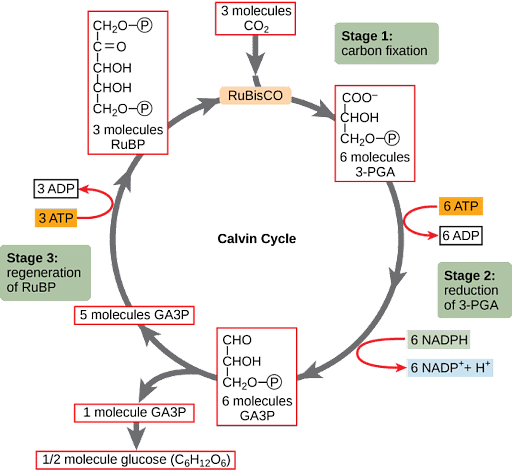
The Calvin cycle has 3 important stages which are as follows:
Carbon Fixation
In this stage the carbon dioxide combines with RuBP, to be reduced and attached to an organic molecule. It forms 2 molecules of 3-PGA (3-phosphoglyceric acid). The enzyme which is used in this process to catalyse the reaction is ribulose bisphosphate carboxylase/oxygenase.
- The enzyme works rather slowly and processes only 3 molecules of RuBP per second.
- The process is called carbon fixation because carbon dioxide is fixed from an inorganic form to organic molecules.

Reduction
In this step, 3-PGA (3-phosphoglyceric acid) is converted into simple sugar- G3P (Glyceraldehyde-3 phosphate). ATP and NADPH is utilized in this stage as energy sources and the energy is transferred to sugar molecules for long storage purposes.

Regeneration
Some G3P molecules (Glyceraldehyde-3 phosphate) are used up to form glucose, while the rest is used to regenerate the RuBP acceptor. This stage consists of complex processes which require ATP. This stage is important because it helps to fix more carbon fixation.
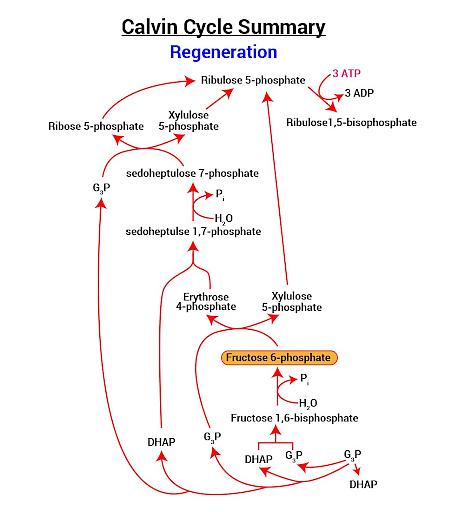
Regeneration
Read More: Receptors
Equation of Calvin Cycle:
[Click Here for Sample Questions]
Given below is the equation for the Calvin Cycle:
6 NADPH + 9 ATP + 3CO2 + + 5H2O → G3P + 2H+ + 6NADP+ + 9ADP + 8Pi
where: G3P - Glyceraldehyde-3 phosphate and Pi = Inorganic Phosphate
Read More: Ecology and Environment
Products of Calvin Cycle
[Click Here for Sample Questions]
The products formed in the calvin cycle is as follows:
- One molecule of carbon is fixed at each turn of the Calvin cycle.
- One molecule of G3P is made in 3 turns of the cycle.
- Two molecules of G3P combine to form one molecule of glucose.
- 3 ATP and 2 NADPH molecules are used to reduce 3-phosphoglyceric acid to glyceraldehyde-3 phosphate.
- Eighteen molecules of ATP and 12 molecules of NADPH are used in the formation of one molecule of glucose.
Things to Remember
- Calvin cycle also known as the C3 cycle has 3 steps which include carbon fixation, reduction and regeneration.
- The raw materials - energy(ATP) and NADPH are provided by the light reactions.
- The sugar produced in the form of glucose is used for long term energy storage.
- RuBP produced in the third step helps in carbon fixation
- In the first stage of the calvin cycle, the reaction is initiated and carbon dioxide is fixed.
- In the second stage, the 3-PGA molecules created through carbon fixation are converted into G3P.
- Later it will produces simple sugar glucose.
Sample Questions
Ques. How many ATP and NADPH molecules are required to synthesize one molecule of glucose in a C3 cycle? (2 marks)
Ans. 18 ATP & 12 NADPH mo;ecules are required to synthesize one molecule of glucose in a C3 cycle.
Ques. What is the final product of the Calvin Cycle? (2 marks)
Ans. The final product of Calvin Cycle is Glucose. The reaction involved in the formation of glucose in the calvin cycle is as follows:
6 NADPH + 9 ATP + 3CO2 + + 5H2O → G3P + 2H+ + 6NADP+ + 9ADP + 8Pi
where: G3P - Glyceraldehyde-3 phosphate and Pi = Inorganic Phosphate
Ques. What are the other names of Calvin cycles? (2 marks)
Ans. The other names of Calvin Cycle are:
- Light independent reaction
- Biosynthetic phase
- Dark reaction
- Photosynthetic carbon reaction (PCR) cycle
Ques. What are the 3 products of the Calvin Cycle? (2 marks)
Ans. The 3 products are:
- 3 ADP
- 2 glyceraldehyde-3-phosphate (G3P) molecules
- 2 NADP+
Ques. What is the importance of the Calvin Cycle? (3 marks)
Ans. The Calvin cycle is very important from the point of view of the ecosystem as it takes the carbon dioxide from the atmosphere and converts it into carbon which can be used as sugar (glucose is a type of sugar), which can store energy for a long term. This same sugar is eaten by animals and other higher organisms in the food chain which keeps them healthy. Also the plants take in carbon dioxide from the atmosphere, hence reducing the greenhouse gas from the ecosystem.
Ques. Why does the Calvin Cycle take place 6 times? (2 marks)
Ans. One G3P molecule leaves the calvin cycle in step 2 to produce glucose which is a 6-carbon molecule. Hence it takes 6 turns of the cycle which leads to the formation of one molecule of glucose. The remaining molecule of G3P helps in the generation of RuBP. ( RuBP : Ribulose-bisphosphate and G3P - Glyceraldehyde-3 phosphate)
Ques. Why is the third step in the Calvin cycle known as the regeneration step? (2 marks)
Ans. The third step is called the regeneration cycle because the RuBP which starts the calvin cycle by combining with carbon dioxide in the first step- the carbon fixation, is regenerated from G3P in the third step of the cycle. This RuBP helps with carbon dioxide fixation. ( RuBP : Ribulose-bisphosphate and G3P - Glyceraldehyde-3 phosphate)
Ques. What is the source of ATP and NADPH in the Calvin Cycle? (2 marks)
Ans. The ATP and NADPH is obtained from the light reaction during photosynthesis. In the light stage the light energy is captured and converted into ATP and NADPH which are used as the energy source which drives the endergonic reactions and the reducing agent respectively in the Calvin Cycle.
Ques. What is the difference between autotrophic and hetrotrophic mode of nutrition? (4 marks)
Ans. The difference between autotrophic and hetrotrophic mode of nutrition are as follows:
| Autotrophic | Hetrotrophic |
|---|---|
| It includes members of plant kingdom and unicellular organism. | It includes members of the animal kingdom. |
| In autotrophs, chloroplast help in preparation of food. | In hetretrophs, chloroplast does not help in preparation of food. |
| It store light and chemical energy. | It does not store light energy. |
| They are found at the primary level of the food chain. | They are found at the secondary level of food chain. |
Ques. What is photosynthesis, and how many stages are there in the process of photosynthesis? (5 marks)
Ans. Photosynthesis is defined as the process by which green plants and other organisms convert light energy to chemical energy. The reaction between water, carbon dioxide and oxygen will form glucose as the final product.
There are two stages of photosynthesis, which are as follows:
- Light Reaction: It is a reaction that is carried out in the thylakoid membranes of chloroplasts. The chemical equation involved in the process is as follows:
2 H2O + 2 NADP+ + 3 ADP + 3 Pi + light → 2 NADPH + 2 H+ + 3 ATP + O2
-
Dark Reaction: It is also known as light independent reaction in which sugar molecules are formed by the reaction of water and carbon molecules. The chemical reaction involved in the process is as follows:
3 CO2 + 9 ATP + 6 NADPH + 6 H+ → C3H6O3-phosphate + 9 ADP + 8 Pi + 6 NADP+ + 3 H2O
Ques. What is the difference between aerobic respiration and anaerobic respiration? (4 marks)
Ans. The difference between aerobic respiration and anaerobic respiration are as follows:
| Aerobic Respiration | Anaerobic Respiration |
|---|---|
| Aerobic Respiration take place in presence of oxygen. | Anaerobic Respiration take place in absence of oxygen. |
| In this process exchange of gases take place. | In this process, no exchange of gases take place. |
| It convert glucose into carbon dioxide and water. | It convert glucose into ethyl alcohol, carbon dioxide and energy. |
| All mammals undergo aerobic respiration. | All bacteria and organism undergo anaerobic respiration. |
Check-Out:



Comments