



Education Journalist | Study Abroad Lead
Metals and Non-metals are the two major classifications of elements in the periodic table. Each of these elements possesses separate characteristics of its own. Metals are usually shiny, hard and good conductors of heat and electricity whereas non-metals are usually rough, non-malleable, non-ductile and poor conductors of electricity. Some examples of metals include sodium, iron, gold, silver, copper, etc. Examples of non-metals include gases like chlorine, fluorine, sulphur, phosphorus, etc.
Read Also: Metallurgy
| Table of Content |
What are Metals?
[Click Here for Sample Questions]
Metals are the elements that make up more than half of the elements in the periodic table. Metals can conduct heat and electricity, are malleable and ductile, and have the material holding capacity. These are shiny, hard, and fusible. Few examples of metals include - Gold, Silver, Copper, Iron, Aluminium, etc. Metals lose electrons to form positive ions. Thus, metals are also known as Electropositive Elements.

Metals and Non-metals in Periodic Table
In the above periodic table, elements shaded red are called metalloids which exhibit the characteristics of both metals and non-metals.
Physical Properties of Metals
- Hardness: Metals are generally hard, with the exception of alkali metals like potassium, sodium, etc, which are very soft and can be cut by using a knife.
- Strength: Metals are strong and have high tensile strength. Except for Sodium and potassium which are soft metals.
- State: At room temperature, all of the metals occur in a solid-state except for mercury.
- Sound: Metals produce a ringing sound, so metals are called Sonorous. Therefore, these are used in making musical instruments.
- Conduction: Electric wires are made of metals like copper and aluminium which makes metals a good conductor of heat and electricity.
- Malleability: Metals can be beaten into a thin sheet, hence they are malleable.
- Ductility: Metals are ductile and hence can be drawn into thin wire.
- Melting and Boiling Point: Metals generally have high melting and boiling points except for potassium and sodium, which have low melting and boiling point.
- Density: Metals have a high density.
- Colour: Except for gold and copper, most of the metals are grey in colour.
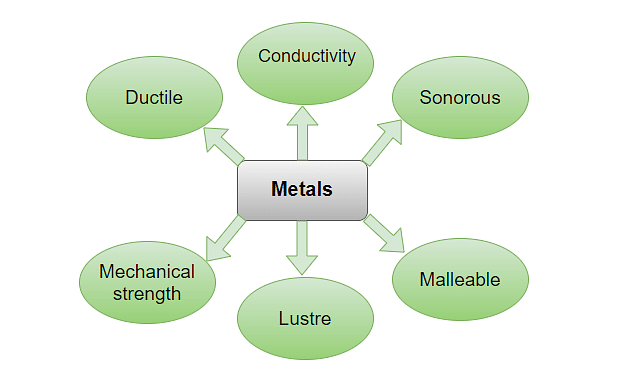
Properties of Metals
Chemical Properties of Metals
- Alkali metals like Lithium, Sodium, Potassium, etc. react vigorously with water and oxygen or air.
- Magnesium reacts with hot water.
- Aluminium, Iron, and Zinc react with steam.
Reactivity Series of Metals
The order of intensity or the reactivity of metal is arranged to give the Reactivity Series. Reactivity of elements decreases on moving from top to bottom of the series.
- Copper, gold, and silver are at the bottom and are known as Noble metals because these are the least reactive.
- Potassium is most reactive as it is at the top of the series.
- Reactivity of some of the metals are given in descending order :
K>Na>Ca>Mg>Al>Zn>Fe>Pb>Cu
Read More: Reactivity Series
Uses of Metals
- Metals are used for various purposes such as making electrical wires and sheets.
- Metals are also used in manufacturing automobiles, water boilers, machinery, industrial gadgets, etc.
- The metals being a good conductor of heat, are used in making utensils and water boilers.
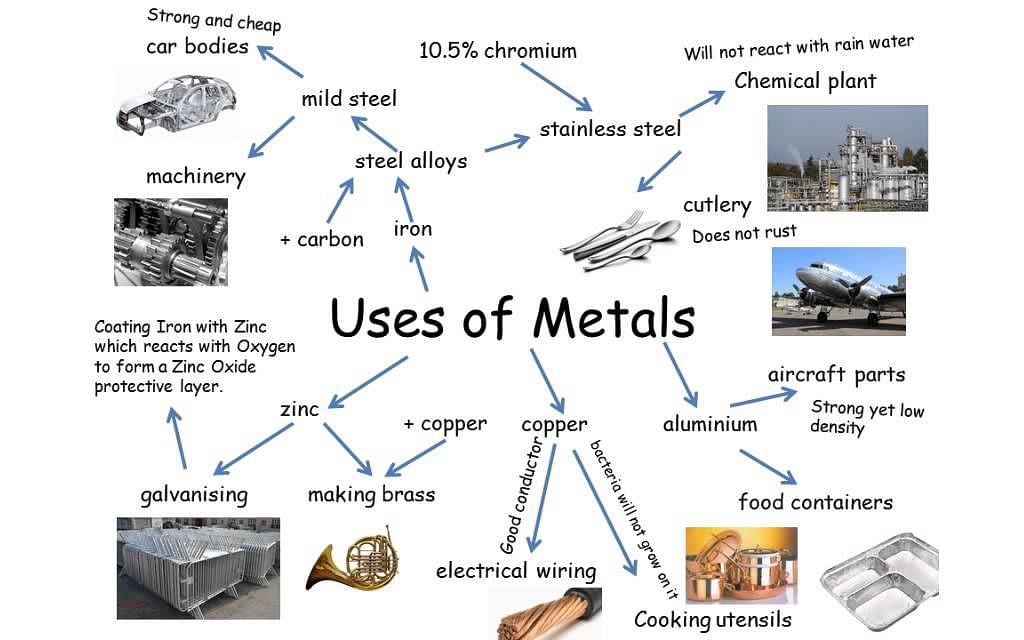
Uses of Metals
What are Non Metals?
[Click Here for Sample Questions]
Non–metals do not exhibit the characteristics of metals, i.e. they are not shiny, hard, fusible, etc. Non-metals are neither malleable nor ductile. They do not conduct electricity. Non-metals are very soft and dull in appearance. On tapping with a hammer, non-metals break down into very fine thin powdery mass.
Few of the non-metals are Carbon, Oxygen, Sulphur, Nitrogen (N), Chlorine (Cl), Bromine (Br), Neon (Ne), and Argon (Ar), etc.
Non-metals form negative ions by gaining an electron. Thus, non-metals are also known as Electronegative Elements.
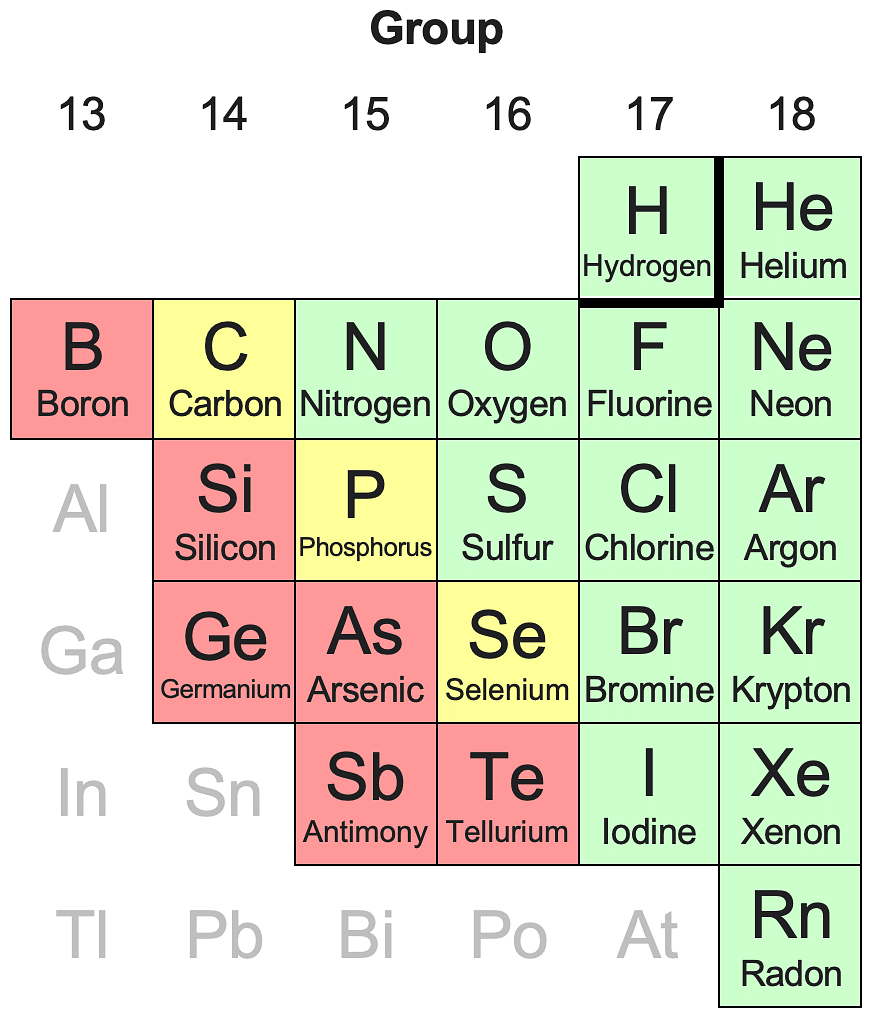
Non-metals in Periodic Table
Read More: Electropositivity of metals
Physical properties of Non-Metals
- Softness: Non-metals are generally soft. However, diamond is an exception to this as it is the hardest substance that occurs naturally.
- State: Non-metals may be solid, liquid, or gas.
- Lustre: All non-metals have a dull appearance except Diamond and iodine.
- Conduction: Non-metals are a bad conductor of electricity and heat. Graphite, which is an allotrope of Carbon, is an exception to this as it is a good conductor of electricity.
- Malleability and ductility: Non-metals are brittle.
- Melting and boiling point: Non-metals generally have low melting and boiling points except Diamond which has a very high melting and boiling point.
- Density: Most of the non-metals have low density.
- Colour: Non-metals are present in many colours.
Chemical properties of Non-Metals
- Reaction of Non-metals with Oxygen: Non-metals form oxide when reacting with oxygen.
Non-metal + Oxygen → Non-metallic oxide
- Reaction of Non-metal with Chlorine: Non-metals react with chlorine gas to produce chlroide.
Non-metal + Chlorine → Non-metal chloride
- Reaction of Non-metals with Hydrogen: When non-metals react with hydrogen, they form covalent hydrides.
Non-metal + Hydrogen → Covalent Hydride
- Non-metals do not react with dilute acids.
Uses of Non-Metals
- Non-metals like chlorine, iodine, Sulphur are very useful for medicinal purposes.
- Oxygen is crucial for our life for respiration.
- We use nitrogen phosphorus in fertilizers for plant growth to enhance the fertility of the soil.
- Sulphur is useful in crackers.
- Chlorine and Fluorine are used for water purification purposes.
Reaction of Metal and Non-metal
Metals react with non-metals to form ionic bonds. Compounds so formed are known as Ionic Compounds.
Ions: The Positive or negative charged atoms known as ions are formed because of loss or gain of electrons.
Example: Sodium is a metal. It reacts with the non-metal Chlorine to form Sodium Chloride or commonly known as table salt. Ionic bond exists between the molecules of sodium and chlorine.

Structure of Sodium Chloride
Difference Between Metals and Non-metals
[Click Here for Sample Questions]
The key differences between Metals and Non-metals are tabulated below.
| Metals | Non-metals |
|---|---|
| Metals generally occur as hard solid substances. | Non-metals generally occur in all the 3 forms of matter- solids, liquids, and gases. |
| Metals are malleable and ductile. | Non-metals are non-malleable and non-ductile. |
| Metals produce ring sound on striking which is called their sonorous property. | Non-metals do not show this sonorous property. |
| Metals are good conductors of heat and electricity. | Non-metals are poor conductors of electricity and heat. Graphite is an exception to this. |
| Metals can form alloys. | Non-metals cannot form alloys. |
Important Topics for JEE MainAs per JEE Main 2024 Session 1, important subtopics included in the metals and non metals are as follows:
Some memory based important questions asked in JEE Main 2024 Session 1 include:
Statement 2: Group 14 has metals, metalloids and non-metals. i. Both statements 1 and 2 are correct. ii. Both statements 1 and 2 are incorrect. iii. Statement 1 is correct and statement 2 is incorrect. iv. Statement 1 is incorrect and statement 2 is correct. |
Things to Remember
- Metals and non-metals are the classifications of elements that make up the periodic table.
- Metals are hard, lustrous, malleable and ductile.
- Non-metals are soft (except diamond), non-malleable and non-ductile.
- Metals are good conductors of heat and electricity whereas non-metals are poor conductors and mostly act as insulators.
- Elements that exhibit the characteristics of both metals and non-metals are called metalloids.
Sample Questions
Ques: Why are metals known as electropositive elements, whereas on the other hand, non-metals are known as electronegative elements?
Ans. Metals form positive ions by losing electrons. That is why they are called electropositive elements. Non-metals are electronegative elements as they form negative ions by gaining electrons.
Ques: Name the most abundant.
a.metal in the earth's crust
b.non-metal in the earth's crust.
Ans. (a) Aluminium. (b) Oxygen.
Ques: Identify a metal that is known to be a poor conductor of heat.
Ans. Lead.
Ques: From the following metals calcium, sodium, copper, aluminium, and magnesium, name the metal:
a.Which reacts with water only when it is boiling
b.Which does not even react with steam.
Ans. (i) Aluminium. (ii) Copper.
Ques: After keeping the iron nails dipped in a copper sulphate solution for about 30 minutes what changes will you observe in the colour copper sulphate solution and of iron nails?
Ans. Iron nails get a red-brown coating of copper metal while the blue colour of copper sulphate solution fades gradually.
Ques: You have put a copper coin submerged in a solution of silver nitrate for some amount of time. What changes will you observe in the coin and the colour of the solution?
Ans. Copper coins will get a shining greyish white coating of silver metal. The colour of the solution will turn blue.
Read More:
| Occurrence of Metals | Refining of Metals | Metals and Non metals Reactions |
| Monoatomic Gases | Noble Gases | Balancing Chemical Reactions |
| Decomposition Reaction | Displacement Reaction | Precipitation Reaction |
Related Links:



Comments