



Content Curator
The Central Limit Theorem states that the sampling distribution of the sampling means approaches a normal distribution as the sample size increases, regardless of the shape of the data distribution.
- In general, the central limit theorem requires a sample size of at least 30.
- The fact of this theorem is that the average of the sample mean and standard deviation approximates the population mean and standard deviation.
- The average sample means will be the population mean, which is a crucial component of the Central Limit Theorem.
| Table of Content |
Key Terms: Central limit theorem, Population mean, Mean, Standard deviation, Data, Average sample, Normal distribution, Variable
What is Central Limit Theorem?
[Click Here for Sample Questions]
According to the central limit theorem, if large enough samples are obtained from the population, the sampling distribution of the mean for that random variable will approach a normal distribution.
The central limit theorem states that if large samples of a population are collected and their sums calculated, the sums form their own normal distribution.
- Furthermore, by applying the law of large numbers, this sum approaches the population mean.
- The central limit theorem is sometimes abbreviated as CLT.
- This is true for samples that are more than or equal to 30.
- In other words, as sample sizes increase, the sample mean graph begins to resemble a normal distribution.
Also Read:
| Related Articles | ||
|---|---|---|
| Cosine rule | Value of log1 to log 10 | Definite Integral Formula |
| Relations and Functions | Integration | Parabola formula |
Central Limit Theorem Formula
[Click Here for Sample Questions]
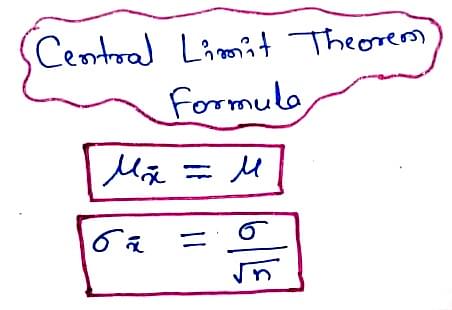
The formula for the central limit theorem can be given by
\(\LARGE \mu _{\overline{x}}=\mu\)
\(and\)
\(\LARGE \sigma _{\overline{x}}=\frac{\sigma }{\sqrt{n}}\)
Where
- σ is the population standard deviation
- μ is the population mean
- \(\LARGE \sigma _{\overline{x}}\) is the sample standard deviation
- \(\LARGE \mu _{\overline{x}}\) is the sample mean
- n is the sample size.
Central Limit Theorem Application
[Click Here for Sample Questions]
The central limit theorem is commonly used in cases where population characteristics must be found but complete population analysis is difficult. Other applications of the central limit theorem are mentioned below:
- In data science, the central limit theorem is used to determine accurate population assumptions to create a reliable statistical model.
- In applied machine learning, the CLT helps in making predictions regarding model performance.
- In statistical hypothesis testing, the central limit theorem is used to determine if a particular sample belongs to a specific population.
Solved Examples
[Click Here for Sample Questions]
Ques. The record of weights of the female population follows a normal distribution. Its mean and standard deviations are 65 kg and 14 kg, respectively. If a researcher considers the records of 50 females, then find out the standard deviation of the chosen sample.
Ans. Given
- Mean of the population μ = 65 kg
- The standard deviation of the population = 14 kg
- Sample size n = 50
The standard deviation is given by
\(\LARGE \sigma _{\overline{x}}=\frac{\sigma }{\sqrt{n}}\)
On substituting the values, we get
\(\LARGE \sigma _{\overline{x}}\) = 14/√50
⇒ \(\LARGE \sigma _{\overline{x}}\) = 14/7.071
⇒ \(\LARGE \sigma _{\overline{x}}\) = 1.97
Ques. A set of samples have been collected from a larger sample and the sample mean values are 13.8, 11.9, 12.4, 14.3, 13.5, 15.6, 16, 8, 12.7. Find the population mean.
Ans. The given sample mean values are 13.8, 11.9, 12.4, 14.3, 13.5, 15.6, 16, 8, 12.7.
The population mean values are an average of the above sample mean values
μ = (13.8 + 11.9 + 12.4 + 14.3 + 13.5 + 15.6 + 16 + 8 +12.7) / 9
⇒ μ = 118.2 / 9
⇒ μ = 13.13
Hence, the mean population is 13.13
Things to Remember
- The central limit theorem formula establishes a link between the sample and population means.
- It is assumed that the samples were drawn from a larger population with replacement.
- The sample means are normally distributed for a sufficiently large set of samples.
- The central limit theorem formula aids in concluding the sample mean and population mean values.
- The average sample means will be the population mean, which is a crucial component of the Central Limit Theorem.
- The sample mean is the same as the population mean. The sample standard deviation equals the population standard deviation divided by the square root of the sample size.
Also Read:
Sample Questions
Ques. In a study, it was reported that the mean of mobile users is 30 years and the standard deviation is 12. Taking a sample size of 100 what is the mean and standard deviation for the sample mean ages of tablet users? (2 Marks)
Ans. The sample mean will be closest to the population mean, hence the mean is 30.
The sample standard deviation is given as σ/√n, therefore
Sample standard deviation = 12 / 10 = 1.2
Ques. What are the assumptions of the central limit theorem? (3 Marks)
Ans. The following are the assumptions of the central limit theorem
- The data must follow the randomization rule. It should be sampled at random.
- The samples should be unrelated to each other. One sample should not affect the others.
- When taking samples without replacement, the sample size should not be more than 10% of the population.
Ques. What is the significance of the central limit theorem? (3 Marks)
Ans. The significance of the central limit theorem is
- Political/election polling is an excellent example of how to apply CLT.
- These polls are used to estimate how many people support a given candidate.
- You may have seen these findings with confidence intervals on news programs. The CLT helps with this computation.
- The CLT is used in a variety of census sectors to compute population data such as family income, power consumption, individual salary, and so on.
Ques. The average weight of a water bottle is 30 kg with a standard deviation of 1.5 kg. If a sample of 45 water bottles is selected at random from a consignment and their weights are measured, then what is the probability that the mean weight of the sample is less than 28 kg? (5 Marks)
Ans. Given
- Population mean, μ = 30 kg
- Population standard deviation, σ = 1.5Kg
- Sample size, n = 45 (which is greater than 30)
The standard deviation is given by
\(\LARGE \sigma _{\overline{x}}=\frac{\sigma }{\sqrt{n}}\)
On substituting the values, we get
\(\LARGE \sigma _{\overline{x}}\) = 1.5/√45
⇒ \(\LARGE \sigma _{\overline{x}}\) = 6.7082
⇒ \(\LARGE \sigma _{\overline{x}}\) = 1.97
Find the z-score for the raw score of x = 28 kg
= (28 – 30)(6.7082) = -0.2981
Using the z-score table, we have
P(z < -0.2981) = 0.3828
Ques. What is the Central Limit Theorem? (3 Marks)
Ans. According to probability theory, the Central Limit Theorem, or CLT, states that the distribution of all samples is approximately equal to the normal distribution. When the sample size is increased, it is assumed that the samples taken are all of the same size, regardless of the shape of the population distribution.
To put it simply, the Central Limit Theorem is a statistical theory that states that when a sufficiently larger sample size of a population with a finite level of variance is given, the mean value of all given samples from the same given population is approximately equal to the population mean. Furthermore, all samples would tend to follow an approximately normal distribution pattern, with all variances being approximately equal to the variance of the entire population when divided by the sample size.
Ques. What are the central theorem's applications in statistics? (3 Marks)
Ans. The following are the various applications of the Central Theorem in the field of statistics.
If the distribution is not normal or unknown, we assume that the sample distribution is normally based on the Central Limit Theorem. This method is based on the assumption that the given population is normally distributed. This, in turn, allows us to analyze the data in ways such as constructing confidence intervals.
To estimate the mean of the population more accurately, we tend to increase the number of samples drawn from the population, which reduces the mean deviation of the samples.
In order to generate a range of different values that are likely to be the population mean, we can make use of the sample mean.
Ques. The male population's weight distribution follows the normal distribution. It has a mean weight of 70 kg and a standard deviation of 15 kg. What is the mean and standard deviation of the chosen sample if a researcher considers the records of 50 males? (4 Marks)
Ans. Mean of the population μ = 70 kg
The standard deviation of the population = 15 kg
sample size n = 50
The mean of the sample is given by:
μx¯ = 70 kg
The sample's standard deviation is given by:
σx¯ = σ/√n
σx¯ = 15/√50
σx¯ = 2.122 = 2.1 kg
Ques. List the Common Applications of the Central Limit Theorem. (2 Marks)
Ans. The central limit theorem is frequently used to examine population parameters. It is also used to construct appropriate machine-learning models. We can use the central limit theorem to determine and relate whether a given sample belongs to a population's sampling distribution.
Ques. A subset of samples from a larger sample was collected, and the sample mean values are 12.8, 10.9, 11.4, 14.2, 12.5, 13.6, 15, 9, and 12.6. Determine the population mean. (2 Marks)
Ans. The given sample mean values are 12.8, 10.9, 11.4, 14.2, 12.5, 13.6, 15, 9, 12.6.
The population mean values are an average of the above sample mean values.
μ=12.8+10.9+11.4+14.2+12.5+13.6+15+9+12.6/9
=112/9
μ=12.4
Ques. The sample means from a larger population are 14, 12.8, X, 13.2, and 15, and the population mean is 13.6. Determine the sample mean X value. (3 Marks)
Ans. The sample means are 14, 12.8, X, 13.2, 15.
Population mean, μ = 13.6.
μ=¯x1+¯x2+¯x3+¯x4+¯x5/n
13.6=14+12.8+X+13.2+15/5
13.6×5=55+X
68=55+X
X=68−55
X=13
For Latest Updates on Upcoming Board Exams, Click Here: https://t.me/class_10_12_board_updates
Check-Out:



Comments