



Education Journalist | Study Abroad Lead
Competent cells are an important part of molecular cloning because they allow researchers to investigate gene expression, protein expression, and many other aspects. Commercial competent cells are bacteria or yeast that have been genetically modified to become competent. The ability of a cell to take up foreign (extracellular) DNA from its surroundings is referred to as cell competence. Competent cells are widely available in the market.
| Table of Content |
Keyterms: Competent cells, Cell, Gene, Protein, Bacteria, Yeast, DNA, Metabolism, Electroporation mechanism, Electrical treatments
What are Competent Cells?
[Click Here for Sample Questions]
The ability of a cell to take up foreign (extracellular) DNA from its surroundings is referred to as cell competence. Competent cells are prepared to use bacteria with more easily changed cell walls, allowing foreign DNA to flow through more easily. Rapidly growing cells are alive, healthy, and actively metabolising. Competent cells are widely available in the market.

Competent Cells
Read Also: Mendel’s experiment
Principle of Competent Cells
[Click Here for Sample Questions]
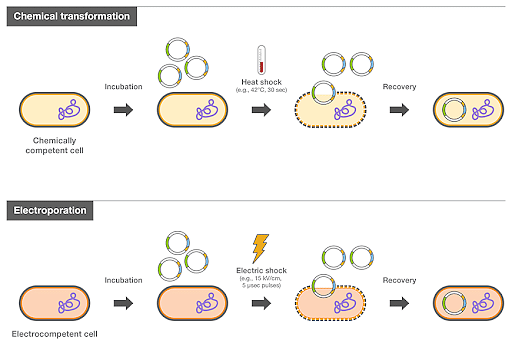
Competent cells have modified cell walls that allow DNA to pass through more easily. To become competent, some cells must be subjected to chemical or electrical treatments. The conventional way for preparing these cells is to treat them with calcium ions. Bacterial cells can also take up DNA via an electroporation mechanism.

Electroporation Mechanism
Also Read:
| Related Articles | ||
|---|---|---|
| Law of Heredity | Diff. between Darwinism and Lamarckism | Genetic Disorder |
| Receptors | Prokaryotic cells | Cell wall and cell membrane |
Characteristics of Competent Cells
[Click Here for Sample Questions]
Competent cells have a number of key features, including:
- Cells assist in the structure and support of an organism's body.
- Individual organelles are surrounded by a distinct membrane in the cell's interior.
- The nucleus stores genetic information that is required for cell reproduction and growth.

Characteristics of Competent cells
- Mitochondria is a double membrane-bound organelle that is primarily responsible for energy exchanges necessary for the cell's survival.
- Lysosomes break down undesirable components in the cell.
- The endoplasmic reticulum contributes to the cell's internal organisation by synthesising certain molecules and processing, directing, and delivering them to their proper destinations.
Read More: Genetics and Evolution
Functions of Competent Cells
[Click Here for Sample Questions]
A cell conducts these major processes that are necessary for an organism's growth and development. A cell's essential activities include:
- Providing support and structure to the cell.
- Aiding mitosis growth
- To allow nutrients to be transported.
- To aid in the reproductive process.
- To aid in the creation of energy.
Read More: Stem cells
Methods of Preparation of Competent Cells
[Click Here for Sample Questions]
Various methods of preparation of Competent cells are as follows.
Natural Competence
Natural cell competence is determined by genetics. A naturally competent cell's DNA does not always become incorporated into the cell's genome. A segment of DNA is frequently used for nutritional purposes. DNA, for example, supplies a critical source of deoxyribonucleotides for cell replication. The way DNA is used within a cell is usually determined by the cell's requirements. Other aspects include the cell's existing DNA damage and the incoming DNA's recombination capacity.

Natural Competence
Artificial Competence
The genes of the cell do not contain any information on artificial competence. Instead, it is a laboratory method that makes cells permeable to DNA under conditions that don't occur naturally. This process is relatively straightforward and easy to carry out, and it can be utilised in the genetic engineering of bacteria, but the transformation efficiency is low in general.

Artificial preparation of competent cells in lab using chemicals
The work of Mandel and Higa, who created a simple therapy based on immersing the cells in cold CaCl2, inspired methods for preparing competent cells. The use of chemically competent cells and electroporation are the two main ways of converting bacterial cells.
Chemically Competent Cells
Chemically competent cells are generated by disrupting the cell membranes with a series of cold salt washes, allowing the cells to receive plasmid DNA. The cells are refrigerated and rinsed with cold deionized water and glycerol to make electrocompetent cells.
The plasmid DNA is mixed with cooled cells and incubated on ice to allow the plasmid to come into intimate contact with the cells, allowing it to be introduced into chemically competent cells. After that, the plasmid-cell mixture is heated to 45–50°C for a few minutes, allowing the DNA to enter the cell through the ruptured membrane. To keep the plasmids inside the bacteria, the heated mixture is placed back on the ice.
Types of artificial competence
Electroporation
The competent cells, along with the plasmid DNA, are placed on ice for electroporation. The plasmid-cell mixture, on the other hand, is subjected to an electrical current, which opens pores in the cell membrane, allowing the plasmid to enter the cell.
Things to Remember
- Competent cells are microbial cells that through a process known as transformation, can rapidly take up foreign DNA from their surroundings. Commercial yeast and bacteria contain these types of cells, which are readily available on the market.
- Competent cells work on the basis that their cell walls have been changed to allow DNA to pass through more easily.
- A few functions of these cells are that they help a cell’s mitosis grow, allow nutrients to be transported, aids in the reproductive process and aids in the creation of energy.
- There are two methods of preparation of competent cells, which are, natural and artificial.
- Natural cell competence is determined by genetics. A naturally competent cell's DNA does not always become incorporated into the cell's genome.
- In the laboratory, the cells are permeable to DNA in the artificial approach. Chemical and electroporation methods can be used to create competent cells artificially.
Also Read:
Sample Questions
Ques. What are competent cells and how are they produced? [2 marks]
Ans. Bacterial cells that may receive extrachromosomal DNA or plasmids (naked DNA) from the environment are known as competent cells. Natural competence and artificial competence are two methods for generating competent cells.
Ques. What are the uses of competent cells? [2 marks]
Ans. Competent cells, designed to take up foreign DNA from the surrounding at a higher efficiency, are routinely used in molecular cloning to propagate and maintain cloned DNA in plasmids.
Ques. Why is Calcium Chloride used for transformation? [2 marks]
Ans. In prokaryotic (bacterial) cell biology, calcium chloride (CaCl2) transformation is a laboratory procedure. Plasmid DNA binding to lipopolysaccharides is aided by the addition of calcium chloride to a cell solution (LPS). Both the negatively charged DNA backbone and the negatively charged groups in the LPS inner core are attracted to positively charged calcium ions. When chilled cells (+4 degrees Celsius) are heated to a higher temperature (+42 degrees Celsius) for a brief time, the plasmid DNA can enter the cell.
Ques. Are E Coli cells naturally competent? [2 marks]
Ans. Natural genetic competence is the ability of cells to take up extracellular DNA and is an important mechanism for horizontal gene transfer. Even though E. coli is not known to be naturally competent for genetic transformation, several E. coli genes have been identified that are homologous to genes known to be involved in natural competence and genetic transformation in other bacteria such as Haemophilus influenzae and Neisseria gonorrhoeae.
Ques. What are artificial competent cells? [2 marks]
Ans. Artificial or induced competent cells are cells researchers have made competent through electrical (electroporation) or chemical manipulation.
Ques. What would happen when one grows a recombinant bacterium in a bioreactor but forgets to add an antibiotic to the medium in which the recombinant is growing? [2 marks]
Ans. In the absence of antibiotics, there will be no pressure on recombinants to retain the plasmid (containing the gene of your interest). Since maintaining a high copy number of plasmids is a metabolic burden to the microbial cells, it will thus tend to lose the plasmid.
Ques. Describe the role of Agrobacterium tumefaciens in transforming a plant cell. [2 marks]
Ans. Agrobacterium tumefaciens harbours a megaplasmid called Ti-plasmid.
This has a T-DNA region flanked by the left border and right border sequence. The T-DNA gets transferred and integrates with the host plant DNA. This property of Ti-plasmid has been exploited for cloning genes of interest and stably integrating them in the plant genes. Therefore, by using Ti-plasmid or its derivatives, recombinant plant cells with desired genes of interest stably integrated into the plant genome have been successfully produced.
Ques. What is a mesosome in a prokaryotic cell? Mention the functions that it performs. [2 marks]
Ans. Mesosome is a membranous structure in a prokaryotic cell, which is formed by the extensions of the plasma membrane into the cell in the form of vesicles, tubules and lamellae. Mesosomes are equal to mitochondria in eukaryotes, as they perform aerobic cellular respiration in prokaryotes. It helps in DNA replication and the distribution of genetic material to daughter cells. Mesosomes also help in respiration, increase the surface area of the plasma membrane and enzymatic content and cell wall formation
Ques. Multicellular organisms have a division of labour. Explain. [2 marks]
Ans. Division of labour is the differentiation of certain components or parts to perform different functions for increased efficiency and higher survival. Multicellular organisms often possess millions of cells. Various cells are grouped together to form specific tissue, organ or organ system, with each specialised to perform a particular function. Every cell of a multicellular organism cannot obtain food from outside. The organism requires a system for obtaining food, its digestion and distribution. Therefore, a digestive system and system of transport are also required. Certain cells of the body take over the function of reproduction. Others take part in the repair and replacement of worn-out or injured portions. For optimum functioning of cells, a multicellular organism also requires an internal favourable environment. Therefore, multicellular organisms come to have a division of labour.
Ques. Both lysosomes and vacuoles are endomembrane structures, yet they differ in terms of their functions. Comment. [2 marks]
Ans. Organelles of the endomembrane system such as lysosomes and vacuoles function in close coordination with one another but are specialised to perform different functions. Lysosomes break down the ageing and dead cells, they help in the digestion of food as they contain hydrolytic digestive enzymes. They are involved in cell division also. Vacuoles on other hand, help in excretion and osmoregulation in Amoeba (contractile vacuole) or provide buoyancy, mechanical strength in prokaryotes (air vacuoles).
For Latest Updates on Upcoming Board Exams, Click Here: https://t.me/class_10_12_board_updates
Check-Out:



Comments