



Content Curator
DC generators are the machines used to convert mechanical energy into electrical energy. These electric generators gives output in the form of electricity and works on the principle of electromagnetic induction. The emf generated due to the change in the magnetic flux induces a current in the closed circuit generating electricity. Unlike an AC generator, DC generator produces direct current. AC generators are also used to produce electrical energy from mechanical energy but they provide output in the form of alternating current.
Also Read: Magnetic Effects of Electric Current
| Table of Content |
Key Terms: DC Generator, AC Generators, Electromagnetic Induction, Magnetic Field, Electromotive Force, Direct Current, Voltage
What is a DC Generator?
[Click Here for Sample Questions]
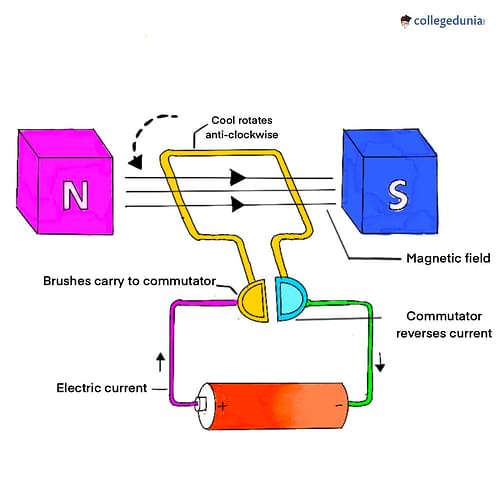
DC generators are the rotating machines that can convert the supplied mechanical energy into electrical power. They carry a conductor which is placed in the magnetic field. When the machine rotates, the rate of change of magnetic field induces an emf or voltage in the coil. If the circuit is closed, this emf produces an induced current in the circuit.
- DC generators works on the same principle as AC generators but output current in an AC generator is alternating while in a DC generator is direct.
- DC generators provides constant power to power grids and electric storage instruments (off-grid application).
- In these generators, the voltage and current are unidirectional.
Types of DC GeneratorsDC generators are mainly categorized into three types:
|
Parts of a DC Generator
[Click Here for Sample Questions]
DC generators can also be used as DC motors without any modifications in their construction. Because of this, DC generators or DC motors can be collectively called DC machines. Below are the essential parts of a DC generator.
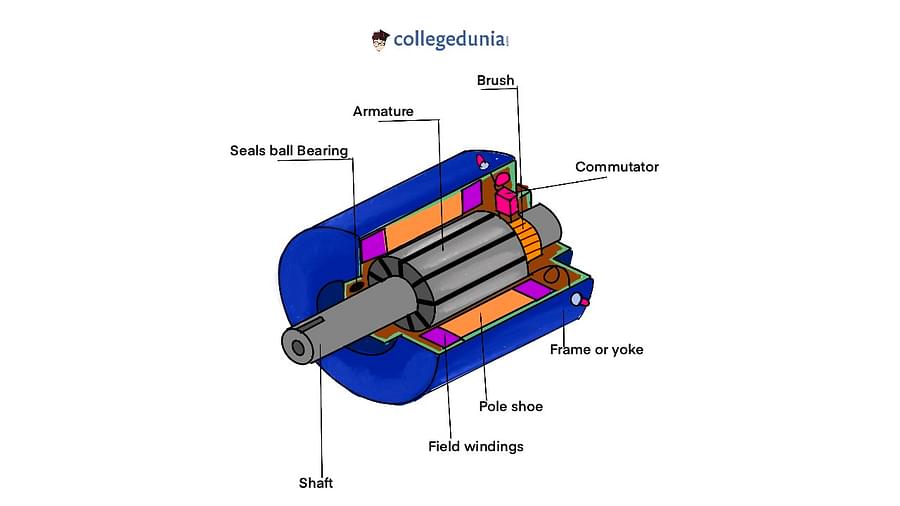
Parts of a DC Generator
- Stator – Stators are used to provide magnetic fields around coils, and are composed of two magnets with opposite polarity. These magnets are positioned to fit in the rotor region.
- Rotor – DC machines have cylindrical armatures made of slotted iron laminations. The lamination supports the armature core and decreases losses caused by eddy currents.
- Armature Core – A cylindrical armature core has slots on its outer surface for winding the armature. These grooves are arranged along the outer surface.
- Armature Winding – In an armature, the current is amplified by connecting series and parallel windings, which create a closed circuit. The actual conversion of power takes place here.
- Field Coils – Over the pole core, field coils are placed each connected in series with the coils over the opposite pole. As current flows through the field coils, adjacent poles acquire opposite polarity.
- Yoke – The external hollow cylindrical structure in a DC generator is known as yoke. It is responsible for transferring the magnetic flux from the poles to the electrical transformer. Also, it supports main poles and interpoles while providing a low reluctance path.
- Poles – The purpose of a pole is to hold field windings. Field windings are wrapped around poles and connected to the armature windings in a series or parallel arrangement.
- Pole Shoe – Pole shoes are primarily used to prevent the field coil from falling and spreading the magnetic flux uniformly.
- Commutator – Commutators convert alternating current to direct current when placed in an armature winding. It is constructed with copper segments that are protected from one another with mica sheets. It is installed on the shaft of a machine. A commutator’s main function is to connect stationary external circuits to armature conductors with brush connections.
- Brush – A brush ensures that electrical connections are made between the commutator and the load circuit on the outside.
Read More:
| Important Concepts Related to Magnetic Effects of Electric Current | ||
|---|---|---|
| Difference Between Motor and Generator | Difference Between AC and DC Generator | Magnetic Effects of Electric Current MCQs |
| EMF Formula | Types of Current | Magnetic Poles |
| Types of Motors | Electromagnetic Field | Generator and Transformer |
Working of a DC Generator
[Click Here for Sample Questions]
The main principle behind the working of a DC generator lies in the concept of electromagnetic induction. Electromagnetic induction is the process of production of an electromotive force due to the changing magnetic field. The working of a DC generator is given below:
- When the machine rotates, the magnetic field varies. The conductor placed in the field cut the lines of the changing magnetic field.
- Due to this, the magnetic flux linkage of the conductor changes which induces an emf in the coil.
- The induced emf flowing in the closed circuit generates a direct current.
- With Fleming’s right-hand rule, the direction of the current can be determined. The current induced in the conductor changes whenever the magnetic field changes.
- Imagine an armature rotating at a clockwise direction and a conductor moving at a left angle upwards. After a half swing of the armature, the movement of the conductor will reverse downwards.
- The motion of the conductor will be reversed downward once the armature has completed a half rotation. Hence, the direction of the current in every armature will alternate.
- During a current reversal, however, the armature conductor connections are reversed. Consequently, the terminals will have a unidirectional current.
EMF Equation of DC Generator
In a DC generator, the EMF equation is given by;
\(E_g = \frac{PZ\phi N}{60A}\)
Where,
- Z = Total number of armature conductors
- P = Number of poles in the field
- Φ = Manetic flux per pole (in Weber)
- A = Number of parallel lanes within the armature
- N = Rotation of armature (in rpm)
- E = Induced emf in any parallel lane within the armature
- Eg = Generated emf in any one of the parallel lanes
- N/60 = Number of turns/second
- Time for one turn, dt = 60/N second
Losses in DC Generator
[Click Here for Sample Questions]
The input power of a DC machine never fully transforms to output power. Some parts of input power get wasted in different ways. These losses can be broadly classified as follows:
- Copper Loss: This loss occurs due to the resistance in the winding when current flows through it. This loss can be divided into three types – armature loss, field winding loss, and brush contact resistance loss.
- Core Losses or Iron Losses: They occur when the current is induced in the armature. These losses are classified into two losses: hysteresis loss and eddy current loss.
- Mechanical Loss: Power is also lost due to the friction present between the different parts of the DC generator.
Check Also: Magnetic Effects of Electric Current Revision Notes
Applications of DC Generators
[Click Here for Sample Questions]
DC generators are used for a variety of purposes. Some of the important applications of DC generators are as follows:
- Different types of DC generators are used for various purposes, such as power and lighting.
- They are used to charge batteries, and also to provide excitation to alternators.
- DC generators are also used in arc welding that requires voltage drop and constant current.
- Hostels, lodges, offices, and other buildings use DC generators to generate power.
- They are used in remote control toys, electric shavers and in motorcycles.
- DC generators are used in DC motors to control the speed.
Advantages of DC Generators
[Click Here for Sample Questions]
The benefits associated with using DC generators are provided below:
- They can produce a large output range.
- Due to their simple design they are easy to construct.
- They are preferred in cases where constant output is required.
- The terminal load of DC generators is very high.
- They are highly reliable with an efficiency rate of 85-95%.
- DC generators can also be used to provide variable output power.
Check Here: NCERT Solutions for Magnetic Effects of Electric Current
Things to Remember
- DC generators are the devices which convert mechanical energy into electrical energy and provide output in the form of direct current.
- DC generators operate on the principle of electromagnetic induction.
- The voltage and current in a DC generator are unidirectional.
- The DC generators have an efficiency rate of 85-95%.
- They are used in remote control toys, for charging batteries, in motorcycles and arc welding etc.
Sample Questions
Ques. Why is the armature of the DC generator laminated? (1 Mark)
Ans. The armature of the DC generator is laminated to reduce the eddy current loss.
Ques. In DC generator, which material is used to laminate the core? (1 Mark)
Ans. In DC Generator, lamination of core is generally made up of silicon steel.
Ques. What is a DC Generator? (2 Marks)
Ans. A DC generator is a category of electrical generator that converts mechanical energy into direct current electricity. DC generators are based on the principle of the ‘dynamically induced EMF production’ i.e., Faraday’s law of electromagnetic induction. They are capable of providing continuous power to electric instruments and power grids and hence are more suited for off-grid applications.
Ques. What does the ‘Fleming’s right-hand rule’ for finding the direction of induced emf state? (2 Marks)
Ans. The Fleming’s right-hand rule for finding the direction of induced emf states that when middle finger points in the direction of induced emf, the forefinger will point in the direction of lines of flux and the thumb points in the direction of motion of conductor.
Ques. State the Faraday’s Law of Electromagnetic Induction. (2 Marks)
Ans. Faraday’s Law of Electromagnetic Induction states that whenever a conductor is placed in a magnetic field of fluctuating nature or is moved in a magnetic field, an emf is induced in the conductor.
Ques. State the factors affecting the resistance of armature windings. (3 marks)
Ans. The resistance of the armature windings on a DC generator depends on:
- Length of the conductor
- Cross-sectional area of the conductor
- Number of conductors present
Ques. What is eddy current? Write any two applications of eddy current. (3 Marks)
Ans. The current produced in the metallic plate when it is placed in a varying magnetic field is called eddy current. The applications of eddy current are given below:
- They are used in induction furnaces. The metal is placed in a varying magnetic field with high frequency alternating current. The eddy currents set up in the metal and produce heat due to which the metal melts. This process is used to extract metal from its ore.
- They are used in induction motors to rotate the rotor.
Ques. A generator has an emf of 440 V and internal resistance of 400 ohm. Its terminals are connected to a load of 4000 ohm. What will be the voltage across the load? (3 Marks)
Ans. Here, total resistance = 4000 + 400 = 4400 ohms
Current, I = V / R
I = 440 / 4400
I = 0.1 A
Voltage across load, VL = IR = 0.1 × 4000 = 400 V
Ques. The armature of a generator of resistance 1 ohm is rotated at its speed and produces 125 V without load and 115 V with full load. What is the current in the armature coil? (5 Marks)
Ans. Here, R = 1 ohm
E = 125 V
e = 115 V
Now, I = V / R
I = (125 – 115) / 1
I = 10 A
Therefore, the current in the armature coil is 10 A.
Check Also:



Comments