



Education Journalist | Study Abroad Lead
Generators and Transformers work based on Faraday’s law of electromagnetic induction principle. Generators generate current, and the transformers convert current and voltage. There are two types of generators- AC Generator and DC generator. There are two types of transformers- Step up Generator and Step Down Generator.
Read More: Electromagnetic Induction Important Questions
| Table of Content |
Key Terms: Generator, Transformer, Electromagnetic Induction, AC, DC, Step Up, Step Down, Magnetic Field, Magnetic Flux, EMF
Generator
[Click Here for Sample Questions]
A Generator can be defined as mechanical equipment that converts mechanical energy into electrical energy. The main principle used in this conversion of energy is the law of electromagnetic force. Generators are widely used for agricultural, industrial, and even domestic purposes.
Discover about the Chapter video:
Current Electricity Detailed Video Explanation:
Generator Parts
[Click Here for Previous Year Questions]
A generator is made up of a rectangular coil with copper wires wound over an iron core. This coil is known as the armature. It increases the magnetic flux.
- A strong permanent magnet is placed here.
- The armature is rotated between the magnets in a way that the magnetic lines remain perpendicular to the axis of the armature.
- Two slip rings are connected to the arms of the armature that provide movable contact.
- To pass current to the slip rings from the armature, two metallic brushes are connected to them.
- Current is passed through a load resistance and is connected across the slip rings.
- The position of the armature keeps changing at different time intervals.
- When the magnetic lines are perpendicular to the coil, the induced e.m.f increases as the coil is rotated in the magnetic field.
- This happens because the number of intercepting magnetic lines in this position is the maximum.
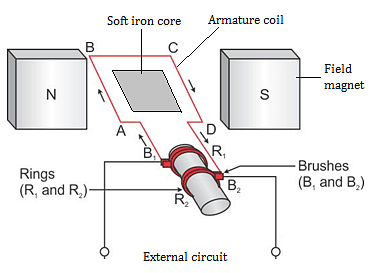
Generator Parts
Read More: Electric Generator
Types of Generators
[Click Here for Sample Questions]
There are primarily two types of Generators that are studied in Physics. They are:
AC Generator
AC generators, also called alternators, are generators that convert mechanical energy into electrical energy in the form of AC or Alternating Current. The measuring unit used for rating AC generators is kilovolt-amperes.

Simple AC Generator
Working Principle of an AC Generator
- The main working principle of an AC generator is based on the Law of Electromagnetic force or Electromagnetic Induction.
- The armature is rotated between the magnetic poles which remain perpendicular to the magnetic field.
- With a change in the flux produced by the armature, the e.m.f. is induced, producing an electric current through a galvanometer, slip rings, and metallic brushes.
- We can observe the flow of alternating current in the galvanometer when it oscillates between positive and negative poles.

AC Generator Working Principle
Types of AC Generator
AC Generators are of mainly two types:
- Synchronous Generators
- Induction Generators
Advantages of AC Generators
AC Generators have certain advantages as follows:
- Maintenance time and expense are very less as there are no brushes.
- The size of AC Generators is small compared to DC Generators.
- Losses are minimal in AC generators.
- When compared to DC generators, the breakers are relatively smaller in AC generators.
Read More:
DC Generator
DC generators convert mechanical energy into electrical energy in the form of DC or Direct Current.
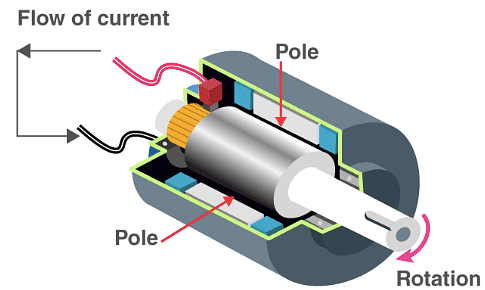
DC Generator Cross-Section
Working Principle of a DC Generator
- The main working principle of a DC Generator is based on Faraday’s Law of Electromagnetic induction.
- On placing a conductor in a varying field, an e.m.f is induced in the conductor.
- The magnitude of this e.m.f is calculated by the e.m.f equation of the DC generator.
- The circulation of the induced current takes place within a closed path and the direction of this induced current can be determined using Fleming’s right-hand thumb rule.

Working Principle of DC Generator
Types of DC Generator
DC Generators are of mainly three types:
- Permanent Magnet DC Generator – no need for external field excitation. Used in dynamos and other low power applications.
- Separately Excited DC Generator- requires external field excitation. Used in electrorefining and electroplating applications.
- Self Excited DC Generator- no requirement for external circuit for excitation, can produce own magnetic field. Used in battery charging and welding application.
- Series Wound Generator
- Shunt Wound Generator
- Compound Wound Generator
Advantages of DC Generators
There are certain advantages of DC generators which are-
- Cable cost is less since there is no shielding due to radiation.
- By the constant arrangement of the coils, fluctuations in the generator can be easily reduced.
- The operating characteristics of a DC generator depend on the field winding.
Also Check: Current Electricity NCERT Solutions
Transformer
[Click Here for Previous Year Questions]
A Transformer is a device that is used to change or transform an alternating voltage from one value to another of a smaller or greater value. Transformers are based on the law of mutual induction.

Transformer Core
The video below explains this:
Transformer Detailed Video Explanation:
Transformer Parts
[Click Here for Sample Questions]
A transformer is made up of two coils called the Primary Coil and the Secondary Coil. These are wound on a soft iron core, which is laminated to minimize eddy currents. The alternating current is passed through the primary coil as input while the output is obtained across the secondary coil in the transformer.
Working Principle
The main working principle of a transformer is based on the law of mutual inductance that occurs between the two circuits. A common magnetic flux links these two circuits. The transformer is made up of two coils electrically separated that are magnetically linked through a path of reluctance.
Also Check: Current Electricity Important Questions
Types of Transformers
[Click Here for Previous Year Questions]
Transformers are primarily categorized into the following two types:
Step-up Transformer
- Converts low voltage electric current to high voltage.
- The number of turns in the primary coil of a step-up transformer is lesser than the number of turns in the secondary coil.
- This results in Np < Ns.
Step-down Transformer
- It converts high voltage when the electric current decreases into low voltage.
- The number of turns in the primary coil of a step-up transformer is greater than the number of turns in its secondary coil.
- This results in Np > Ns.
Transformers are categorized on various factors and parameters. Some important basis for categorizing transformers are
On the basis of Design
- Core-type Transformer
- Shell-type Transformer
On the basis of Cooling Method
- Oil-filled Self-cooled Transformer
- Oil-filled Water-cool Transformer
- Air Blast Type
Read More: Types of Resistors
Application of Transformers
[Click Here for Sample Questions]
Transformers have various kinds of applications in different areas of industrial, official as well as domestic areas. Some significant applications of transformers in daily lives are:
- To increase or step up the voltage of the current
- To decrease or step down the voltage of the current
- Prevention of Direct Current (DC) to the next circuit within DC transformers
Important QuestionsQues. What happens when the number of turns is increased in an AC Generator? Ans. The emf increases with an increase in the number of turns. Ques. What does the emf of an AC generator depend on? Ans. The length of the rotating wire is a crucial factor affecting the emf of the AC generator. Ques. What is the role of an armature in an AC generator? Ans. An Armature produces an output voltage in an AC generator. Ques. What is the role of lap winding in a DC generator? Ans. Lap winding helps in maintaining a low voltage and high current in an AC generator. Ques. What is the role of Primary and secondary windings? Ans. The primary winding is the winding to which supply is given and the secondary winding is the source of the supply for load connecting. |
Things to Remember
- Generator is mechanical equipment that converts mechanical energy into electrical energy.
- A generator is made up of a rectangular coil with copper wires wound over an iron core. This coil is known as the armature.
- Two types of Generators:
- DC Generator
- AC Generator
- Two types of AC Generators:
- Synchronous Generators
- Induction Generators
- DC Generators convert mechanical energy into electrical energy in the form of DC or Direct Current.
- Types of DC Generators:
- Permanent Magnet DC Generator
- Separately Excited DC Generator
- Self Excited DC Generator
- Transformers are based on the law of mutual induction.
- Transformers are classified as step–up and step–down.
Read More:
Previous Year Questions
- In the circuit shown, the symbols have their usual meanings… [BITSAT 2018]
- An electrical cable having a resistance of… [WBJEE 2009]
- A coil of inductance 8.4 mH and resistance… [JEE Advanced 1999]
- A coil of resistance 10Ω and inductance… [VITEEE 2011]
- For a coil having L = 2 mH, current flow through it is… [NEET 2001]
- A direct current of 5A is superposed on an alternating current… [NEET 2015]
- A resistance wire of 72Ω is connected across 120 V dc source… [COMEDK UGET]
- A 220volt input is supplied to a transformer… [NEET 2010]
- A 40μF capacitor is connected to a 200V, 50Hz ac supply… [NEET 2020]
- A circuit when connected to an AC source of 12V gives a current of… [NEET 2019]
- Soft iron is preferred as the core of transformers due to its :
- Two identical conductors maintained at different temperatures are given potential differences in the ratio 1 : 2. Caculate drift velocity ratio.
- On increasing the temperature of a conductor. its resistance increases because the
- The voltage VV and current. II graphs for a conductor at two different temperatures T1T1 and T2T2 are shown in the figure.
- Two batteries of emf ε1ε1 and ε2(ε2>ε1)ε2(ε2>ε1)i) and internal resistances r1r1 and r2r2 respectively are connected in parallel as shown in figure
- 1 ampere current is equivalent to?
Read More:
Sample Questions
Ques. Is there a way to reduce the magnetic leakage in a transformer? (2 marks)
Ans. Yes, magnetic leakages in a transformer can be reduced by sectionalizing and interleaving the primary and secondary windings present in it.
Ques. What is the similarity and difference between generators and transformers? (2 marks)
Ans. Transformers and generators are similar in the way that both their working principle is based on Faraday’s Law of Electromagnetic Induction. The difference between them however is that transformers can convert between current and voltage while generators only generate current of a certain voltage.
Ques. What is the usual frequency at which a transformer runs? (2 marks)
Ans. Usually, transformers run at the average frequency of 50 Hz to 60 Hz. High-frequency transformers however use frequencies as high as 20 KHz to more than 1 MHz.
Ques. What is meant by critical resistance in a DC generator? (2 marks)
Ans. Critical resistance is a term associated with DC shunt generators. It is the maximum field circuit resistance that is required by the shunt generator to excite. In a shunt generator, the voltage build-up depends on the field circuit resistance.
Ques. What are the possible classifications of transformers? (2 marks)
Ans. According to applications and necessity, transformers can be classified into various types like Power Transformers, Measurement Transformers, Distribution Transformers, Indoor Transformers, and Outdoor Transformers.
Ques. When can two DC generators be operated simultaneously? (2 marks)
Ans. When the dropping voltage characteristics of both the DC generators are the same then the two DC generators can be operated simultaneously.
Ques. Name the important parts of a transformer. (2 marks)
Ans. A transformer is made up of two coils called the Primary Coil and the Secondary Coil. These are wound on a soft iron core, which is laminated to minimize eddy currents. The alternating current is passed through the primary coil as input while the output is obtained across the secondary coil in the transformer.
Ques. What is the difference between Power Transformer and Distribution Transformer? (5 marks)
Ans. The difference between Power Transformer and distribution transformer is:
| Parameters | Power Transformer | Distribution Transformer |
|---|---|---|
| Definition | Stepping up the voltage for efficient transmission | Stepping down the voltage in order to be consumed. |
| Specifications | Higher voltages and commonly rated above 200 MVA. | Middle to lower voltage ranges and rated below 200 MVA |
| Efficiency | Operating at maximum efficiency (100%) | Around 60 - 70% |
| Size | Larger and heavier | Smaller compared to power transformer. |
| Losses | More constant, optimal losses at full load operation | Fluctuating losses when operating around 75% of full load |
| Winding Connection | Primary winding connected in star. | Primary winding connected in delta. |
Ques. Do generators use transformers? (2 marks)
Ans. A transformer is the only piece that makes the generator work. It takes in power from the outgoing wires and converts it into rotating magnetic fields. These fields make the magnetic subject attain its maximum potential and flip the generator's turbine to produce mechanical energy.
Ques. What is a generator used for? (2 marks)
Ans. A generator is used to convert mechanical energy into electrical energy. Generators are useful as a simple, compact, efficient, source of alternating current at any desired frequency, voltage, and amperage. In addition, a generator can automatically adjust its output to accommodate variations in load.
For Latest Updates on Upcoming Board Exams, Click Here:https://t.me/class_10_12_board_updates
Also check:



Comments