



Education Journalist | Study Abroad Lead
Electromotive force or EMF is referred to as the electric potential produced by either an electrochemical cell or by changing the magnetic field. EMF formula can be expressed as, e = IR + Ir or, e = V + Ir, where, e is the electromotive force (Volts), I = current (A), R = Load resistance, r is the internal resistance of the cell measured in ohms. Let us take a closer look at the emf formula, nature of emf, its importance, examples, and discuss some important questions.
Read More: Physical Significance of Electric Field
Related Links
- Appearing for JEE Main, Download JEE Mains PYQ for all sabjects
- Appearing for NEET, Download NEET PYQ for all subjects
| Table of Content |
Key takeaways: emf formula, electromotive force, potential difference, nature of emf, electric current, generators, the importance of electromotive force.
What is EMF?
[Click Here for Sample Questions]
Electromagnetic force, also known popularly by emf, is an electrical action produced by a source that is non-electrical by nature. Many devices provide this force by converting different forms of energy into electrical energy. These may be loudspeakers, sensors, microphones, thermometers, etc. for example, batteries we use every day are associated with converting chemical energy. In the case of a closed-loop of conductors, the function of emf can be evidently seen. the electron experiences the electromagnetic function performed on them if it moves around the loop once. This is how emf plays an important role in electromagnetic induction. The idea of emf was first introduced by English scientist Michael Faraday in 1830. The SI Unit for the measurement of emf is volts. It is denoted by ε.

In the International metric system, an electromotive force is abbreviated as ε. It is measured in volts, which is also equal to one joule per coulomb of electric charge.
The video below explains this:
Electromotive Force Detailed Video Explanation:
Also Read:
| Related Articles | ||
|---|---|---|
| AC Generator | Unit of Magnetic Flux | Faraday Constant |
| magnetic flux | Eddy Currents | Inductance |
| Uses of Inductor | Electric Field | induced electromotive force and current |
Nature of EMF
[Click Here for Previous Year Questions]
The electromotive force depends on certain factors to take place. It is important that a potential difference between two poles must be present. One pole must have a negative charge whereas the other should possess a positive charge. They must take upon the electrical charges. This can be done with the help of a closed or open circuit. The working mechanism or the nature of the open and closed circuit decides which is better. For example, in an open circuit, is responsible for generating electric current. When this current flow is disturbed, the circuit does not function effectively. No proper flow of energy is produced and therefore the connection is proven not to be effective.
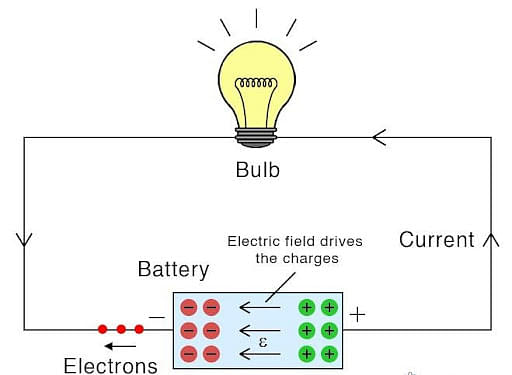
When the circuit is closed, it works more efficiently. This is because of the movement of the electric current which readily moves from the source and produces energy. This can be seen in the case of generators and batteries. In a battery, a conducting wire is joined to a bulb. The current passes through the switch and reaches and starts the generator. Generators are also known to convert mechanical energy and act as a very good source of emf. Thus, the effectiveness of a closed circuit is much more promising than an open electrical circuit.
Read Further: NCERT Solutions for Class 12 Physics Chapter 6 Electromagnetic Induction
Importance of EMF
[Click Here for Sample Questions]
Electromotive force/emf is important as it helps measure the amount and magnitude of energy. This is the energy that is concerned with the current flowing inside the circuit. It has also been defined as the potential difference across the two places of the cell terminal.
Also check: Electromagnetic Damping
EMF Formula
[Click Here for Previous Year Questions]
The formula for electromotive force/emf is given as,
| ε=E/Q |
Where,
ε refers to the emf or electromotive force and is denoted by volts or (V),
W = energy (Joules), and
Q denotes charge (Coulombs)
We can also use the formula given by Ohm’s law. Ohm’s law states that the current flowing through a conductor between two points is directly proportional to the voltage across two points. It should be noted that both emf and potential differences are measured in V (Volts).
The formula for electromotive force can be given as,
| e = IR + Ir, or e = V + Ir |
Where,
e is the electromotive force (Volts),
I = current (A),
R = Load resistance,
r is the internal resistance of a cell. The SI Unit of internal resistance is Ohm (Ω).
Also Read:
| Related Articles | ||
|---|---|---|
| Solenoid Engine | Transformers | Electromagnets |
| Electromagnetic Field | Motional emf | experiment faraday henry |
Difference between EMF and Potential Difference
[Click Here for Sample Questions]
EMF can be described as the amount of energy in any form changed into energy i.e., electrical per coulomb of charge while the potential difference is the amount of energy (electrical) that is changed into other forms of energy per coulomb of charge. Some of the examples of sources of emf are cells, solar cells, battery, generators, thermocouples, dynamo, etc.
| Example 1: Let us assume that we have a circuit with a potential difference of 3.2 V, with a current of 0.6 A. The internal resistance of the battery at 0.5 ohms. Use EMF Formula. Solution: Given,
By using the formula: ε = V + Ir ε = 3.2+0.6×0.5 = 3.2 V + 0.3 V = 3.5 V So the EMF of the circuit is 3.5 V. Example 2: Find the terminal potential difference of a cell when it is connected to a 9-ohm load with cell emf = 2 Volts and resistance (internal) 1 ohm? Solution: Given, emf =2 External resistance = 9 ohm Internal resistance = 1 ohm Since, I = V/R And R = External resistance + Internal resistance = 9 + 1 = 10 Ohm Now, I = 2/10 = 0.2 Ampere e = V + Ir 2=V+ (0.2)1 V =2-0.2 Therefore, the external resistor gets, V = 1.8 Volts. Example 3: If we consider an electrical circuit with a potential difference of 5V, with a current of 1 A, and the internal resistance of the battery used is 0.8 ohms. Then, determine the EMF of the circuit using the EMF formula. Solution: Given, The potential difference of the electric circuit (V) = 5 volts The total current flowing through the circuit (I) = 1 A The internal resistance of the battery (r) = 0.8 ohms We are asked to determine the EMF of the circuit using the EMF equation. We know that the EMF of the circuit can be calculated using the formula given below: ε = V + Ir…….(1) Where, V - The total potential difference developed in the circuit I - The total current flowing in the circuit r - The internal resistance of the battery Substituting the value of potential difference, current and the internal resistance in equation (1) we get: ε = V + Ir ε = 5 + (10.8) ε = 5.8 volts Therefore, the EMF of the circuit using the EMF formula is 5.8 Volts. |
Also check: Faraday’s Law of Induction
Things to Remember
- Emf or electromotive force has been defined as a force or energy which is supplied by a battery, per coulomb of charge passing through it.
- It is abbreviated as the letter ε and basically denotes an electrical action produced by a non-electrical source. Many devices provide emf by converting different forms of energy into electrical energy.
- For emf to take place, potential differences must be present across two terminals. One should be of positive charge while the other should be negative. The help of closed or open circuits can be taken.
- The SI Unit for the measurement of emf is Volts. Electromotive force is also defined as the potential difference across the terminals when there is no current flowing.
- The formula for the measurement of emf is given as ε=E/Q. Here ε denotes the emf, whereas Q stands for charge and E is energy. Ohm’s law also gives a formula that can be used to calculate ehm. e = V + Ir, where e implies emf, I is current, and r is internal resistance.
Also check: Lenz’s Law and Conservation of Energy
Previous Year Questions
- Lenz’s law is consequence of the law of conservation of….. [UPSEE 2019]
- The magnetic field is increasing at a constant rate. The directions of induced current in wires AB and CD are…. [VITEEE 2019]
- the circular loop of wire is moved with velocity towards the infinite current carrying wire…… [VITEEE 2016]
- Two identical coaxial coils P and Q carrying equal amount of current in the same direction are brought nearer. The current in...[KEAM]
- The polarity of induced emf is given by….[KEAM]
- Two identical circular coils A and B are kept on a horizontal tube side by side without touching each other…. [KCET 2013]
- The magnetic flux through a circuit of resistance RR changes by an amount….[NEET 2004]
- A conducting loop in the shape of a right angled isosceles triangle of height...[JEE Advance 2016]
- If a transformer of an audio amplifier has output impedance…..[JCECE]
- A wire loop is rotated in magnetic field. The frequency of change of direction of the induced e.m.f. is….[NEET 2013]
- An electron moves on a straight line path XY as shown. The abcd is a coil...[NEET 2015]
- An inductor 20 mH , a capacitor 100….[NEET 2018]
- The magnitude of change in flux through the coil in weber is...[NEET 2012]
- The rms value of the current in the circuit is...[NEET 2011]
- In which of the following devices, the eddy current effect is not used ?….[NEET 2019]
- An electric buib rated 220 V, 100 W is connected in series with another bulb… [KEAM]
- A carbon resistor is marked with the ring coloured brown, black, green and gold….[KEAM]
- The effective resistance across the points A and I is...[KEAM]
- A metal conductor of length 1m rotates vertically about one...[KEAM]
- The north pole of a long horizontal bar magnet is being brought closer to a...
Sample Questions
Ques 1: What is emf? (3 marks)
Ans: Emf, or electromagnetic force, has a close relation with voltage. It is electrical energy or force, supplied by a non-electrical source, for example, a battery. When fluctuations in the magnetic field occur from a surface, the electromotive force is said to be generated. The magnitude of emf has been defined as the potential difference found across the terminals of the cell at the time when no current is flowing through the circuit. The SI Unit of emf is volts, or joules per coulomb.
Ques 2: Why is emf required? (2 marks)
Ans: We require emf because it helps measure the amount of circuit which flows inside the electrical circuit. One terminal is positively charged while the other one has a negative charge. Emf is denoted by the letter ε.
Ques 3: Find the potential difference of the cell, if the cell is connected to a 10-ohm load. The emf of the cell is 5 Volts and internal resistance is given as 1 ohm. (4 marks)
Ans: Given that, the external or load resistance = 8 ohm
Internal resistance = 2 ohm
Emf of cell = 5 Volts
We know according to the formula, I =V/R
Also, R = external resistance + internal resistance
R = 8 + 2
R = 10 ohm
I = 5/10
I = 0.5 ampere
e = V +Ir
5 = V + (0.5)2
V = 4
Therefore, the external resistance of the cell is 4 Volts.
Ques 4: How is emf calculated? (3 marks)
Ans: Solution: Emf can be easily calculated with the help of the given formula.
ε = E/Q
Where ε is the electromotive force, E is the energy running in the circuit, and Q is implied as to the charge of the circuit. We can use this or the formula given by Ohm's law, which is denoted as V=IR,
ε = I(R+r), where I is current, R is the resistance of the circuit, r is the internal resistance of the cell, V is the voltage and ε is the emf.
Ques 5: A circuit is present with a potential difference of 4.6 V, the current is 1.6A. The internal resistance of the battery is 0.8 ohms. Find out the emf. (2 marks)
Ans: Given that,
V = 4.6
I = 1.6 A
r = 0.8
According to the formula, we know that, ε = V + Ir
ε = 4.6 + (1.6 x 0.8)
ε = 5.9 V
Hence, emf = 5.9 volts.
Ques 6: What is the magnitude of emf? (3 marks)
Ans: The magnitude of emf is the same as the potential difference found across the cell terminal in the case of absence of current flowing through the electrical circuit. To find this, Faraday's law of induction is devised. The magnitude of the emf running in the circuit is equal to the absolute value of the time rate of change of the magnetic flux through the circuit.in this case, the emf present in the circuit is always equal to 1.
Ques 7: What is known as potential difference? (2 marks)
Ans: It has been defined as the difference of electrical potential between two points. Or, in simpler words, we can also say it measures how much energy is transferred between the two points in an electrical circuit.
Join Our Telegram Channel for Live Updates on Board Exams: https://t.me/class_10_12_board_updates
Do Check Out:



Comments